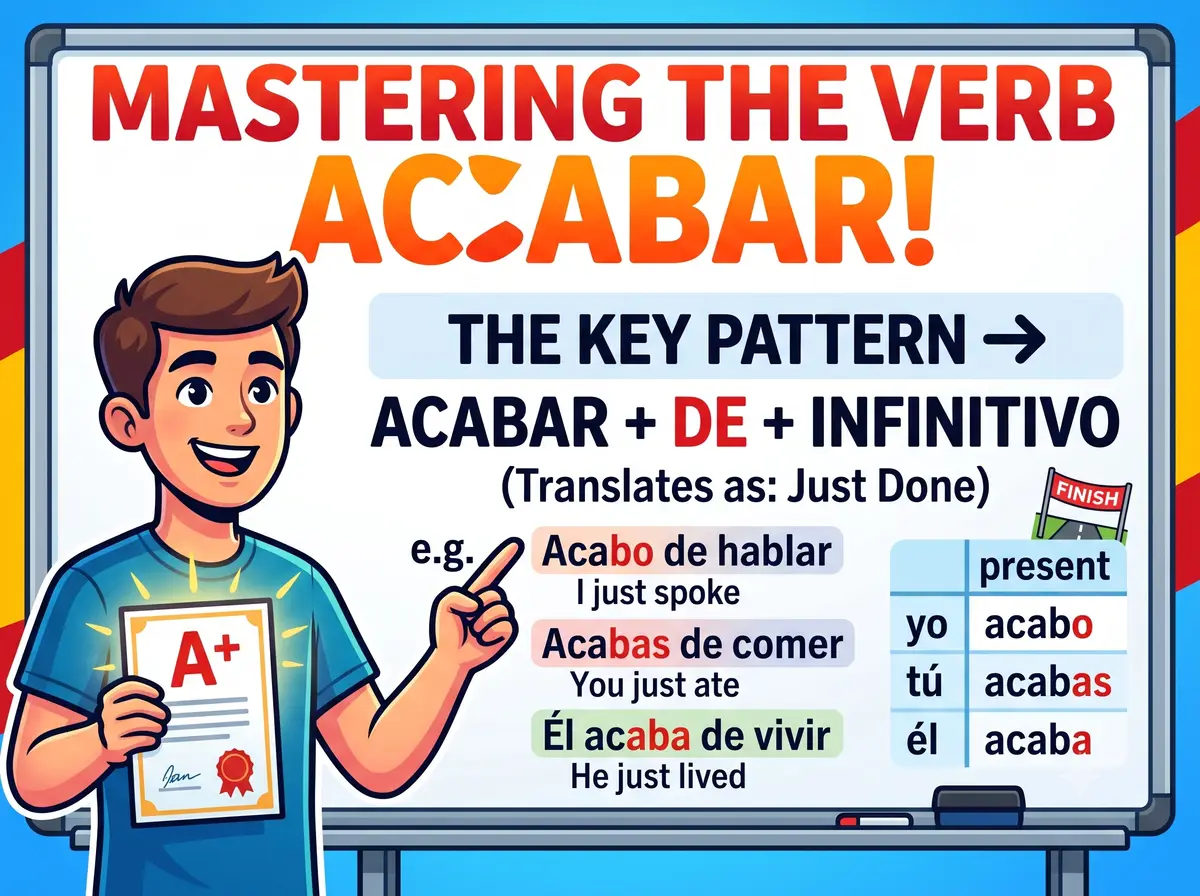
The Spanish verb Acabar is one of the most versatile verbs in the language. While its literal translation is 'to finish' or 'to end', it changes meaning dramatically when paired with prepositions or used reflexively. In this guide, we break down its various meanings and provide its full conjugation charts.
The Key Meanings of Acabar
1. Acabar (Literal Meaning)
In its simple form, acabar means to finish, complete, or terminate something.
- Example: Acabé mi tarea. (I finished my homework.)
2. Acabar de + Infinitive (Just Finished)
When followed by the preposition de and an infinitive verb, acabar express that an action was just completed in the immediate past.
-
Example: Acabo de comer. (I have just eaten.)
-
Example: Ella acababa de llegar. (She had just arrived.)
3. Acabarse (Reflexive Form: Running Out)
In its pronominal/reflexive form (acabarse), it means that something has run out, expired, or come to an end.
- Example: Se acabó el café. (The coffee ran out / is finished.)

Learn Languages with YouTube
Watch videos in your target language, auto-capture words into flashcards, and track your progress — all in one place.
Start Free →Conjugation Charts for Acabar
Present Tense (Presente)
Used to express current actions or states.
-
Yo acabo
-
Tú acabas
-
͉l/Ella/Usted acaba
-
Nosotros acabamos
-
Ellos/Ellas/Ustedes acaban
Preterite Tense (Pretérito Indefinido)
Used for completed actions in the past.
-
Yo acabé
-
Tú acabaste
-
͉l/Ella/Usted acabó
-
Nosotros acabamos
-
Ellos/Ellas/Ustedes acabaron
Imperfect Tense (Pretérito Imperfecto)
Used for ongoing or repeated past actions (frequently used as 'acababa de' for 'had just').
-
Yo acababa
-
Tú acababas
-
͉l/Ella/Usted acaba
-
Nosotros acabábamos
-
Ellos/Ellas/Ustedes acababan
Practice Spanish Verbs in Context
Understanding conjugation rules is only half the battle. To speak naturally, you must see verbs used in native context.
Stop memorizing dry grammar tables. Sign up for Metheus free today and save verbs directly from native Spanish media into your SRS flashcards.
FAQ
What is the difference between acabar and terminar?
They are highly synonymous and interchangeable in most contexts meaning 'to finish'. However, only acabar can be used in the structure 'acabar de + infinitive' to mean 'to have just done something'.
Related phrases
Language learning in 2026 isn't about finishing daily streaks. The fastest path to fluency combines three elements: comprehensible input from real media you enjoy, active vocabulary capture while consuming that content, and spaced repetition to lock words into long-term memory. Gamified apps build the habit. Immersion tools build the fluency. The most effective learners use both—in that order.
Start with Metheus
Watch videos in your target language, auto-capture words into flashcards, and track your progress — all in one place.
Get Started Free →