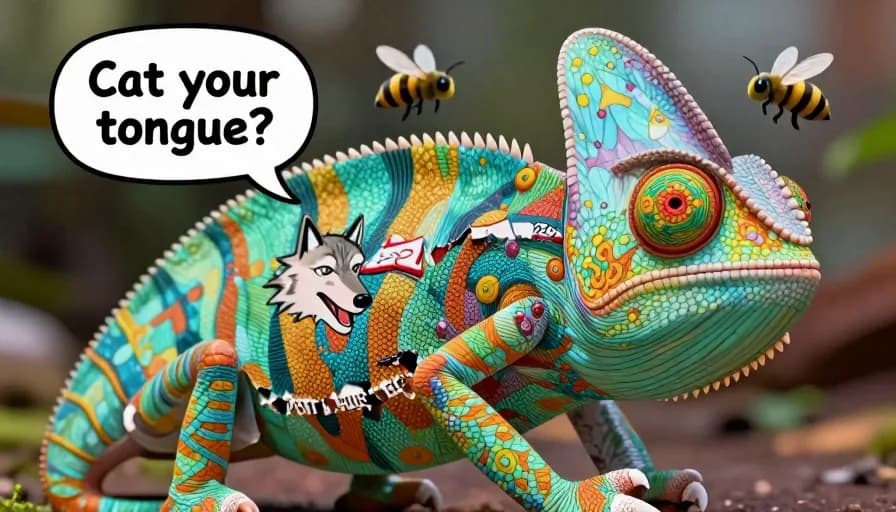
English is full of animal idioms that native speakers use without thinking: you let the cat out of the bag, hold your horses, or feel like a fish out of water. These expressions rarely have anything to do with real animals — they are vivid shortcuts for ideas like secrecy, patience, or discomfort. For learners, animal idioms are one of the fastest ways to sound fluent because they appear constantly in series, news, and everyday chat. This guide explains the most common ones, groups them by theme so they are easier to remember, and shows you how to use them without forcing them.
Why Animal Idioms Are Everywhere in English
English has collected animal idioms for centuries, mostly from farm life, hunting, and household pets. Their images are so concrete that a whole situation fits in three words: everyone knows what it looks like to be as busy as a bee or to have butterflies in your stomach. The cultural layer matters too: idioms carry assumptions about animals — cats are curious, dogs are loyal, foxes are sly — that learners pick up through exposure rather than dictionary definitions.
The 10 Animal Idioms You Will Actually Hear
| Idiom | Meaning | Example |
| --- | --- | --- |
| let the cat out of the bag | reveal a secret | She let the cat out of the bag about the surprise party. |
| raining cats and dogs | raining very heavily | We stayed home; it was raining cats and dogs. |
| hold your horses | slow down, wait | Hold your horses, we are not ready yet. |
| kill two birds with one stone | achieve two goals at once | I kill two birds with one stone: commute and exercise. |
| the elephant in the room | obvious problem nobody mentions | Let's address the elephant in the room: the budget. |
| take the bull by the horns | face a problem directly | He took the bull by the horns and asked for a raise. |
| a wolf in sheep's clothing | someone who pretends to be harmless | Be careful: he's a wolf in sheep's clothing. |
| as busy as a bee | very hardworking | She's been as busy as a bee all week. |
| the early bird catches the worm | starting early brings rewards | I booked first — the early bird catches the worm. |
| a fish out of water | uncomfortable in a situation | At that formal dinner I felt like a fish out of water. |

Learn Languages with YouTube
Watch videos in your target language, auto-capture words into flashcards, and track your progress — all in one place.
Start Free →More Animal Idioms by Theme
Once you know the top ten, expand by theme. Cats and dogs:
-
A dark horse — someone whose abilities are hidden — She was the dark horse of the competition.
-
Let sleeping dogs lie — avoid reopening old problems — I won't mention it; let sleeping dogs lie.
-
Dog-eat-dog — ruthless competition — It's a dog-eat-dog market out there.
Birds and farm animals:
-
A wild goose chase — a pointless search — That rumor sent us on a wild goose chase.
-
A bird's-eye view — a view from above — From the tower we had a bird's-eye view of the city.
-
Chicken out — back out out of fear — He chickened out at the last second.
Wild and other animals:
-
The lion's share — the largest part — He got the lion's share of the profits.
-
A snake in the grass — a hidden traitor — Watch out: there's a snake in the grass.
-
Butterflies in your stomach — nervous excitement — I had butterflies before the interview.
-
A sitting duck — an easy target — Leaving your bike unlocked makes it a sitting duck.
How to Use Animal Idioms Naturally
-
Use them in the right register: most animal idioms are casual, so keep them out of formal writing.
-
Learn each idiom with a full example sentence, not just a definition — context is what makes it stick.
-
Don't force more than one idiom per sentence; stacking them sounds unnatural.
-
Don't take them literally: kill two birds with one stone involves no violence and no birds.
-
Shadow native dialogue in series or podcasts to absorb the tone and timing of each idiom.
Quick Practice: Which Idiom Fits?
Match the situation to the idiom: (1) You accidentally revealed the surprise — you let ___; (2) The meeting keeps ignoring the failing product — that is ___; (3) Your friend waited before deciding — she held ___; (4) You exercised during your commute — you killed ___; (5) The quiet genius who surprised everyone was ___.
Answers: the cat out of the bag, the elephant in the room, her horses, two birds with one stone, a dark horse.
A few more worth knowing: a leopard can't change its spots (people cannot change their nature), an eager beaver (a very enthusiastic worker), a copycat (someone who imitates others), and pig-headed (stubborn). Say them aloud with the chart above until they come out without translating.
The Verdict
Animal idioms reward learners enormously because they are high-frequency and instantly recognizable. Start with the ten in the chart, use them in speech and writing until they feel automatic, and let your listening habits add the rest. Two or three used correctly will do more for sounding fluent than perfect grammar in a long sentence.
Metheus is built for exactly this kind of learning: watch English series with translatable subtitles, hover over any animal idiom to get an instant contextual translation, and save the whole sentence as an SRS flashcard
FAQ
What are the most common animal idioms in English?
The most frequent animal idioms include let the cat out of the bag (reveal a secret), raining cats and dogs (raining heavily), hold your horses (wait), kill two birds with one stone (achieve two goals at once), and the elephant in the room (an obvious problem nobody mentions). These appear constantly in everyday English conversation and in series.
How do I learn animal idioms without forgetting them?
Learn each animal idiom with a full example sentence and a mental image of its meaning, not just its definition. Grouping them by theme — cats and dogs, birds, farm and wild animals — makes them easier to remember, and reviewing them inside real subtitles or articles with instant translations turns passive knowledge into active use.
Can I use animal idioms in formal or work situations?
Most animal idioms are casual, so use them with care at work. A few are neutral enough for professional chat, like killing two birds with one stone when talking about efficiency. When in doubt, keep animal idioms for everyday conversation and friendly emails, and match the formality of the person you are speaking with.
What is the difference between an idiom and a metaphor in English?
An idiom is a fixed expression whose meaning cannot be guessed from its individual words, like let the cat out of the bag. A metaphor is a direct comparison, like time is money. Most animal idioms are metaphorical, but not all metaphors are idioms — the difference is whether the phrase is frozen and conventional.
Why are cats and dogs so common in English idioms?
Cats and dogs have lived alongside English speakers for centuries, so they appear in idioms about daily life: curiosity, secrecy, loyalty, and weather. Raining cats and dogs probably comes from old Norse myth, while let the cat out of the bag goes back to a market trick of hiding a worthless cat in a bag and selling it as a pig.
Related phrases
Language learning in 2026 isn't about finishing daily streaks. The fastest path to fluency combines three elements: comprehensible input from real media you enjoy, active vocabulary capture while consuming that content, and spaced repetition to lock words into long-term memory. Gamified apps build the habit. Immersion tools build the fluency. The most effective learners use both—in that order.
Start with Metheus
Watch videos in your target language, auto-capture words into flashcards, and track your progress — all in one place.
Get Started Free →