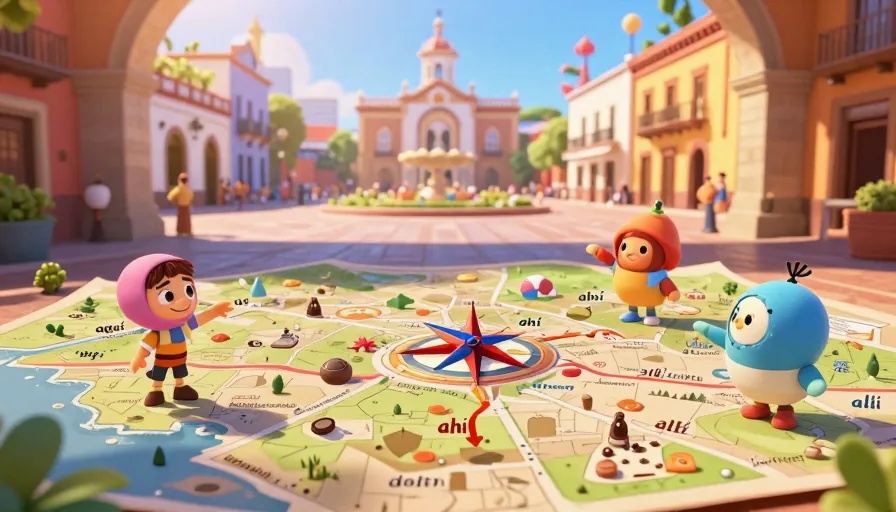
Understanding the aquí meaning Spanish is crucial for effective communication in Spanish. 'Aquí', 'ahí', and 'allí' are essential adverbs that indicate location and direction. This guide will help you master these terms, avoid common mistakes, and communicate more precisely.
Aquí: Indicating Location and Presence
'Aquí' translates to 'here' in English. It indicates a location that is close to the speaker. For example:
- Estoy aquí. (I am here.)
- El libro está aquí. (The book is here.)
Mini Drill: Aquí Usage
-
Translate the following sentences into Spanish using 'aquí':
- I live here.
- The cat is here.
- We will meet here.
-
Create your own sentences using 'aquí' to describe locations near you.
Ahí y Allí: Indicating Distance and Location
Both 'ahí' and 'allí' translate to 'there' in English, but they have different nuances. 'Ahí' is used for locations that are not very far from the speaker but not as close as 'aquí'. 'Allí', on the other hand, is used for locations that are far from the speaker.
Ahí
- La tienda está ahí. (The store is there.)
- Mira ahí. (Look there.)
Allí
- La montaña está allí. (The mountain is there.)
- Vamos allí. (Let's go there.)
Mini Drill: Ahí vs. Allí
-
Translate the following sentences into Spanish using either 'ahí' or 'allí':
- The restaurant is not very far from here.
- The airport is far from here.
- Look over there.
- We will meet over there.
-
Create your own sentences using 'ahí' and 'allí' to describe different distances.

Learn Languages with YouTube
Watch videos in your target language, auto-capture words into flashcards, and track your progress — all in one place.
See How It Works →When to Use Which: A Quick Comparison Guide
| Term | Proximity | Example | English Translation |
|---|---|---|---|
| Aquí | Close to speaker | Estoy aquí. | I am here. |
| Ahí | Somewhat far from speaker | La tienda está ahí. | The store is there. |
| Allí | Far from speaker | La montaña está allí. | The mountain is there. |
Checklist: Choosing the Right Term
- Is the location close to you? Use 'aquí'.
- Is the location somewhat far but still within sight? Use 'ahí'.
- Is the location far from you? Use 'allí'.
Grammar Tip: Adverbs in Spanish
'Aquí', 'ahí', and 'allí' are adverbs of place. They modify verbs, adjectives, or other adverbs to indicate location. For example:
- El libro está aquí. (The book is here.)
- La tienda está ahí. (The store is there.)
- La montaña está allí. (The mountain is there.)
Common Mistakes to Avoid
- Mistake: Using 'aquí' when referring to a location far from the speaker.
- Correct: La montaña está allí, no aquí.
- Mistake: Using 'ahí' when the location is very close to the speaker.
- Correct: El libro está aquí, no ahí.
- Mistake: Using 'allí' when the location is somewhat far but still within sight.
- Correct: La tienda está ahí, no allí.
Practical Examples and Contextual Usage
Everyday Conversations
-
Speaker A: ¿Dónde está el restaurante? (Where is the restaurant?)
-
Speaker B: Está ahí, a la derecha. (It is there, to the right.)
-
Speaker A: ¿Dónde está el parque? (Where is the park?)
-
Speaker B: Está allí, cerca de la plaza. (It is there, near the square.)
Describing Directions
- Para llegar a la biblioteca, camina aquí y gira a la izquierda. (To get to the library, walk here and turn left.)
- El museo está ahí, al final de la calle. (The museum is there, at the end of the street.)
- La playa está allí, a unos kilómetros de distancia. (The beach is there, a few kilometers away.)
Narrative Context
- Cuando llegué a la ciudad, dejé mis maletas aquí y fui a explorar. (When I arrived in the city, I left my suitcases here and went to explore.)
- Vi un hermoso paisaje ahí, en la colina. (I saw a beautiful landscape there, on the hill.)
- Allí, en el horizonte, se veía el mar. (There, on the horizon, you could see the sea.)
By understanding and practicing these nuances, you'll be able to communicate more effectively in Spanish, avoiding common mistakes and using 'aquí', 'ahí', and 'allí' with confidence.
FAQ
What is the difference between 'aquí' and 'ahí'?
'Aquí' is used for locations close to the speaker, while 'ahí' is used for locations that are somewhat far but still within sight. For example, 'Estoy aquí' (I am here) vs. 'La tienda está ahí' (The store is there).
When should I use 'allí' instead of 'ahí'?
Use 'allí' for locations that are far from the speaker. For example, 'La montaña está allí' (The mountain is there) indicates a distant location, while 'La tienda está ahí' (The store is there) indicates a location that is somewhat far but still within sight.
Can 'aquí', 'ahí', and 'allí' be used with other adverbs?
Yes, 'aquí', 'ahí', and 'allí' can be used with other adverbs to provide more specific directions. For example, 'Estoy aquí, a la izquierda' (I am here, on the left) or 'La tienda está ahí, al final de la calle' (The store is there, at the end of the street).
Related phrases
Start with Metheus
Watch videos in your target language, auto-capture words into flashcards, and track your progress — all in one place.
Get Started →

