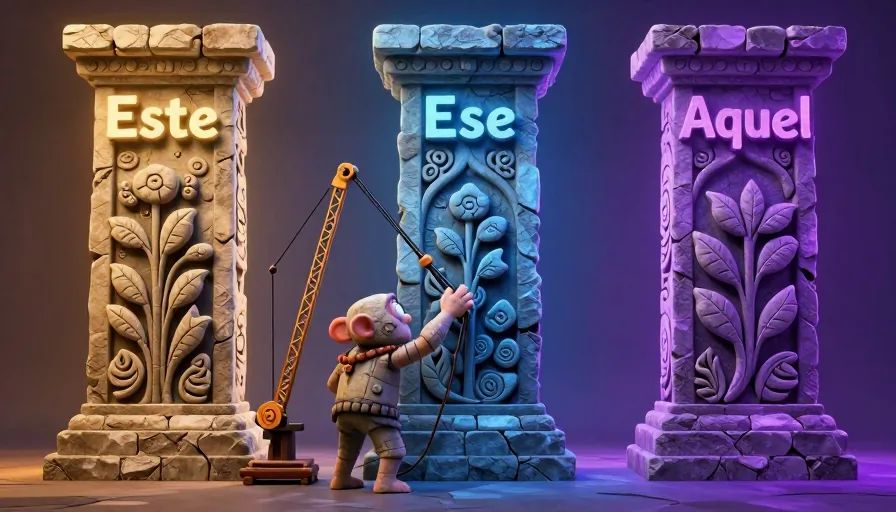
Demonstrative Spanish adjectives are essential for indicating specific nouns in Spanish. They must agree with the noun(s) in gender and number, and there are three different sets: este, ese, and aquel. This guide will help you understand and use these adjectives correctly, with a strong focus on the crucial agreement rules that are often overlooked.
Understanding the Three Forms: Este, Ese, Aquel
Demonstrative Spanish adjectives come in three main forms: este, ese, and aquel. Each form is used based on the proximity of the noun to the speaker. Let's break down each form with clear examples:
Este
Este is used to refer to nouns that are close to the speaker. It can be masculine or feminine, and singular or plural.
- Masculine Singular: Este libro es interesante. (This book is interesting.)
- Feminine Singular: Esta casa es grande. (This house is big.)
- Masculine Plural: Estos libros son útiles. (These books are useful.)
- Feminine Plural: Estas casas son bonitas. (These houses are pretty.)
Ese
Ese is used to refer to nouns that are close to the listener but not the speaker. It also has masculine and feminine forms, as well as singular and plural forms.
- Masculine Singular: Ese coche es rápido. (That car is fast.)
- Feminine Singular: Esa mesa es nueva. (That table is new.)
- Masculine Plural: Esos perros son grandes. (Those dogs are big.)
- Feminine Plural: Esas sillas son cómodas. (Those chairs are comfortable.)
Aquel
Aquel is used to refer to nouns that are far from both the speaker and the listener. It also has masculine and feminine forms, as well as singular and plural forms.
- Masculine Singular: Aquel edificio es alto. (That building over there is tall.)
- Feminine Singular: Aquella montaña es impresionante. (That mountain over there is impressive.)
- Masculine Plural: Aquellos árboles son viejos. (Those trees over there are old.)
- Feminine Plural: Aquellas flores son hermosas. (Those flowers over there are beautiful.)
The Golden Rule: Agreement in Gender and Number
One of the most important rules when using demonstrative Spanish adjectives is that they must agree with the noun they modify in both gender and number. This means that if the noun is masculine singular, the adjective must also be masculine singular, and so on.
Gender Agreement
- Masculine: Este libro (This book)
- Feminine: Esta casa (This house)
Number Agreement
- Singular: Este libro (This book)
- Plural: Estos libros (These books)
Common Mistakes
A common mistake is to use the wrong form of the adjective based on the noun's gender or number. For example:
- Incorrect: *Este casas son bonitas. (These houses are pretty.)
- Correct: Estas casas son bonitas. (These houses are pretty.)

Learn Languages with YouTube
Watch videos in your target language, auto-capture words into flashcards, and track your progress — all in one place.
See How It Works →When to Use Which Demonstrative: Proximity Guide
Choosing the correct demonstrative adjective depends on the proximity of the noun to the speaker and the listener. Here's a quick guide:
- Close to the speaker: Use este.
- Close to the listener: Use ese.
- Far from both: Use aquel.
Practical Examples
- Speaker and listener are in the same room:
- Este libro es interesante. (This book is interesting.)
- Speaker is pointing to something across the room:
- Ese libro es interesante. (That book is interesting.)
- Speaker is pointing to something outside the room:
- Aquel libro es interesante. (That book over there is interesting.)
Agreement in Context: Examples and Mini Drills
Let's practice with some examples and mini drills to reinforce the agreement rules.
Mini Drill 1: Fill in the Blank
Fill in the blank with the correct demonstrative adjective based on the context:
- ¿Cuál es ése ó ésa árbol? (Which is that tree?)
- ¿Cuál es ése ó ésa árbol? (Which is that tree?)
- ¿Cuál es ése ó ésa árbol? (Which is that tree?)
Mini Drill 2: Correct the Mistakes
Correct the mistakes in the following sentences:
- Este libros son interesantes. (These books are interesting.)
- Esa casa es grande. (That house is big.)
- Aquel perros son grandes. (Those dogs are big.)
Mini Drill 3: Write Your Own Sentences
Write three sentences using each demonstrative adjective (este, ese, aquel) and ensure they agree with the noun in gender and number.
Quick Summary and Quiz
Summary
- Este: Close to the speaker
- Ese: Close to the listener
- Aquel: Far from both
- Agreement: Must agree with the noun in gender and number
Quiz
- Which demonstrative adjective would you use to refer to a book that is close to you?
- Which demonstrative adjective would you use to refer to a car that is close to the listener?
- Which demonstrative adjective would you use to refer to a mountain that is far from both you and the listener?
- How do you ensure agreement with the noun?
Checklist for Mastery
- I understand the three forms of demonstrative Spanish adjectives: este, ese, and aquel.
- I know when to use each form based on proximity.
- I can correctly apply the agreement rules for gender and number.
- I can write and speak sentences using demonstrative adjectives accurately.
By following this guide and practicing regularly, you'll master demonstrative Spanish adjectives and improve your overall Spanish language skills.
FAQ
What if I'm unsure about the proximity of the noun?
If you're unsure about the proximity, it's best to use 'ese' as a default, as it refers to something close to the listener, which is a more neutral position. However, with practice, you'll become more comfortable with using 'este' and 'aquel' correctly.
How do I remember the agreement rules?
Remember that the demonstrative adjective must match the noun it modifies in both gender and number. Practice with mini drills and write your own sentences to reinforce this rule.
Related phrases
Start with Metheus
Watch videos in your target language, auto-capture words into flashcards, and track your progress — all in one place.
Get Started →

