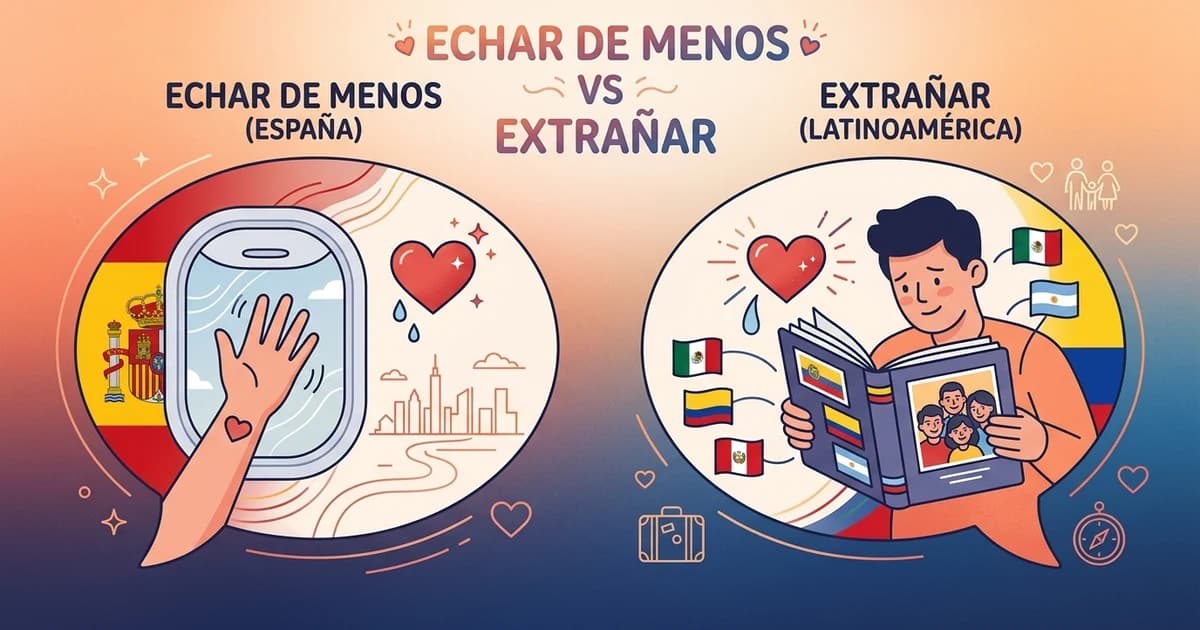
If you are learning Spanish, you have almost certainly hit this wall: you want to tell a friend "I miss you," and you are not sure whether to say te echo de menos or te extraño. Both are correct, both are natural, and both mean exactly the same thing. The difference is geography. Echar de menos is the dominant form in Spain, while extrañar rules in most of Latin America. But the story does not end there: extrañar has a second meaning in Spain that can completely change what you accidentally say. This guide untangles both verbs, explains the regional split, and gives you patterns you can recognize in real series and songs.
The Basic Meaning: Expressing Absence and Nostalgia
Both constructions express missing someone or something — the feeling of absence, nostalgia, or longing. They are interchangeable in their core meaning, so there is no right or wrong choice between them, only regional convention: te echo de menos (Spain) vs te extraño (Mexico, Argentina, Colombia, Chile, and most of Latin America). And note that in Spanish you do not only miss people: you can miss a meal from your hometown, a time in your life, a place, or even a pet.
Where Each Form Is Used: A Regional Map
| Region | Typical form | Example |
|---|---|---|
| Peninsular Spain | echar de menos | Te echo de menos |
| Mexico | extrañar | Te extraño |
| Argentina & Uruguay | extrañar | Te extraño mucho |
| Colombia & Chile | extrañar | Te extraño |
| Central America | extrañar | Te extraño un montón |
| Andean regions (Ecuador, etc.) | echar de menos (coexists) | Te echo de menos |
The Trap: "Extrañar" Means Something Else in Spain
Here is the trap that makes this pair fascinating. In Spain, extrañar primarily means "to find strange" or "to surprise." If you say te extraño in Madrid, many speakers will interpret it as "you seem strange to me" — a baffling thing to say to a friend. Spaniards themselves joke about this confusion when talking to Latin American speakers. This is why learners studying Peninsular Spanish should default to te echo de menos, and why extrañar-based expressions are perfectly safe in Latin America. The reverse situation also exists: in some Latin American contexts, extrañar with the sense of "to surprise" survives in phrases like me extraña que (it surprises me that).

Learn Languages with YouTube
Watch videos in your target language, auto-capture words into flashcards, and track your progress — all in one place.
Start Free →"Echar" and the World of Compound Expressions
Echar de menos is a locución verbal (verbal phrase): the meaning comes from the whole unit, not from echar (to throw) plus de menos (of less). The verb echar is one of the most productive verbs in Spanish — echar una mano (to lend a hand), echar a perder (to spoil), echar de menos (to miss) — and its meaning changes completely depending on the words around it. This is exactly the situation where generic dictionaries fail: look up echar in isolation and you will never guess that echar de menos means "to miss." Learners in forums regularly describe this frustration when watching native shows, asking how to make sense of compound verbs and idioms that never appear as a unit in a dictionary entry.
Similar Expressions and Equivalents in English
Besides the two main verbs, Spanish has other ways of expressing the same feeling: extrañar a alguien, echar en falta (used in parts of Spain as a synonym of echar de menos), and, in very informal Latin American speech, expressions like me haces falta. In English, both verbs map to "to miss someone or something," and "I miss you" covers both te extraño and te echo de menos. The nuance to learn is not lexical but regional: choosing the right form tells your listener where you learned your Spanish. You can hear the split everywhere in music — Spanish artists sing te echo de menos, while Latin American hits almost always say te extraño.
Learning These Differences in Context
The most reliable way to internalize echar de menos vs extrañar is to meet both forms in real content: a Spanish series will say te echo de menos dozens of times, while a Mexican or Argentine movie will use te extraño. When you watch, pay attention to which form the characters use and in what emotional register. Tools help here too: the Metheus contextual dictionary lets you press Ctrl+D on any word or phrase in subtitles and web articles to get a translation that considers the full sentence — so a locución like echar de menos is analyzed as a unit, not as three unrelated words. If you want to understand why sentence-level translation beats word-by-word lookup, read our comparison of contextual vs generic dictionaries.
The Bottom Line
Echar de menos and extrañar both mean "to miss," and the choice is purely regional: echar de menos in Spain, extrañar in Latin America. Remember the extrañar trap in Spain, treat echar de menos as a single unit, and let the shows you watch teach you the variant that matches your goals. You can never go wrong with te extraño in Latin America or te echo de menos in Spain.
Start Free with Metheus and learn Spanish expressions in the context where they actually live.
FAQ
Is it correct to say te extraño in Spain?
It exists, but it is risky: in Spain extrañar primarily means "to find strange," so te extraño is more likely to be heard as "you seem strange to me." Use te echo de menos in Spain.
Do they use echar de menos in Latin America?
Rarely as the default. Extrañar dominates in Mexico, Argentina, Colombia, Chile, and Central America, though echar de menos coexists in some Andean regions like Ecuador.
Which one should I use, echar de menos or extrañar?
It depends on your target variant: use echar de menos if you are learning Peninsular Spanish, and extrañar if you are learning Latin American Spanish. Both are correct everywhere.
Related phrases
Language learning in 2026 isn't about finishing daily streaks. The fastest path to fluency combines three elements: comprehensible input from real media you enjoy, active vocabulary capture while consuming that content, and spaced repetition to lock words into long-term memory. Gamified apps build the habit. Immersion tools build the fluency. The most effective learners use both—in that order.
Start with Metheus
Watch videos in your target language, auto-capture words into flashcards, and track your progress — all in one place.
Get Started Free →