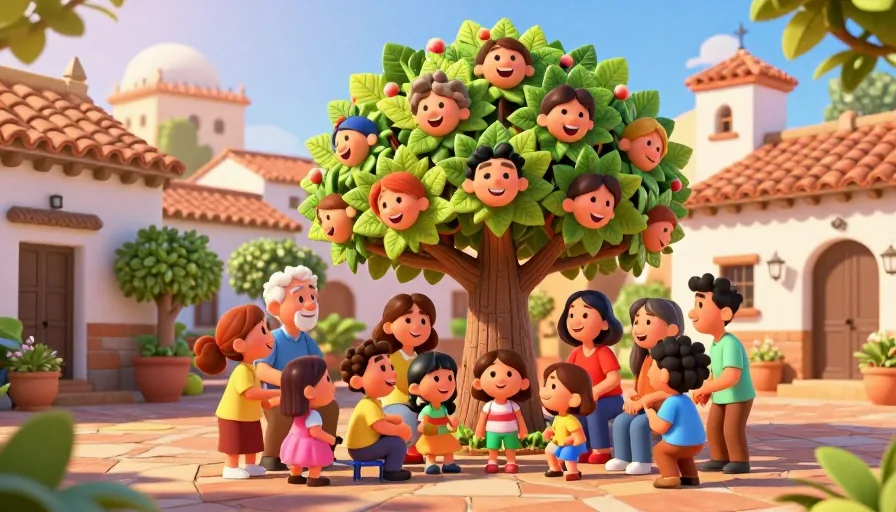
When learning Spanish, understanding families in Spanish is crucial for building strong conversational skills. This guide will help you master key vocabulary, grammar rules, and cultural nuances related to families in Spanish, ensuring you can discuss family relationships with confidence.
Essential Spanish Family Vocabulary
To start, let's explore the essential vocabulary for family members. Here are some key terms:
- Parents: Padre (father), Madre (mother)
- Siblings: Hermano (brother), Hermana (sister)
- Grandparents: Abuelo (grandfather), Abuela (grandmother)
- Aunts and Uncles: Tío (uncle), Tía (aunt)
- Cousins: Primo (male cousin), Prima (female cousin)
Mini Drill: Gender Agreement
Practice identifying the gender of each family member and matching it with the correct article (el/la).
- El ______ (padre/madre)
- La ______ (hermano/hermana)
- El ______ (abuelo/abuela)
- La ______ (tío/tía)
- El ______ (primo/prima)
Understanding Spanish Noun Gender in Family Terms
Spanish nouns have a gender, which is either masculine or feminine. Understanding this is crucial for correct grammar. For example:
- El padre (the father) is masculine.
- La madre (the mother) is feminine.
Interactive Examples
- El hermano (the brother) is masculine, so you say el hermano.
- La hermana (the sister) is feminine, so you say la hermana.
Conversational Phrases for Talking About Your Family
Here are some common phrases and expressions used in daily conversation about family:
- ¿Tienes hermanos? (Do you have siblings?)
- Mi padre es médico. (My father is a doctor.)
- Mi madre trabaja en una escuela. (My mother works in a school.)
- Tengo dos primos. (I have two cousins.)
- Mis abuelos viven en España. (My grandparents live in Spain.)
Scenario-Based Learning
Scenario 1: Introducing Your Family
Imagine you are at a party and someone asks about your family. You can say:
Tengo una hermana y un hermano. Mi hermana se llama María y mi hermano se llama Juan. (I have a sister and a brother. My sister's name is María and my brother's name is Juan.)
Scenario 2: Talking About Your Parents' Jobs
If someone asks about your parents' professions, you can respond with:
Mi padre es ingeniero y mi madre es maestra. (My father is an engineer and my mother is a teacher.)

Learn Languages with YouTube
Watch videos in your target language, auto-capture words into flashcards, and track your progress — all in one place.
See How It Works →Cultural Context: How Family Concepts Differ in Spanish-Speaking Cultures
Family dynamics in Spanish-speaking cultures often emphasize close-knit relationships and extended family involvement. For example, in many Latin American countries, it's common for multiple generations to live under the same roof. This is reflected in the language through terms like la familia extendida (the extended family).
Cultural Tips
- Respect for Elders: Always address elders with respect, using usted instead of tú.
- Family Gatherings: Family gatherings are frequent and important. Be prepared to discuss family events and traditions.
- Naming Conventions: In some cultures, children are named after family members, so knowing these traditions can help in conversations.
Useful Sentence Structures for Describing Family Relationships
To describe family relationships effectively, use the following sentence structures:
- Tengo + [number] + [family member]. (I have [number] [family member].)
- Example: Tengo dos hermanos. (I have two brothers.)
- Mi + [family member] + [verb]. (My [family member] [verb].)
- Example: Mi padre trabaja en una oficina. (My father works in an office.)
- [Family member] + [verb] + [action]. ([Family member] [verb] [action].)
- Example: Mi madre cocina muy bien. (My mother cooks very well.)
Checklist for Mastering Family Vocabulary
- Learn the basic vocabulary for family members.
- Practice gender agreement with family nouns.
- Memorize common conversational phrases about family.
- Understand cultural nuances related to family dynamics.
- Use sentence structures to describe family relationships.
Practical Examples and Role-Playing
Example 1: Describing Your Family
Practice: Describe your family to a friend in Spanish.
Response: Tengo una familia grande. Mi padre es médico y mi madre es maestra. Tengo dos hermanos y una hermana. Mis abuelos viven en España. (I have a large family. My father is a doctor and my mother is a teacher. I have two brothers and a sister. My grandparents live in Spain.)
Example 2: Asking About Someone's Family
Practice: Ask a new acquaintance about their family.
Response: ¿Tienes hermanos? ¿Qué hacen tus padres? (Do you have siblings? What do your parents do?)
Example 3: Talking About Family Traditions
Practice: Discuss family traditions with a classmate.
Response: En mi familia, celebramos la Navidad juntos. Cocinamos tamales y cantamos villancicos. (In my family, we celebrate Christmas together. We cook tamales and sing carols.)
By mastering these vocabulary, grammar rules, and cultural insights, you'll be well-equipped to discuss families in Spanish with confidence and accuracy.
FAQ
How do I know if a family noun is masculine or feminine in Spanish?
In Spanish, the gender of a noun is typically indicated by its ending. Most nouns ending in -o are masculine, and those ending in -a are feminine. However, there are exceptions, so it's important to learn the gender of each noun individually. For example, 'el padre' (father) is masculine, and 'la madre' (mother) is feminine.
What are some common mistakes to avoid when talking about family in Spanish?
Common mistakes include using the wrong gender for family nouns, incorrect verb conjugations, and not understanding cultural nuances. For example, always use 'usted' when addressing elders to show respect. Additionally, be aware of regional differences in family structures and traditions.
Related phrases
Start with Metheus
Watch videos in your target language, auto-capture words into flashcards, and track your progress — all in one place.
Get Started →

