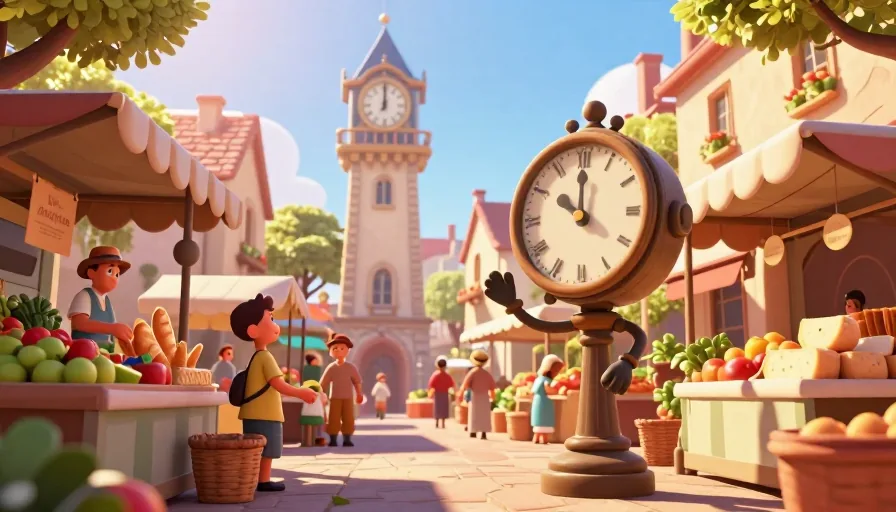
Learning to discuss clocks in French is essential for navigating daily conversations and understanding French culture. This guide will equip you with the vocabulary and phrases needed to talk about timekeeping in French, from direct translations to common expressions and cultural nuances.
Translating 'Clock' and Timekeeping Terms in French
The direct translation of 'clock' in French is 'l'horloge.' Here are some key terms related to timekeeping:
- L'horloge (the clock)
- La montre (the watch)
- Le temps (the time)
- L'heure (the hour)
- La minute (the minute)
- La seconde (the second)
Mini Drill: Translate the Following
- The clock
- The watch
- The time
- The hour
- The minute
- The second
Common Phrases Using 'L'horloge' (The Clock)
French uses several common phrases involving 'l'horloge.' Here are some practical examples:
- L’horloge de l’église sonna onze heures. (The church clock struck eleven.)
- Il est temps de regarder l'horloge. (It's time to look at the clock.)
- L'horloge est cassée. (The clock is broken.)
- Je regarde l'horloge pour voir l'heure. (I look at the clock to see the time.)
- L'horloge avance de cinq minutes. (The clock is five minutes fast.)
Checklist: Common Phrases
- L’horloge de l’église sonna onze heures.
- Il est temps de regarder l'horloge.
- L'horloge est cassée.
- Je regarde l'horloge pour voir l'heure.
- L'horloge avance de cinq minutes.
Distinguishing Between 'Horloge' and Other Time-Related Nouns
While 'l'horloge' refers specifically to a clock, other nouns are used for different timekeeping devices:
- La montre: A watch, typically worn on the wrist. Example: Ma montre est cassée. (My watch is broken.)
- Le réveil: An alarm clock. Example: Le réveil sonne à sept heures. (The alarm clock rings at seven o'clock.)
- Le chronomètre: A stopwatch. Example: Le chronomètre mesure le temps. (The stopwatch measures time.)
Mini Drill: Identify the Correct Term
- I need to set an alarm for tomorrow morning.
- I use this to measure how fast I run.
- I wear this on my wrist to tell the time.

Learn Languages with YouTube
Watch videos in your target language, auto-capture words into flashcards, and track your progress — all in one place.
See How It Works →Grammatical Context: How Time Expressions are Structured in French
In French, time expressions often follow specific grammatical structures. For example, when telling the time, French uses a 24-hour format for precision:
- Il est sept heures du matin. (It is seven o'clock in the morning.)
- Il est dix-neuf heures. (It is seven o'clock in the evening.)
Common Mistakes to Avoid
- Mistake: Using 'de' instead of 'du' in the morning. Correct: sept heures du matin, not sept heures de matin.
- Mistake: Using 'de' instead of 'à' when specifying the time. Correct: à sept heures, not de sept heures.
Cultural Context: How Timekeeping Concepts are Expressed in French Culture
In French culture, timekeeping is often expressed with a sense of precision and formality. For instance, punctuality is highly valued in professional settings, and meetings often start on the dot. Understanding and using the correct timekeeping vocabulary is crucial for fitting in and showing respect for these cultural norms.
Practical Example
Imagine you are in a French café, and you want to ask the waiter what time it is. You might say:
Excusez-moi, quelle heure est-il, s'il vous plaît? (Excuse me, what time is it, please?)
The waiter might respond with:
Il est trois heures et quart. (It is three fifteen.)
Related Vocabulary: Clock vs. Watch vs. Time
Understanding the differences between 'l'horloge,' 'la montre,' and 'le temps' is essential for clear communication:
- L'horloge: A clock, often found in public places or on walls.
- La montre: A watch, typically worn on the wrist.
- Le temps: Time in a general sense, often used in expressions like le temps passe vite (time passes quickly).
Checklist: Related Vocabulary
- L'horloge
- La montre
- Le temps
Practical Examples and Usage
To solidify your understanding, practice the following sentences:
- Je regarde l'horloge pour voir l'heure. (I look at the clock to see the time.)
- Ma montre est cassée. (My watch is broken.)
- Le temps passe vite. (Time passes quickly.)
- Il est temps de partir. (It is time to leave.)
- Le réveil sonne à sept heures. (The alarm clock rings at seven o'clock.)
By mastering these phrases and vocabulary, you'll be well-equipped to discuss clocks in French and navigate timekeeping conversations with ease.
FAQ
What is the difference between 'l'horloge' and 'la montre'?
'L'horloge' refers to a clock, often found in public places or on walls, while 'la montre' refers to a watch, typically worn on the wrist.
How do I say 'the clock struck eleven' in French?
You say 'L’horloge de l’église sonna onze heures.' This phrase is commonly used to indicate that the church clock has struck eleven.
Is punctuality important in French culture?
Yes, punctuality is highly valued in French culture, especially in professional settings. Meetings often start on the dot, and being on time shows respect for others' schedules.
Related phrases
Start with Metheus
Watch videos in your target language, auto-capture words into flashcards, and track your progress — all in one place.
Get Started →

