Expressing a French exclamation of surprise authentically can significantly enhance your language skills and cultural understanding. This guide will help you master the nuances of French surprise expressions, from mild astonishment to shock, and provide practical tips for native-like delivery.
The Spectrum of Surprise: From Mild Surprise to Shock
French has a rich vocabulary for expressing surprise, each with its own intensity and cultural context. Here are some key expressions categorized by their level of surprise:
Mild Surprise
-
Ah bon ? - This phrase translates to 'Really?' and is used to express mild surprise or disbelief. It's often used in casual conversations.
- Example: You're telling me you've already finished your homework? Ah bon ?
-
Tiens ! - This exclamation means 'Well, well!' and is used to express mild surprise or realization.
- Example: Tiens ! I didn't expect to see you here!
Moderate Surprise
-
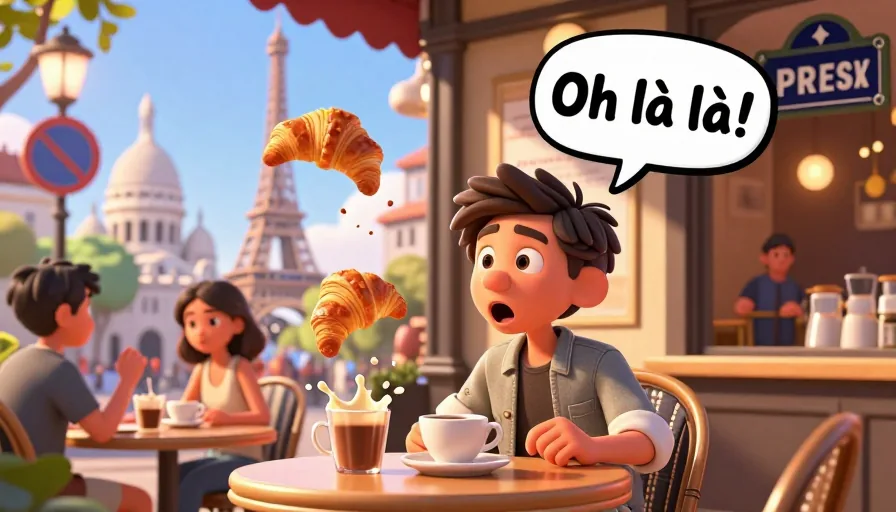
Oh là là ! - This is a versatile expression that can convey surprise, shock, or admiration. It's often used in informal contexts.
- Example: Oh là là ! That dress is gorgeous!
-
Mon Dieu ! - Literally translating to 'My God!', this exclamation conveys strong surprise or shock. It's commonly used in both formal and informal settings.
- Example: Mon Dieu ! I can't believe I forgot my keys again!
Extreme Shock
-
J’hallucine ! - This phrase means 'I'm hallucinating!' and is used to express extreme shock or disbelief. It's typically used in informal contexts.
- Example: J’hallucine ! I can't believe he actually did that!
-
Je suis abasourdi ! - Translating to 'I am stunned!', this expression conveys extreme shock or astonishment. It's more formal than 'J’hallucine !'.
- Example: Je suis abasourdi ! The news of his resignation came as a complete shock.
Context is King: When to Use Which French Exclamation
Understanding when to use each exclamation is crucial for authentic communication. Here are some common contexts and situations:
Casual Conversations
- Ah bon ? and Tiens ! are perfect for casual, everyday conversations. They help you sound more natural and engaged.
Formal Settings
- Mon Dieu ! and Je suis abasourdi ! are suitable for formal settings where a higher register of language is expected.
Informal or Emotional Situations
- Oh là là ! and J’hallucine ! are best used in informal or emotionally charged situations. They add a touch of authenticity and emotional depth to your expressions.
Checklist: Choosing the Right Exclamation
- Consider the context: Is it a casual or formal setting?
- Assess the intensity: How surprised or shocked are you?
- Match the register: Choose an exclamation that fits the tone of the conversation.

Learn Languages with YouTube
Watch videos in your target language, auto-capture words into flashcards, and track your progress — all in one place.
See How It Works →Pronunciation Deep Dive: Sounding Truly Native
Pronunciation is key to sounding native. Here are some tips to help you master the pronunciation of these exclamations:
Ah bon ?
- Pronunciation: /a bɔ̃/
- Tip: Focus on the nasal sound of 'bon'.
Tiens !
- Pronunciation: /tjɛ̃/
- Tip: The 's' is silent, and the 'i' is pronounced like the 'e' in 'bed'.
Oh là là !
- Pronunciation: /o la la/
- Tip: The 'là' sounds like 'lah', with a slight emphasis on the second syllable.
Mon Dieu !
- Pronunciation: /mɔ̃ djø/
- Tip: The 'u' in 'Dieu' is pronounced like the 'u' in 'duke'.
J’hallucine !
- Pronunciation: /ʒalysin/
- Tip: The 'll' is silent, and the 'u' is pronounced like the 'u' in 'duke'.
Je suis abasourdi !
- Pronunciation: /ʒə sɥi abazuʁdi/
- Tip: The 's' in 'suis' is silent, and the 'di' at the end is pronounced like 'dee'.
Mini Drill: Practice Pronunciation
- Record yourself saying each exclamation.
- Listen back and compare with native pronunciations.
- Repeat until you sound as close to native as possible.
Comparative Analysis: Shades of Surprise
Understanding the nuances between different exclamations can help you convey the exact shade of surprise you intend. Here’s a comparative analysis:
Ah bon ? vs. Tiens !
- Ah bon ? is more questioning and skeptical, while Tiens ! is more of a realization or acknowledgment.
Oh là là ! vs. Mon Dieu !
- Oh là là ! is versatile and can convey a range of emotions, while Mon Dieu ! is more specific to strong surprise or shock.
J’hallucine ! vs. Je suis abasourdi !
- J’hallucine ! is informal and conveys extreme shock, while Je suis abasourdi ! is more formal and conveys stunned disbelief.
Cultural Nuances and Register
French exclamations often carry cultural nuances and specific registers. Understanding these can help you use them appropriately:
Oh là là !
- This expression is very French and can be used in a variety of contexts, from admiration to surprise. It's a staple in French conversations and adds a touch of authenticity.
Mon Dieu !
- This phrase is deeply rooted in French culture and religion. It's a strong exclamation that conveys shock or surprise and is used in both formal and informal settings.
J’hallucine !
- This expression is more modern and informal. It's often used by younger generations and in casual conversations. It conveys extreme shock or disbelief.
Je suis abasourdi !
- This phrase is more formal and literary. It's used in situations where a higher register of language is expected, such as in formal conversations or written texts.
Common Mistakes to Avoid
- Overusing Exclamations: Be mindful of not overusing these expressions, as it can make your speech sound unnatural.
- Mispronunciation: Incorrect pronunciation can change the meaning or make you sound unnatural. Practice regularly to avoid this.
- Incorrect Context: Using an exclamation in the wrong context can be confusing or inappropriate. Always consider the situation and the register of the conversation.
Conclusion
Mastering French exclamations of surprise can significantly enhance your language skills and cultural understanding. By understanding the nuances, contexts, and pronunciation tips, you can express yourself authentically and sound more like a native speaker. Practice regularly and pay attention to the cultural nuances to become truly proficient.
FAQ
Why is it important to use the right French exclamation of surprise?
Using the right French exclamation of surprise helps you convey the exact shade of emotion you intend, making your communication more authentic and effective. It also shows a deeper understanding of the language and culture, which can enhance your overall language proficiency.
Can I use these exclamations in both formal and informal settings?
While some exclamations like 'Mon Dieu !' and 'Je suis abasourdi !' are suitable for formal settings, others like 'J’hallucine !' are more informal. It's important to choose the right exclamation based on the context and the register of the conversation.
How can I improve my pronunciation of French exclamations?
Practice regularly by recording yourself and comparing your pronunciation with native speakers. Pay attention to the specific sounds and intonations of each exclamation. Using language learning apps and resources can also help improve your pronunciation.
Related phrases
Start with Metheus
Watch videos in your target language, auto-capture words into flashcards, and track your progress — all in one place.
Get Started →

