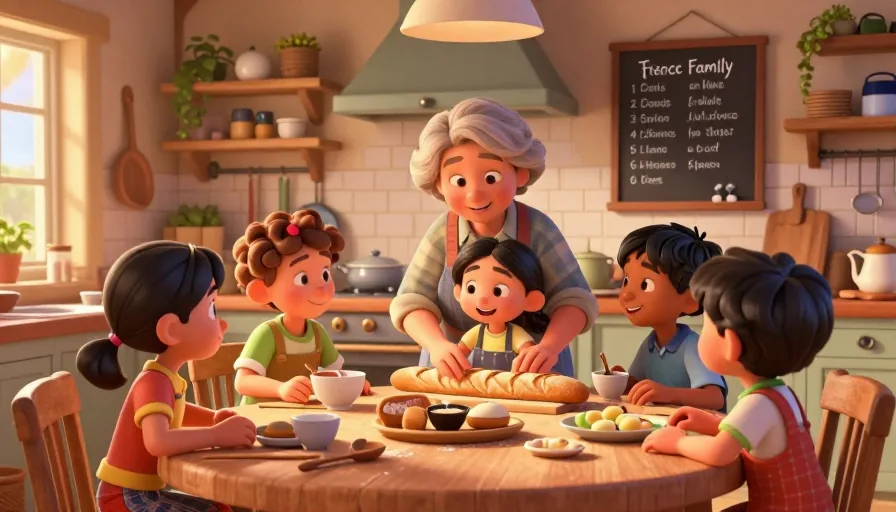
Learning French for family interactions is crucial for anyone looking to communicate effectively in French. This guide covers essential vocabulary, grammatical nuances, and practical phrases to help you describe your family relationships accurately.
Essential French Family Vocabulary: Core Terms
Start with the basics: parents, siblings, and immediate family members.
| English | French | Gender | Plural |
|---|---|---|---|
| mother | mère | f | mères |
| father | père | m | pères |
| sister | sœur | f | sœurs |
| brother | frère | m | frères |
| child | enfant | m/f | enfants |
| son | fils | m | fils |
| daughter | fille | f | filles |
| husband | mari | m | maris |
| wife | femme | f | femmes |
Mini Drill: Try describing your immediate family using the terms above. For example, "J'ai deux frères et une sœur." (I have two brothers and one sister.)
Expanding Your Vocabulary: In-Laws and Extended Family
Next, learn vocabulary for in-laws and extended family members.
| English | French | Gender | Plural | | mother-in-law | belle-mère | f | belles-mères | | father-in-law | beau-père | m | beaux-pères | | sister-in-law | belle-sœur | f | belles-sœurs | | brother-in-law | beau-frère | m | beaux-frères | | aunt | tante | f | tantes | | uncle | oncle | m | oncles | | cousin | cousin | m/f | cousins | | nephew | neveu | m | neveux | | niece | nièce | f | nièces | | grandparent | grand-parent | m/f | grands-parents | | grandma | grand-mère | f | grands-mères | | grandpa | grand-père | m | grands-pères |
Checklist:
- Can you name all your in-laws in French?
- Can you describe your extended family using the terms above?
Grammatical Nuances: Noun vs. Adjective Usage
In French, family terms can function as both nouns and adjectives. For example, "parent" can mean both "parent" (noun) and "parental" (adjective).
- Noun: "Mon parent est médecin." (My parent is a doctor.)
- Adjective: "C'est une relation parentale." (It's a parental relationship.)
Common Mistake: Avoid using the wrong gender for family terms. For example, "ma sœur" (my sister) is feminine, while "mon frère" (my brother) is masculine.

Learn Languages with YouTube
Watch videos in your target language, auto-capture words into flashcards, and track your progress — all in one place.
See How It Works →Complex Family Structures: Step-Family and Adoptive Family
French also has specific terms for complex family structures.
| English | French | Gender | Plural | | stepmother | belle-mère | f | belles-mères | | stepfather | beau-père | m | beaux-pères | | stepsister | belle-sœur | f | belles-sœurs | | stepbrother | beau-frère | m | beaux-frères | | adoptive mother | mère adoptive | f | mères adoptives | | adoptive father | père adoptif | m | pères adoptifs | | adopted child | enfant adopté | m/f | enfants adoptés |
Example: "Ma belle-mère est très gentille." (My stepmother is very kind.)
Putting It Together: Talking About Your Family in French
Use these phrases to describe your family relationships:
- "J'ai un cousin qui vit à Paris." (I have a cousin who lives in Paris.)
- "Ma belle-sœur est mariée à mon frère." (My sister-in-law is married to my brother.)
- "Mes parents sont retraités." (My parents are retired.)
- "J'ai une nièce et un neveu." (I have a niece and a nephew.)
- "Mon beau-père est un médecin." (My father-in-law is a doctor.)
Practice: Describe your family tree in French, using as many terms as possible from this guide.
Comparing Resources: French for Family Vocabulary
While resources like Lawless French and Copycat Cafe offer valuable insights, they often lack the depth and structured approach needed for comprehensive learning. This guide provides a more detailed exploration of family vocabulary, including complex family structures and practical usage examples.
Comparison:
- Lawless French: Focuses on vocabulary lists without much context.
- Copycat Cafe: Offers introductory content but lacks structured learning.
- Metheus.app: Provides in-depth vocabulary, grammatical nuances, and practical examples for natural conversation.
Conclusion
Mastering French for family vocabulary is essential for effective communication. Use this guide to expand your vocabulary, understand grammatical nuances, and practice describing your family relationships in French. With consistent practice and the right resources, you'll be able to communicate confidently about your family in French.
FAQ
How do I differentiate between 'parent' as a noun and 'parental' as an adjective in French?
In French, 'parent' can be both a noun and an adjective. As a noun, it refers to a parent (e.g., 'Mon parent est médecin.'). As an adjective, it describes something related to parents (e.g., 'C'est une relation parentale.'). Pay attention to the context to determine the correct usage.
What are the terms for step-family and adoptive family in French?
French has specific terms for step-family and adoptive family members. For example, 'belle-mère' for stepmother, 'beau-père' for stepfather, 'mère adoptive' for adoptive mother, and 'père adoptif' for adoptive father. These terms help you describe complex family structures accurately.
How can I practice describing my family in French?
Start by learning the basic vocabulary for immediate family members, in-laws, and extended family. Then, practice using these terms in sentences. For example, 'J'ai un cousin qui vit à Paris.' (I have a cousin who lives in Paris.) or 'Ma belle-sœur est mariée à mon frère.' (My sister-in-law is married to my brother.) Use this guide's checklist and mini drills to reinforce your learning.
Related phrases
Start with Metheus
Watch videos in your target language, auto-capture words into flashcards, and track your progress — all in one place.
Get Started →

