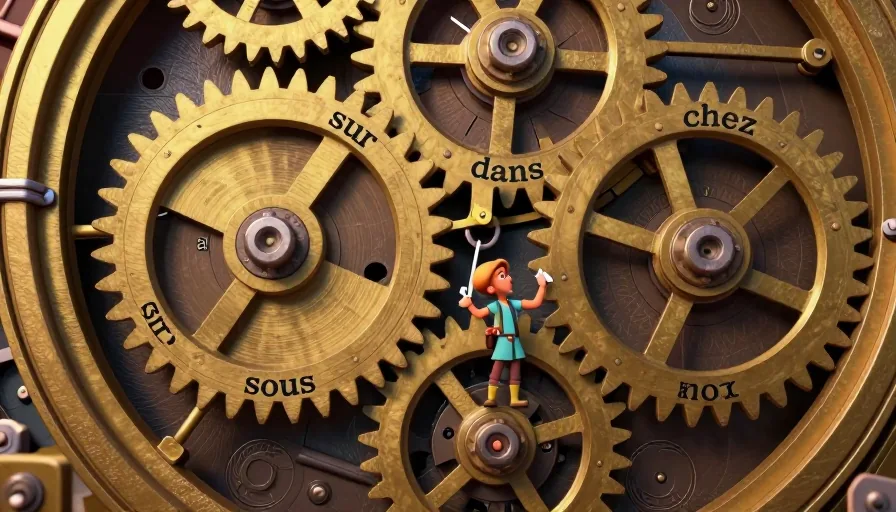
Prepositions in French language are crucial for expressing relationships between words, indicating location, time, and more. Unlike English, French prepositions often don't translate directly, making them a common stumbling block for learners. This guide will help you master the nuances of French prepositions, focusing on spatial, temporal, and relational meanings.
What Exactly Are French Prepositions?
French prepositions are short words that connect nouns, pronouns, or phrases to other words in a sentence. They provide essential information about location, time, direction, and more. Commonly used prepositions include à, de, en, sur, and sous. Understanding these prepositions is key to constructing meaningful sentences in French.
Examples of French Prepositions
- à (at, in, to): Je vais à la plage. (I am going to the beach.)
- de (of, from): C'est le livre de Marie. (It is Marie's book.)
- en (in, on): Je suis en France. (I am in France.)
- sur (on, about): Le livre est sur la table. (The book is on the table.)
- sous (under, below): La clé est sous la chaise. (The key is under the chair.)
Mastering Prepositions of Place and Movement
Prepositions of place and movement are essential for describing locations and directions. French uses specific prepositions for different contexts, which can be confusing for English speakers.
Prepositions of Place
- à (at, in): Used for cities, countries, and specific locations.
- Je suis à Paris. (I am in Paris.)
- en (in): Used for countries and regions.
- Je suis en France. (I am in France.)
- sur (on): Used for surfaces.
- Le chat est sur la table. (The cat is on the table.)
- sous (under): Used for positions below something.
- La clé est sous la chaise. (The key is under the chair.)
Prepositions of Movement
- à (to): Used for destinations.
- Je vais à la plage. (I am going to the beach.)
- en (in): Used for entering a place.
- Je vais en France. (I am going to France.)
- vers (towards): Used for direction.
- Je vais vers la montagne. (I am going towards the mountain.)
Mini Drill: Prepositions of Place and Movement
Fill in the blanks with the correct preposition:
- Je vais à la école. (I am going to school.)
- Le livre est à la table. (The book is on the table.)
- Je suis à Paris. (I am in Paris.)
- La clé est à la chaise. (The key is under the chair.)
- Je vais à la montagne. (I am going towards the mountain.)
Understanding Prepositions of Time
Prepositions of time help indicate when an action occurs. French uses specific prepositions for different time expressions, which can be tricky for learners.
Common Prepositions of Time
- à (at): Used for specific times.
- Je vais à la plage à midi. (I am going to the beach at noon.)
- en (in): Used for months, years, and seasons.
- Je vais en France en été. (I am going to France in summer.)
- pendant (during): Used for durations.
- Je vais à la plage pendant l'été. (I am going to the beach during the summer.)
- depuis (since): Used for starting points in time.
- Je suis à Paris depuis deux ans. (I have been in Paris for two years.)
Mini Drill: Prepositions of Time
Fill in the blanks with the correct preposition:
- Je vais à la plage à midi. (I am going to the beach at noon.)
- Je vais en France été. (I am going to France in summer.)
- Je vais à la plage pendant l'été. (I am going to the beach during the summer.)
- Je suis à Paris depuis deux ans. (I have been in Paris for two years.)

Learn Languages with YouTube
Watch videos in your target language, auto-capture words into flashcards, and track your progress — all in one place.
See How It Works →The Art of Prepositional Phrases: Beyond Single Words
Prepositional phrases consist of a preposition and its object, providing more context and detail. Mastering these phrases is crucial for expressing complex ideas in French.
Examples of Prepositional Phrases
- à côté de (next to): La maison est à côté de la plage. (The house is next to the beach.)
- en face de (in front of): Le restaurant est en face de la banque. (The restaurant is in front of the bank.)
- derrière (behind): Le chat est derrière la chaise. (The cat is behind the chair.)
- devant (in front of): Le livre est devant la table. (The book is in front of the table.)
Mini Drill: Prepositional Phrases
Fill in the blanks with the correct prepositional phrase:
- La maison est à côté de la plage. (The house is next to the beach.)
- Le restaurant est en face de la banque. (The restaurant is in front of the bank.)
- Le chat est derrière la chaise. (The cat is behind the chair.)
- Le livre est devant la table. (The book is in front of the table.)
Handling Prepositional Phrases
Prepositional phrases can be challenging, especially when they involve multiple words. Here are some tips to help you master them:
Checklist for Mastering Prepositional Phrases
- Practice Regularly: Use prepositional phrases in your daily conversations and writing.
- Listen to Native Speakers: Pay attention to how native speakers use prepositional phrases.
- Use Context Clues: Understand the context to choose the correct prepositional phrase.
- Avoid Direct Translation: Remember that French prepositions often don't translate directly to English.
Common Mistakes to Avoid
- Confusing Prepositions: Be careful not to confuse similar prepositions like à and en.
- Overusing Prepositions: Avoid using too many prepositions in a single sentence.
- Ignoring Context: Always consider the context when choosing a preposition.
Practical Examples and Checklists
Example Sentences with Prepositions
- à (at, in, to): Je vais à la plage. (I am going to the beach.)
- de (of, from): C'est le livre de Marie. (It is Marie's book.)
- en (in, on): Je suis en France. (I am in France.)
- sur (on, about): Le livre est sur la table. (The book is on the table.)
- sous (under, below): La clé est sous la chaise. (The key is under the chair.)
Checklist for Using Prepositions Correctly
- Identify the Relationship: Determine the relationship between the words.
- Choose the Correct Preposition: Select the preposition that best fits the context.
- Practice with Examples: Use example sentences to reinforce your understanding.
- Listen to Native Speakers: Pay attention to how native speakers use prepositions.
- Avoid Direct Translation: Remember that French prepositions often don't translate directly to English.
Beware of Direct Translation
One of the biggest challenges in learning French prepositions is avoiding direct translation from English. French prepositions often have different meanings and uses than their English counterparts. For example, the English preposition 'in' can translate to à, en, or dans in French, depending on the context.
Examples of Direct Translation Mistakes
- Incorrect: Je suis in Paris. (Direct translation from English.)
- Correct: Je suis à Paris. (Correct French usage.)
Tips for Avoiding Direct Translation
- Learn Contextual Usage: Understand how prepositions are used in different contexts.
- Practice with Examples: Use example sentences to reinforce your understanding.
- Listen to Native Speakers: Pay attention to how native speakers use prepositions.
- Use Language Learning Tools: Utilize tools like Metheus.app to practice and reinforce your learning.
Conclusion
Mastering prepositions in French language requires practice and a deep understanding of contextual usage. By focusing on spatial, temporal, and relational meanings, and avoiding direct translation, you can improve your French language skills significantly. Use the examples, checklists, and mini drills provided in this guide to enhance your learning experience.
FAQ
Why is it important to avoid direct translation when learning French prepositions?
Avoiding direct translation is crucial because French prepositions often have different meanings and uses than their English counterparts. Direct translation can lead to incorrect usage and misunderstandings. For example, the English preposition 'in' can translate to **à**, **en**, or **dans** in French, depending on the context. By learning the contextual usage and practicing with examples, you can master French prepositions more effectively.
How can I improve my understanding of prepositional phrases in French?
Improving your understanding of prepositional phrases involves regular practice, listening to native speakers, and using context clues. Prepositional phrases consist of a preposition and its object, providing more context and detail. Practice using prepositional phrases in your daily conversations and writing, and pay attention to how native speakers use them. Use language learning tools like Metheus.app to reinforce your learning and avoid common mistakes.
Related phrases
Start with Metheus
Watch videos in your target language, auto-capture words into flashcards, and track your progress — all in one place.
Get Started →

