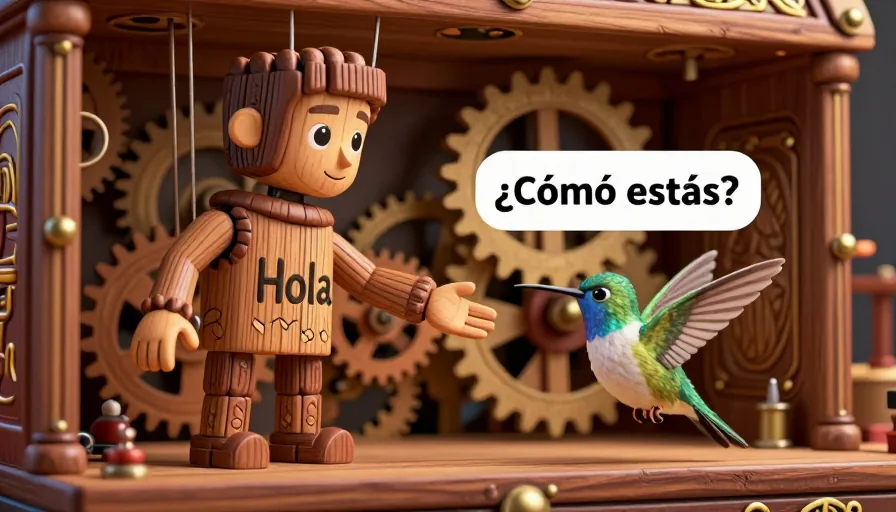
When learning Spanish, one of the first phrases you'll want to master is 'Hello, how are you?' This common greeting is essential for building connections and showing politeness. In Spanish, the direct translation of 'Hello, how are you?' can vary based on formality and context. This guide will help you understand the nuances and use this phrase confidently in any situation.
The Direct Translation: Hello, ¿Cómo estás?
The most direct translation of 'Hello, how are you?' in Spanish is 'Hola, ¿cómo estás?' This phrase is informal and suitable for friends, family, and people your own age. Here's a breakdown:
- Hola: Hello
- ¿Cómo estás?: How are you?
Pronunciation Guide
- Hola: /ˈo.la/
- ¿Cómo estás?: /ˈko.mo es.tas/
Interactive Audio Examples
Listen to the audio below to hear the pronunciation:
[Audio: Hola, ¿cómo estás?]
Choosing the Right Form: Tú vs. Usted
In Spanish, the choice between 'tú' and 'usted' depends on the level of formality and respect. 'Tú' is informal and used with friends, family, and people your own age. 'Usted' is formal and used with elders, superiors, and people you don't know well.
Informal: ¿Cómo estás?
- Hola, ¿cómo estás?: Hello, how are you? (informal)
Formal: ¿Cómo está?
- Hola, ¿cómo está?: Hello, how are you? (formal)
Pronunciation Guide
- ¿Cómo está?: /ˈko.mo es.ta/
Interactive Audio Examples
Listen to the audio below to hear the pronunciation:
[Audio: Hola, ¿cómo está?]

Learn Languages with YouTube
Watch videos in your target language, auto-capture words into flashcards, and track your progress — all in one place.
See How It Works →Context Matters: When to Use This Greeting
Understanding when to use 'Hola, ¿cómo estás?' versus 'Hola, ¿cómo está?' is crucial for effective communication. Here are some contextual examples:
Informal Situations
- Greeting friends: 'Hola, ¿cómo estás, Juan?'
- Talking to family members: 'Hola, ¿cómo estás, mamá?'
- Speaking to peers: 'Hola, ¿cómo estás, Carlos?'
Formal Situations
- Greeting a teacher: 'Hola, ¿cómo está, profesor?'
- Speaking to a boss: 'Hola, ¿cómo está, jefe?'
- Talking to an elder: 'Hola, ¿cómo está, señora?'
Comparison Chart: Choosing the Right Greeting
| Situation | Greeting | Pronunciation | Example |
|---|---|---|---|
| Informal | Hola, ¿cómo estás? | /ˈo.la ˈko.mo es.tas/ | Hola, ¿cómo estás, Juan? |
| Formal | Hola, ¿cómo está? | /ˈo.la ˈko.mo es.ta/ | Hola, ¿cómo está, profesor? |
Mini Drill: Practice Makes Perfect
- Identify the context: Determine if the situation is formal or informal.
- Choose the correct greeting: Use 'Hola, ¿cómo estás?' for informal situations and 'Hola, ¿cómo está?' for formal situations.
- Practice pronunciation: Listen to the audio examples and repeat the phrases aloud.
- Role-play: Practice with a friend or language partner, switching between formal and informal contexts.
Common Mistakes to Avoid
- Using 'tú' with elders or superiors: This can be seen as disrespectful.
- Using 'usted' with friends or family: This can sound overly formal and distant.
- Incorrect pronunciation: Pay attention to the stress and intonation in the audio examples.
Checklist for Mastering 'Hello, How Are You?' in Spanish
- Understand the difference between 'tú' and 'usted'
- Learn the pronunciation of 'Hola, ¿cómo estás?' and 'Hola, ¿cómo está?'
- Practice in both formal and informal contexts
- Use the comparison chart to choose the right greeting
- Role-play with a language partner
By following this guide, you'll be able to confidently greet people in Spanish, whether in informal or formal situations. Practice regularly, and soon you'll be using 'Hola, ¿cómo estás?' and 'Hola, ¿cómo está?' like a native speaker.
FAQ
What if I'm not sure about the formality level?
If you're unsure about the formality level, it's better to err on the side of caution and use the formal 'Hola, ¿cómo está?' until you're more familiar with the person. You can always switch to the informal 'Hola, ¿cómo estás?' later if the context allows.
Can I use 'Hola' and '¿Cómo estás?' separately?
While 'Hola' and '¿Cómo estás?' can be used separately, combining them into 'Hola, ¿cómo estás?' creates a more natural and fluid greeting. Using them together is more common in everyday conversations.
Related phrases
Start with Metheus
Watch videos in your target language, auto-capture words into flashcards, and track your progress — all in one place.
Get Started →

