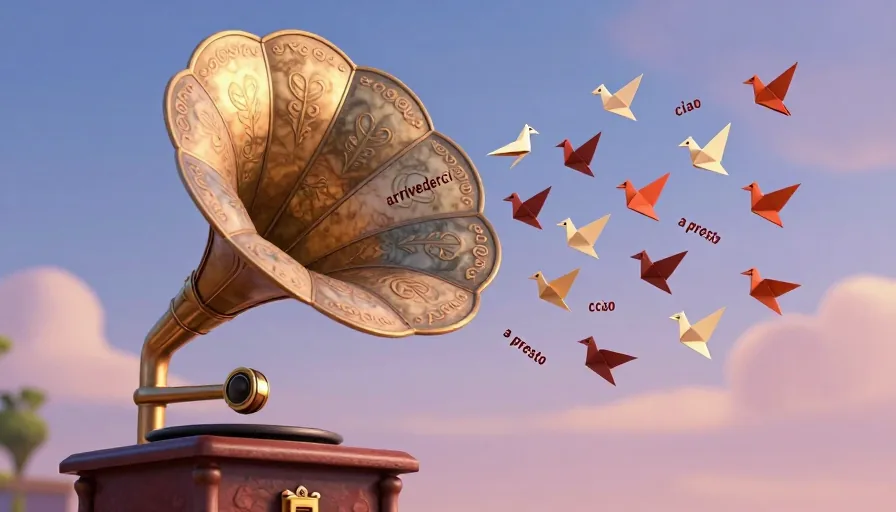
Understanding when to use 'italian arrivederci' and other Italian farewells can significantly enhance your language skills and cultural awareness. This guide will help you navigate the nuances of Italian goodbyes, ensuring you sound natural and appropriate in various contexts.
Understanding the Nuances: When to Use 'Arrivederci' vs. Other Farewells
The literal translation of 'arrivederci' is 'until we meet again,' and it is commonly used as a formal or semi-formal farewell. Unlike 'ciao,' which is casual and can be used with friends and family, 'arrivederci' is more appropriate for professional settings or when addressing someone you respect or don't know well. For example, you might say 'arrivederci' to a colleague after a meeting or to a shopkeeper after making a purchase.
Mini Drill: Practice Contextual Farewells
-
You are leaving a business meeting. What do you say?
- a) Ciao
- b) Arrivederci
- c) Buonanotte
- d) Addio
-
You are saying goodbye to a close friend. What do you say?
- a) Arrivederci
- b) Ciao
- c) Buonanotte
- d) Addio
-
You are ending a phone call with a client. What do you say?
- a) Ciao
- b) Arrivederci
- c) Buonanotte
- d) Addio
A Complete Guide to Italian Goodbyes: From Casual to Formal
Casual Farewells
- Ciao: The most casual way to say goodbye, similar to 'hi' or 'bye' in English. Use it with friends, family, and in informal settings.
- Ciao ciao: Even more casual, often used with children or in very informal contexts.
- A dopo: Literally 'until later,' used when you expect to see the person again soon.
Formal Farewells
- Arrivederci: As mentioned, this is a formal or semi-formal farewell. It's safe to use in most situations where you're unsure of the appropriate level of formality.
- Buongiorno: Literally 'good day,' it can be used as a farewell in the morning or early afternoon.
- Buonasera: Literally 'good evening,' used as a farewell in the late afternoon or evening.
Time-Specific Farewells
- Buonanotte: Literally 'good night,' used as a farewell in the evening or night, often before going to bed.
- A domani: Literally 'until tomorrow,' used when you expect to see the person the next day.
- A presto: Literally 'until soon,' used when you expect to see the person again soon but not necessarily the next day.
Beyond 'Arrivederci': Essential Italian Farewell Phrases
Dramatic Farewells
- Addio: A dramatic farewell, often used in emotional or final goodbyes. It's stronger than 'arrivederci' and implies a longer or permanent separation.
- Arrivederla: The formal version of 'arrivederci,' used when addressing someone with 'Lei' (the formal 'you').
Checklist: Choosing the Right Farewell
- Consider the context: Is it a casual or formal setting?
- Consider the relationship: Are you addressing a friend, colleague, or stranger?
- Consider the time of day: Is it morning, afternoon, evening, or night?
- Consider the expected duration of separation: Will you see the person again soon, tomorrow, or much later?

Learn Languages with YouTube
Watch videos in your target language, auto-capture words into flashcards, and track your progress — all in one place.
See How It Works →Practical Scenarios: Using Italian Farewells in Context
Leaving a Café
You've finished your coffee and are ready to leave. The barista smiles at you. What do you say?
- If it's a small, local café and you're on friendly terms with the barista, you might say 'ciao' or 'a dopo.'
- If it's a larger café or you're unsure of the appropriate level of formality, 'arrivederci' is a safe choice.
Ending a Business Meeting
You've just finished a productive meeting with a client. What do you say?
- 'Arrivederci' is appropriate here, as it's formal enough for a business setting but not too stiff.
- If the meeting was particularly successful and you expect to see the client again soon, you might say 'a presto.'
Saying Goodbye to a Friend
You're leaving a friend's house after a fun evening. What do you say?
- 'Ciao' is the most natural choice here, as it's casual and friendly.
- If it's late at night, you might say 'buonanotte' instead.
Etiquette for Written Goodbyes: Email/Text
When writing a goodbye in an email or text, the rules are similar to spoken farewells. However, there are a few additional considerations:
- Email: Use 'arrivederci' or 'a presto' for formal or semi-formal emails. For casual emails, 'ciao' is fine.
- Text: Text messages are generally more casual, so 'ciao' or 'a dopo' are usually appropriate.
Mini Drill: Written Farewells
-
You're sending a follow-up email to a client after a meeting. What do you write?
- a) Ciao
- b) Arrivederci
- c) Buonanotte
- d) Addio
-
You're texting a friend to say goodbye for the night. What do you write?
- a) Arrivederci
- b) Ciao
- c) Buonanotte
- d) Addio
-
You're sending a goodbye email to a colleague who is leaving the company. What do you write?
- a) Ciao
- b) Arrivederci
- c) Buonanotte
- d) Addio
By understanding the nuances of 'italian arrivederci' and other Italian farewells, you'll be able to navigate social and professional situations with confidence. Remember to consider the context, relationship, and time of day when choosing the appropriate farewell. With practice, you'll sound like a native speaker in no time!
FAQ
Is 'arrivederci' always the best choice for a formal farewell?
While 'arrivederci' is a safe choice for many formal situations, it's not always the best option. For example, if you're saying goodbye to someone you respect or don't know well in the evening, 'buonasera' might be more appropriate. Similarly, if you're saying goodbye to a colleague who is leaving the company, 'addio' could be a more fitting choice.
Can I use 'ciao' in professional settings?
It's generally best to avoid using 'ciao' in professional settings, as it's too casual. Instead, opt for 'arrivederci' or another formal or semi-formal farewell. However, if you're in a more casual work environment or have a close relationship with your colleagues, 'ciao' might be acceptable.
How do I know if I should use 'Lei' or 'tu' with a farewell?
The choice between 'Lei' (formal 'you') and 'tu' (informal 'you') depends on your relationship with the person you're addressing. If you're unsure, it's always better to err on the side of formality and use 'Lei.' For example, you would say 'arrivederla' instead of 'arrivederci' when using 'Lei.'
Related phrases
Start with Metheus
Watch videos in your target language, auto-capture words into flashcards, and track your progress — all in one place.
Get Started →

