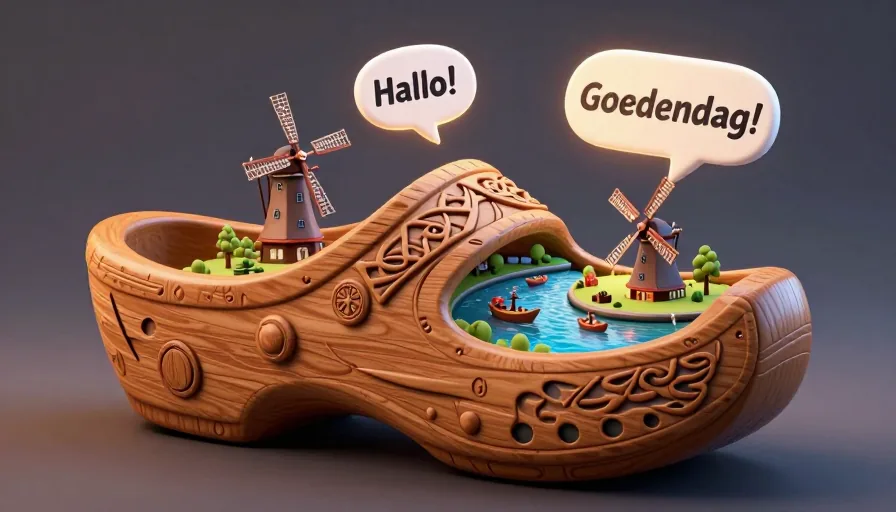
Learning the dutch language hello is your first step into the rich and vibrant culture of the Netherlands. Whether you're traveling, working, or simply interested in the language, knowing how to greet people correctly is crucial. This guide will walk you through the most common ways to say 'hello' in Dutch, provide pronunciation tips, and offer cultural insights to help you navigate social settings with ease.
The Essential Dutch Greetings: From Casual to Formal
In Dutch, greetings can vary based on the context and the level of formality. Here are the most common greetings you'll need to know:
Casual Greetings
-
Hallo: This is the most casual and versatile way to say 'hello' in Dutch. It's used among friends, family, and in informal settings.
- Example: Hallo, hoe gaat het? (Hello, how are you?)
-
Hoi: Even more casual than 'hallo,' 'hoi' is often used among young people and friends.
- Example: Hoi, wat doet je? (Hi, what are you doing?)
Formal Greetings
-
Goedendag: This is a formal way to say 'good day' and is used in professional settings or when addressing someone you don't know well.
- Example: Goedendag, mijn naam is... (Good day, my name is...)
-
Goede morgen / Goede middag / Goede avond: These greetings translate to 'good morning,' 'good afternoon,' and 'good evening,' respectively. They are used in formal and informal settings.
- Example: Goede morgen, hoe gaat het? (Good morning, how are you?)
Interactive Audio Examples
To help you master the pronunciation, listen to these audio examples recorded by native Dutch speakers:
Mastering Pronunciation: How to Sound Natural When Greeting Dutch Speakers
Pronunciation is key to sounding natural and being understood. Here are some tips to help you pronounce Dutch greetings correctly:
- Hallo: Pronounced as 'HAH-loh,' with the stress on the first syllable.
- Hoi: Pronounced as 'HOH-y,' with a short 'o' sound.
- Goedendag: Pronounced as 'KHOO-dun-dahk,' with the stress on the second syllable.
- Goede morgen: Pronounced as 'KHOO-duh MOR-guhn,' with the stress on the second syllable.
Mini Drill: Practice Your Pronunciation
Try repeating these greetings aloud, focusing on the correct pronunciation. Record yourself and compare it to the audio examples to improve.

Learn Languages with YouTube
Watch videos in your target language, auto-capture words into flashcards, and track your progress — all in one place.
See How It Works →Cultural Nuances: When to Use 'Hallo' vs. 'Goedendag'
Understanding when to use each greeting is essential for navigating Dutch social settings. Here's a quick reference chart to help you:
| Setting | Greeting | Example |
|---|---|---|
| Casual, friends | Hallo | Hallo, hoe gaat het? |
| Very casual, young people | Hoi | Hoi, wat doet je? |
| Formal, professional | Goedendag | Goedendag, mijn naam is... |
| Morning, formal/informal | Goede morgen | Goede morgen, hoe gaat het? |
| Afternoon, formal/informal | Goede middag | Goede middag, hoe gaat het? |
| Evening, formal/informal | Goede avond | Goede avond, hoe gaat het? |
Checklist: Greeting Like a Local
- Use 'hallo' with friends and family.
- Use 'hoi' with young people and close friends.
- Use 'goedendag' in professional settings.
- Use 'goede morgen,' 'goede middag,' and 'goede avond' based on the time of day.
- Practice pronunciation regularly.
Common Mistakes to Avoid
- Overusing 'hallo': While 'hallo' is versatile, using it in formal settings can come across as too casual.
- Mispronouncing greetings: Incorrect pronunciation can lead to misunderstandings or difficulty being understood.
- Ignoring cultural context: Using the wrong greeting for the setting can be seen as disrespectful or inappropriate.
Mini Drill: Correcting Mistakes
Identify and correct the mistakes in the following sentences:
- Hoi, goedendag, hoe gaat het? (Incorrect: Mixing casual and formal greetings)
- Correction: Goedendag, hoe gaat het?
- Hallo, goede avond. (Incorrect: Using 'hallo' in a formal setting)
- Correction: Goede avond.
- Hoi, goedemiddag. (Incorrect: Mispronouncing 'goede middag')
- Correction: Goede middag.
Cultural Etiquette Surrounding Greetings in the Netherlands
Dutch people value directness and authenticity. Here are some cultural tips to keep in mind:
- Be direct: Dutch people appreciate straightforward communication. Use greetings that match the context and your relationship with the person.
- Use first names: The Netherlands is quite informal, and using first names is common, even in professional settings.
- Shake hands: A firm handshake is a standard greeting in professional and formal settings.
- Maintain eye contact: Eye contact shows respect and engagement during conversations.
Checklist: Cultural Etiquette
- Use direct and appropriate greetings.
- Use first names in informal settings.
- Shake hands in professional settings.
- Maintain eye contact during conversations.
By following this guide, you'll be well on your way to mastering the dutch language hello and navigating Dutch social settings with confidence. Happy learning!
FAQ
Is 'hallo' the only way to say 'hello' in Dutch?
No, 'hallo' is the most common and casual way to say 'hello' in Dutch. Other greetings like 'hoi,' 'goedendag,' 'goede morgen,' 'goede middag,' and 'goede avond' are also used depending on the context and formality of the situation.
How do I know when to use 'hallo' vs. 'goedendag'?
Use 'hallo' in casual settings with friends and family. Use 'goedendag' in formal or professional settings. The quick reference chart in the guide can help you determine the appropriate greeting for different situations.
What if I make a mistake with a greeting?
Mistakes happen, and Dutch people are generally understanding. If you make a mistake, simply correct yourself and continue the conversation. Practice and familiarity will help you become more comfortable with the greetings over time.
Related phrases
Start with Metheus
Watch videos in your target language, auto-capture words into flashcards, and track your progress — all in one place.
Get Started →

