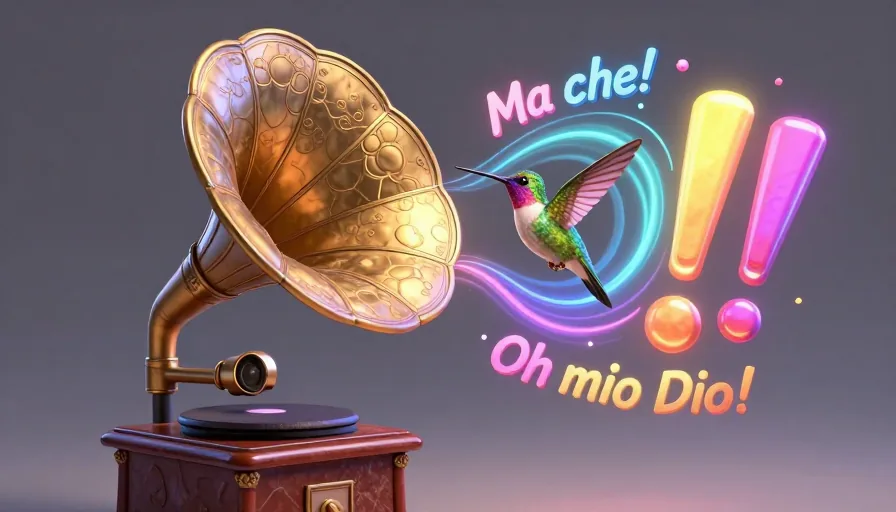
Italian exclamations are more than just words; they are expressions of emotion and cultural identity. Understanding and using Italian exclamations correctly can make your conversations more engaging and authentic. This guide will help you master the art of using Italian exclamations, from basic vocabulary to the emotional nuances that make them truly expressive.
Mastering the Tone: Understanding the Emotion Behind Common Italian Exclamations
To sound like a native speaker, you need to understand the emotional tone behind each Italian exclamation. Here are some key exclamations and their associated emotions:
Macché!
Emotional Tone: Disbelief or strong disagreement.
Usage: Use Macché! when you want to express strong disbelief or disagreement. It's often used in response to a statement you find absurd.
Example:
Friend: "Did you hear that Marco won the lottery?"
You: "Macché! He never buys tickets."
Ma dai!
Emotional Tone: Surprise or disbelief.
Usage: Ma dai! is used to express surprise or disbelief, similar to "Really?" in English.
Example:
Friend: "I just saw a UFO in the sky!"
You: "Ma dai! Are you sure?"
Dai!
Emotional Tone: Encouragement or urging.
Usage: Dai! is used to encourage someone to do something or to hurry up.
Example:
Friend: "I can't finish this report by tomorrow."
You: "Dai! You can do it. Just focus and get it done."
Quick Reference: Essential Italian Exclamations for Daily Conversation
Here is a quick reference guide to some essential Italian exclamations for daily conversation:
| Exclamation | Emotional Tone | Usage Example |
|---|---|---|
| Macché! | Disbelief | "Macché! That's not true." |
| Ma dai! | Surprise | "Ma dai! I can't believe it." |
| Dai! | Encouragement | "Dai! You can do it." |
| Vai! | Excitement | "Vai! Go for it!" |
| Che bello! | Joy | "Che bello! That's beautiful!" |
Beyond 'Mamma Mia!': Deeper Dive into Expressive Italian
While 'Mamma Mia!' is a well-known Italian exclamation, there are many others that can add depth and expressiveness to your conversations. Here are a few more nuanced exclamations:
Vai!
Emotional Tone: Excitement or encouragement.
Usage: Vai! is used to express excitement or to encourage someone to go for it.
Example:
Friend: "I'm going to ask my boss for a raise."
You: "Vai! You deserve it."
Che bello!
Emotional Tone: Joy or admiration.
Usage: Che bello! is used to express joy or admiration for something beautiful or wonderful.
Example:
Friend: "Look at this painting I found."
You: "Che bello! It's amazing."

Learn Languages with YouTube
Watch videos in your target language, auto-capture words into flashcards, and track your progress — all in one place.
See How It Works →Practical Usage Scenarios: When and How to Use Italian Exclamations
Understanding when and how to use Italian exclamations is crucial for sounding natural. Here are some practical usage scenarios:
Formal vs. Informal Usage
Formal: In formal settings, exclamations are used sparingly and with more restraint. For example, in a business meeting, you might say "Che bello!" to admire a presentation but avoid using "Dai!" to encourage someone.
Informal: In informal settings, exclamations are more freely used. For example, among friends, you might say "Dai!" to encourage a friend to try something new or "Macché!" to express disbelief.
Dialogue Snippets
Scenario 1: Encouraging a Friend
Friend: "I'm nervous about my presentation tomorrow."
You: "Dai! You've practiced a lot. You'll do great."
Scenario 2: Expressing Disbelief
Friend: "I just saw a ghost in my room!"
You: "Macché! There's no such thing as ghosts."
Scenario 3: Admiring Something Beautiful
Friend: "Look at this sunset!"
You: "Che bello! It's stunning."
Cultural Context: Why These Specific Phrases Are Used by Native Speakers
Italian exclamations are deeply rooted in the culture and are used to convey a wide range of emotions. Understanding the cultural context can help you use these exclamations more effectively. Here are some key points:
Emotional Mapping
Italian exclamations are often used to map specific emotions. For example, "Macché!" is used to express disbelief, while "Che bello!" is used to express joy. Understanding these emotional mappings can help you choose the right exclamation for the right situation.
Contextual Usage
The context in which an exclamation is used can greatly affect its meaning. For example, "Dai!" can mean "Come on!" in an encouraging context but "Go!" in a competitive context. Paying attention to the context can help you use these exclamations more naturally.
Formal vs. Informal Usage
In formal settings, exclamations are used sparingly and with more restraint. For example, in a business meeting, you might say "Che bello!" to admire a presentation but avoid using "Dai!" to encourage someone. In informal settings, exclamations are more freely used. For example, among friends, you might say "Dai!" to encourage a friend to try something new or "Macché!" to express disbelief.
Checklist for Mastering Italian Exclamations
- Learn the Basic Exclamations: Start with the essential exclamations like "Macché!", "Ma dai!", and "Dai!".
- Understand the Emotional Tone: Know the emotional tone associated with each exclamation.
- Practice in Context: Use exclamations in different contexts to understand their nuances.
- Listen to Native Speakers: Pay attention to how native speakers use exclamations in conversations.
- Use Exclamations Naturally: Incorporate exclamations into your daily conversations to sound more natural.
Mini Drills for Practicing Italian Exclamations
- Dialogue Practice: Create short dialogues using different exclamations and practice them with a friend or language partner.
- Emotional Mapping Exercise: Write down a list of emotions and match them with the appropriate Italian exclamations.
- Contextual Usage Exercise: Write short scenarios and choose the appropriate exclamation for each situation.
- Listening Practice: Watch Italian movies or TV shows and pay attention to how exclamations are used.
- Role-Playing: Role-play different scenarios with a friend or language partner, using exclamations to express various emotions.
By following this guide and practicing regularly, you'll be able to master Italian exclamations and express yourself like a native speaker. Buona fortuna!
FAQ
Why are Italian exclamations important for language learning?
Italian exclamations are important because they add emotional depth and authenticity to your conversations. They help you sound more natural and expressive, making your interactions with native speakers more engaging and meaningful.
How can I use Italian exclamations correctly?
To use Italian exclamations correctly, you need to understand the emotional tone and context in which they are used. Practice in different scenarios and pay attention to how native speakers use them. This will help you incorporate them naturally into your conversations.
Are there any cultural nuances I should be aware of when using Italian exclamations?
Yes, Italian exclamations are deeply rooted in the culture and are used to convey a wide range of emotions. Understanding the cultural context and emotional mapping can help you use these exclamations more effectively. For example, 'Macché!' is used to express disbelief, while 'Che bello!' is used to express joy.
Related phrases
Start with Metheus
Watch videos in your target language, auto-capture words into flashcards, and track your progress — all in one place.
Get Started →

