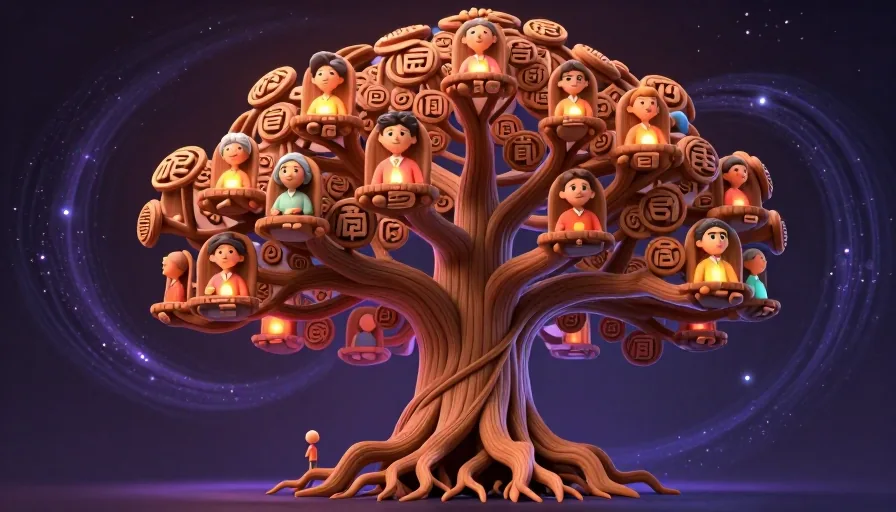
Japanese family terms are a fundamental aspect of the language, reflecting the deep cultural nuances and hierarchical structures within Japanese society. Understanding these terms is crucial for effective communication and cultural sensitivity. This guide will delve into the distinctions between reference vs. address terms, formal vs. casual usage, and provide practical examples to help you master Japanese family terms.
Understanding the Japanese Family Vocabulary System
The Japanese language has a complex system of family terms that can be overwhelming for beginners. The system is built on a foundation of respect and hierarchy, which is reflected in the vocabulary used to address and refer to family members. There are two main types of family terms: reference terms and address terms.
Reference Terms
Reference terms are used to talk about family members when they are not present. For example, when discussing your mother with a friend, you would use the reference term for mother, which is おかあさん (okāsan).
Address Terms
Address terms, on the other hand, are used when speaking directly to a family member. For instance, when talking to your mother, you would use the address term お母さん (okāsan).
Formal vs. Casual Usage
Japanese family terms also vary based on the level of formality. Formal terms are used in polite or respectful contexts, while casual terms are used in informal or intimate settings. This distinction is crucial in understanding the nuances of Japanese family terms.
Basic Family Terms: Parents and Siblings
Parents
- Father: 父 (chichi) - Reference term for father
- Mother: 母 (haha) - Reference term for mother
- Dad: 父さん (tōsan) - Address term for father
- Mom: 母さん (kāsan) - Address term for mother
Siblings
- Older Brother: 兄 (ani) - Reference term for older brother
- Older Sister: 姉 (ane) - Reference term for older sister
- Younger Brother: 弟 (otōto) - Reference term for younger brother
- Younger Sister: 妹 (imōto) - Reference term for younger sister
Japanese Words for Extended Family Members
Grandparents
- Grandfather: 祖父 (sofu) - Reference term for grandfather
- Grandmother: 祖母 (sobo) - Reference term for grandmother
- Grandpa: じいじ (jīji) - Address term for grandfather
- Grandma: ばあば (bāba) - Address term for grandmother
Aunts and Uncles
- Aunt (Father's Sister): 叔母 (obā) - Reference term for aunt (father's sister)
- Uncle (Father's Brother): 叔父 (ojī) - Reference term for uncle (father's brother)
- Aunt (Mother's Sister): 伯母 (obā) - Reference term for aunt (mother's sister)
- Uncle (Mother's Brother): 伯父 (ojī) - Reference term for uncle (mother's brother)

Learn Languages with YouTube
Watch videos in your target language, auto-capture words into flashcards, and track your progress — all in one place.
See How It Works →Aunts and Uncles Vocabulary Words
Cousins
- Cousin (Male): 従兄弟 (itoko) - Reference term for male cousin
- Cousin (Female): 従姉妹 (itoko) - Reference term for female cousin
Grandparents in Japanese Families
Grandparents hold a special place in Japanese families, and the terms used to address them reflect this respect. The reference terms for grandparents are 祖父 (sofu) for grandfather and 祖母 (sobo) for grandmother, while the address terms are じいじ (jīji) for grandfather and ばあば (bāba) for grandmother.
Cultural Context Behind the Terminology
The complexity of Japanese family terms stems from the cultural emphasis on respect, hierarchy, and familial roles. Understanding these terms requires a deep dive into the cultural context, as the nuances can significantly impact communication and social interactions.
Practical Examples and Checklists
Example 1: Addressing Family Members
Imagine you are at a family gathering. When addressing your grandfather, you would use the address term じいじ (jīji). However, when talking about him to your cousin, you would use the reference term 祖父 (sofu).
Example 2: Formal vs. Casual Usage
When introducing your mother to a new acquaintance, you would use the formal reference term おかあさん (okāsan). However, when talking to your mother directly, you would use the casual address term お母さん (okāsan).
Checklist for Mastering Japanese Family Terms
- Understand the distinction between reference and address terms.
- Learn the formal and casual usage for each family member.
- Practice using the terms in different contexts to build fluency.
- Listen to sound files or pronunciation guides to ensure accurate pronunciation.
Mini Drills for Practice
- Identify the Correct Term: Write down the reference and address terms for each family member and practice using them in sentences.
- Role-Playing: Practice conversations with a language partner, using the appropriate terms based on the context and level of formality.
- Cultural Immersion: Watch Japanese dramas or movies and pay attention to how family members address each other. Take note of the terms used and the context in which they are used.
Conclusion
Mastering Japanese family terms is essential for effective communication and cultural understanding. By understanding the distinctions between reference vs. address terms, formal vs. casual usage, and the cultural context behind the terminology, you can navigate Japanese family vocabulary with confidence. Use the practical examples, checklists, and mini drills provided in this guide to enhance your language learning journey.
FAQ
Why are there different terms for addressing and referring to family members in Japanese?
Japanese family terms are designed to reflect the hierarchical and respectful nature of Japanese society. Address terms are used when speaking directly to a family member, while reference terms are used when talking about them in their absence. This distinction helps maintain respect and clarity in communication.
How do I know when to use formal vs. casual terms for family members?
The choice between formal and casual terms depends on the context and the level of formality required. Formal terms are used in polite or respectful contexts, such as when introducing family members to new acquaintances. Casual terms are used in informal or intimate settings, such as when talking to family members at home.
What are some common mistakes to avoid when using Japanese family terms?
Common mistakes include using the wrong term for the context (e.g., using an address term when referring to a family member), mixing up formal and casual terms, and mispronouncing the terms. To avoid these mistakes, practice using the terms in different contexts and listen to pronunciation guides.
Related phrases
Start with Metheus
Watch videos in your target language, auto-capture words into flashcards, and track your progress — all in one place.
Get Started →

