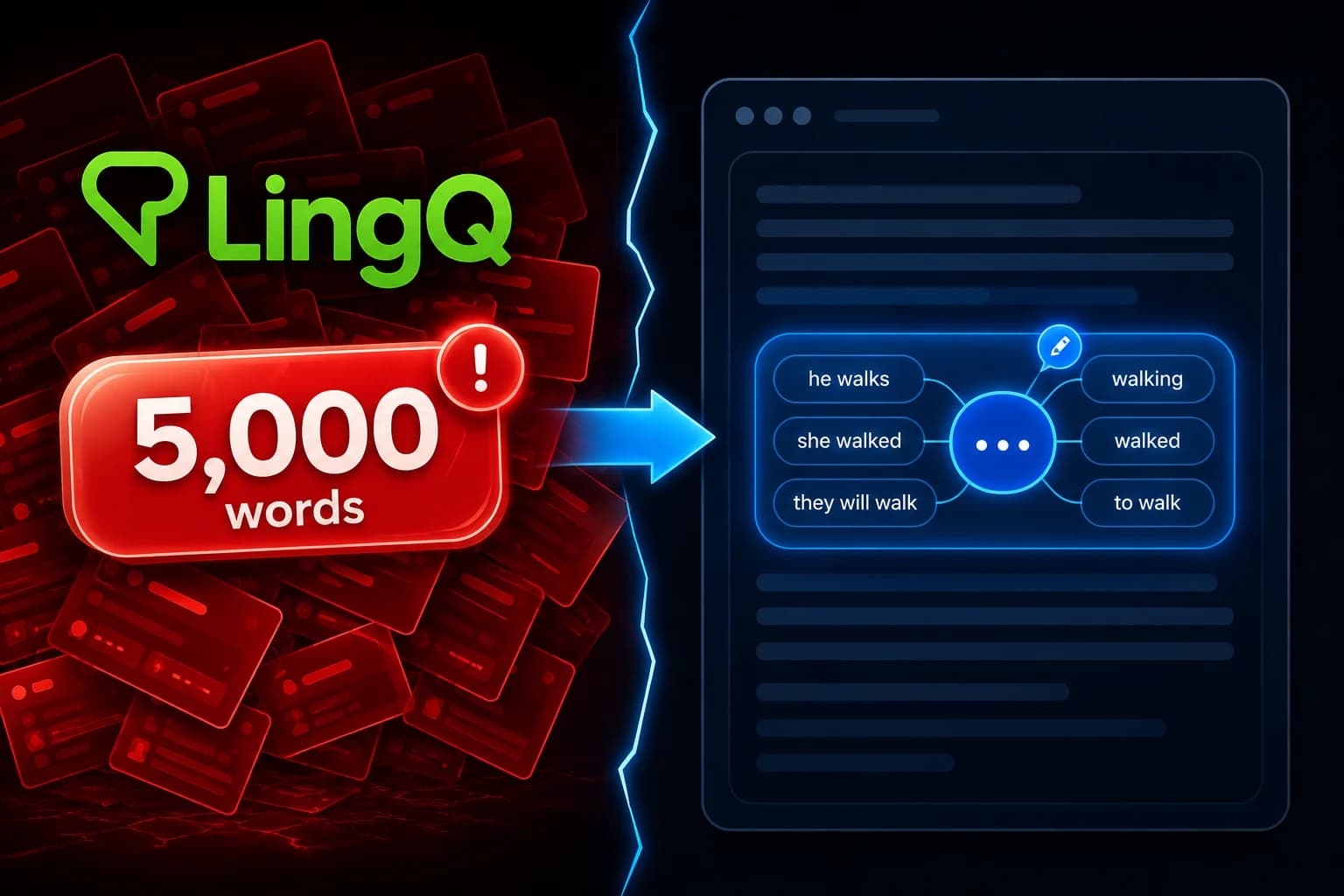
If you have used LingQ for reading practice in inflected languages like Spanish, French, German, Russian, or Korean, you have likely encountered its most persistent design flaw: LingQ treats every single conjugated verb form and declined noun as a completely separate word.
If you learn the Spanish verb hablar, LingQ still flags hablo, hablas, hablamos, hablé, and hablaría as brand-new unknown terms. This artificially inflates your "known word" count, giving you a false sense of progression while charging $13+/month for subscription fees. In this guide, we analyze why this happens and how modern readers use lemmatization to fix it.
The Technical Cause: String Matching vs. Lemmatization
LingQ’s legacy backend relies on naive string matching. It compares exact character strings rather than analyzing morphological roots.
In contrast, modern platforms use NLP Lemmatization. A lemmatizer recognizes that amais, amait, aimeront, and aimé all map back to the lemma aimer (to love).
LingQ vs. Metheus Lemmatized Reading
| Feature | LingQ | Metheus Library |
|---|---|---|
| Verb Conjugations | Tracked as 10-50 separate words | Grouped under 1 Lemma Root |
| Known Word Statistics | Artificially Inflated | Accurate Lexical Count |
| Video Subtitle Support | None (Text/Audio only) | Full Netflix & YouTube Integration |
| Monthly Cost | ~$13/month | 100% Free & Open Source |
| Custom EPUB Import | Requires Paid Plan | Free Unlimited Import |

Learn Languages with YouTube
Watch videos in your target language, auto-capture words into flashcards, and track your progress — all in one place.
Start Free →How Lemmatized Reading Accelerates Fluency
1. Eliminates Redundant Card Reviews
Instead of reviewing 12 flashcards for different tense variations of the same high-frequency verb, you master the core lemma once and let natural reading exposure handle morphological patterns.
2. Accurate Reading Difficulty Assessment
When you import an eBook or article into the Metheus Library, the reader highlights words based on your true lexical knowledge. If you know the root verb, variations won't clutter your screen with false unknown highlights.
3. Real Progress Tracking
Tracking 3,000 true lemmas represents real B1-B2 functional vocabulary, whereas 3,000 string-matched forms on LingQ might only equal 600 actual base concepts.
Try Lemmatized Reading Free on Metheus
Upgrade your reading workflow without overpaying. Metheus offers assisted reading, custom eBook imports, smart level highlighting, and video subtitle controls in one free platform.
FAQ
What is lemmatization in language learning?
Lemmatization is the process of grouping inflected forms of a word (like conjugated verbs or plural nouns) under their base dictionary lemma so they are tracked as a single concept.
Is Metheus a free alternative to LingQ?
Yes. Metheus provides assisted reading, text highlighting, dictionary lookups, and SRS flashcards for free without word limits or subscriptions.
Related phrases
Language learning in 2026 isn't about finishing daily streaks. The fastest path to fluency combines three elements: comprehensible input from real media you enjoy, active vocabulary capture while consuming that content, and spaced repetition to lock words into long-term memory. Gamified apps build the habit. Immersion tools build the fluency. The most effective learners use both—in that order.
Start with Metheus
Watch videos in your target language, auto-capture words into flashcards, and track your progress — all in one place.
Get Started Free →