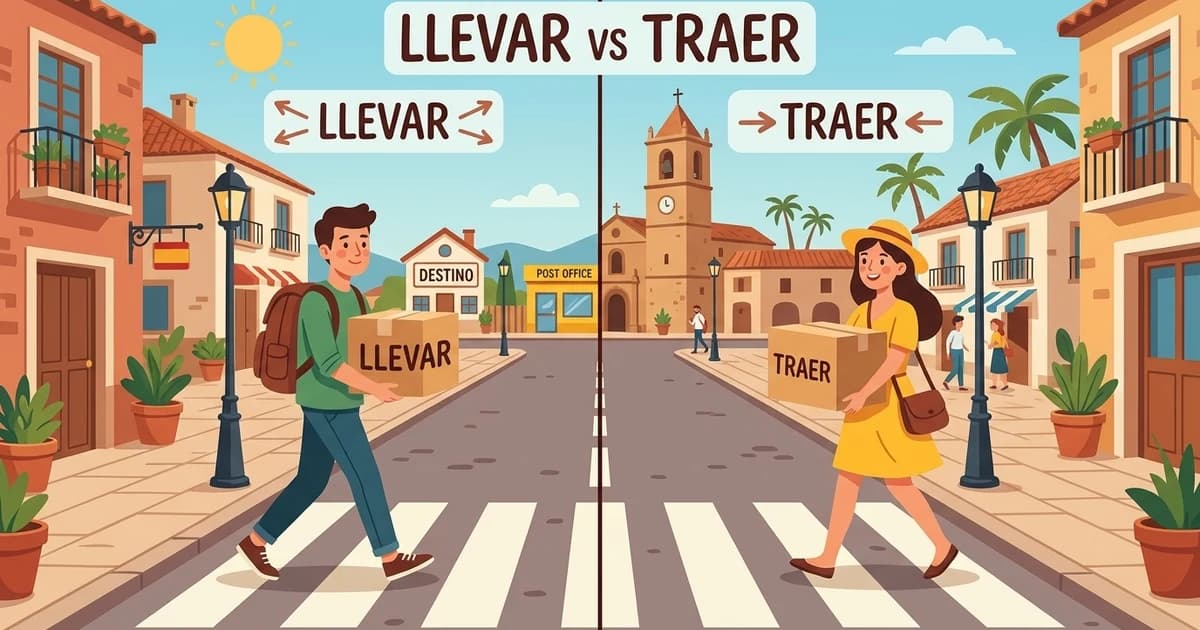
Textbooks teach that llevar means 'to take' and traer means 'to bring,' then move on. Real Spanish laughs at that simplification. These two verbs carry dozens of meanings: duration, movement, carrying, wearing, running an activity, or getting along with someone. Mastering llevar vs traer is less about memorizing translations and more about reading the structure around them. This guide breaks down the direction rule, the idioms, the time expressions, and the context clues that tell you which meaning is in play.
The Direction Rule: Llevar Moves Away, Traer Moves Toward
The core distinction is deictic: it depends on where the speaker is. Llevar moves something away from the speaker's location (or toward the place where the speaker is not). Traer moves something toward the speaker or the person they are addressing.
-
'Te llevo al aeropuerto.' (I take you away from here to the airport.)
-
'Te traigo un café.' (I bring coffee toward you / here.)
The rule of thumb: if you are going somewhere, you carry with llevar; if you are arriving somewhere, you carry with traer. This is why 'Can you bring me to the airport?' translated literally becomes '¿Me traés al aeropuerto?', which sounds odd in Spanish: the speaker is at home and the movement is away, so the natural version is '¿Me llevás al aeropuerto?'.
Llevar for Time and Duration
Beyond direction, llevar is the workhorse of time expressions. With a period of time, it means 'to have been doing something':
-
'Llevo tres años estudiando español.' (I have been studying Spanish for three years.)
-
'Llevan dos horas esperando.' (They have been waiting for two hours.)
It also expresses physical states: 'Llevo puesta una campera' (I am wearing a jacket) and 'llevar las de ganar' (to be winning). None of these are translatable as 'to take.'
More Everyday Senses of Llevar
The verb keeps expanding beyond direction and time. It is the verb for conducting or managing an activity: 'llevar la cuenta' (to keep the bill or the tally), 'llevar la casa' (to run the household), 'llevar las riendas' (to hold the reins). It also describes how well a task is going: 'llevo la mitad del libro' means 'I am halfway through the book,' and '¿cómo llevás el proyecto?' asks how a project is coming along. You will hear these constantly in everyday speech, far more often than the textbook 'take.'

Learn Languages with YouTube
Watch videos in your target language, auto-capture words into flashcards, and track your progress — all in one place.
Start Free →Idioms and Fixed Expressions
This is where the two verbs get genuinely rich:
| Expression | Meaning | Example |
|---|---|---|
| Llevar a cabo | To carry out | Llevamos a cabo el proyecto |
| Llevarse bien/mal | To get along (badly) | Se llevan muy bien |
| Llevar la voz cantante | To call the shots | Ella lleva la voz cantante |
| Traer de cabeza | To drive crazy | Esta app me trae de cabeza |
| Traer a colación | To bring up in conversation | Trajo a colación su viaje |
| Traer consigo | To entail | Eso trae consigo riesgos |
Note how the reflexive llevarse changes meaning entirely: 'se llevan bien' is about a relationship, not about transporting anything.
Common Mistakes English Speakers Make
Three errors repeat across learner forums:
-
Direction inversion: using traer when the movement is away from the speaker ('¿Me traés al aeropuerto?').
-
Literal take/bring mapping: assuming llevo always means 'I take' physically, missing 'I have been...' ('Llevo un mes en Buenos Aires').
-
Ignoring the preposition: the same verb changes meaning with 'a cabo,' 'bien,' 'puesto,' or 'de cabeza'. Learners who look up single words instead of whole phrases stay confused forever. As one student put it: 'You have to look up whole phrases rather than individual words, because verbs like llevar change meaning completely with prepositions and context.'
Learn the Verb in the Exact Sentence
The practical takeaway: do not memorize 'llevar = take.' Instead, read real dialogue and identify which meaning the structure selects. When you watch Spanish series, pay attention to the full sentence before translating: the direction of the verb, the preposition, and the reflexive pronoun decide the meaning. Translating word by word fails exactly when it matters most, in idioms like 'me trae de cabeza'.
Summary: Carry These Rules With You
-
Direction first: away from speaker = llevar; toward speaker = traer.
-
Time = llevar: 'Llevo + time + gerund' expresses duration.
-
Prepositions and pronouns change everything: llevarse bien, llevar a cabo, traer de cabeza are new words, not variations.
-
Context is the dictionary: the same verb form means different things in different sentences.
Metheus helps with the last point directly: its Ctrl+D contextual translation analyzes the full sentence and gives you the meaning of llevar or traer for that exact structure, instead of a generic dictionary definition. Check the phrase, keep the context, and let the pattern sink in through repetition.
Start Free with Metheus and unlock every meaning of llevar and traer in real Spanish.
FAQ
What is the difference between llevar and traer?
Llevar moves something away from the speaker's location; traer moves it toward the speaker. With time expressions, llevar also means 'to have been doing something.'
How is llevar used to express time?
Use llevar plus a period of time and a gerund: 'Llevo tres años estudiando español' means 'I have been studying Spanish for three years.'
What does llevarse bien mean?
It means 'to get along.' 'Se llevan muy bien' means 'They get along very well.' The reflexive pronoun completely changes the verb's meaning.
Related phrases
Language learning in 2026 isn't about finishing daily streaks. The fastest path to fluency combines three elements: comprehensible input from real media you enjoy, active vocabulary capture while consuming that content, and spaced repetition to lock words into long-term memory. Gamified apps build the habit. Immersion tools build the fluency. The most effective learners use both—in that order.
Start with Metheus
Watch videos in your target language, auto-capture words into flashcards, and track your progress — all in one place.
Get Started Free →