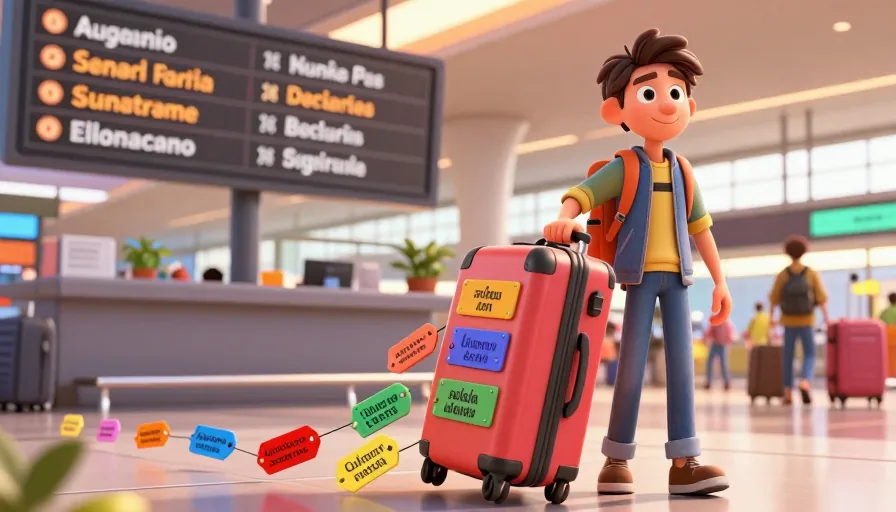
Understanding the Spanish word 'maleta' and its English equivalents is crucial for anyone learning Spanish or planning to travel to Spanish-speaking countries. 'Maleta' translates directly to 'suitcase' or 'luggage' in English, but its usage can vary based on context. This guide will help you navigate the nuances of 'maleta' in English contexts, focusing on travel vocabulary and cultural insights.
What is 'Maleta' in English? (Direct Translations)
The direct translations of 'maleta' are 'suitcase' and 'luggage.' However, the choice between these terms depends on the context. 'Suitcase' is more specific and refers to a single piece of luggage, while 'luggage' is a broader term that can encompass multiple items, including bags, backpacks, and suitcases.
Practical Examples
- Suitcase: 'I packed my suitcase for the trip to Spain.'
- Luggage: 'I checked in my luggage at the airport.'
Using 'Maleta' in Context: Travel Scenarios
In travel scenarios, 'maleta' is often used interchangeably with 'suitcase' or 'luggage.' However, understanding the nuances can help you communicate more effectively.
Checklist for Travel Vocabulary
- At the Airport: Use 'luggage' when referring to all your bags. 'I need to pick up my luggage from the carousel.'
- On the Go: Use 'suitcase' when referring to a single piece of luggage. 'I carried my suitcase through the crowded terminal.'
- In Conversations: Use 'baggage' when discussing the process of handling luggage. 'The airline lost my baggage during the flight.'
Mini Drill: Fill in the Blanks
- I need to find my _______ at the baggage claim.
- My _______ is too heavy to carry.
- The airline lost my _______.
Grammar Spotlight: Understanding 'Maleta' in Spanish Sentences
In Spanish, 'maleta' is a feminine noun, which means it is used with feminine articles and adjectives. Understanding this grammatical context is essential for accurate translation and usage.
Examples in Spanish
- La maleta: 'I packed my suitcase.'
- Una maleta: 'I bought a suitcase.'
- Mi maleta: 'My suitcase is missing.'
Common Mistakes
- Incorrect Article: Avoid using masculine articles with 'maleta.' For example, 'el maleta' is incorrect.
- Plural Form: The plural form of 'maleta' is 'maletas.' For example, 'I have two suitcases.' translates to 'Tengo dos maletas.'

Learn Languages with YouTube
Watch videos in your target language, auto-capture words into flashcards, and track your progress — all in one place.
See How It Works →Travel Vocabulary Integration: 'Maleta' in Conversations
Integrating 'maleta' into travel conversations can enhance your language skills and cultural understanding. Here are some practical examples:
Example Sentences
- At the Hotel: 'I need to store my suitcase in the room.' translates to 'Necesito guardar mi maleta en la habitación.'
- At the Airport: 'I need to check in my luggage.' translates to 'Necesito facturar mi maleta.'
- On the Plane: 'I need to find my suitcase in the overhead bin.' translates to 'Necesito encontrar mi maleta en el compartimento superior.'
Cultural Nuances
In Spanish-speaking countries, airport procedures and luggage handling can vary. For example, in some countries, it's common to tip the baggage handler, while in others, it's not expected. Understanding these nuances can help you navigate travel logistics more smoothly.
Related Vocabulary: Connecting 'Maleta' to Other Travel Terms
Connecting 'maleta' to other travel terms can enrich your vocabulary and communication skills. Here are some related terms:
- Baggage: Refers to all the luggage you carry. 'I need to pick up my baggage from the carousel.'
- Bag: A general term for any type of luggage. 'I packed my bag for the trip.'
- Backpack: A specific type of luggage, often used for hiking or travel. 'I carried my backpack through the crowded streets.'
- Carry-on: A small suitcase or bag that you carry onto the plane. 'I packed my carry-on with essentials.'
Mini Drill: Match the Terms
- I need to find my _______ at the baggage claim.
- I carried my _______ through the crowded streets.
- I packed my _______ with essentials.
Practical Tips for Using 'Maleta' in English Contexts
- Context Matters: Always consider the context when choosing between 'suitcase' and 'luggage.'
- Grammar Accuracy: Ensure you use the correct articles and adjectives with 'maleta.'
- Cultural Awareness: Understand the cultural nuances related to travel logistics in Spanish-speaking countries.
By following these tips and practicing with the examples provided, you'll be able to use 'maleta' effectively in English contexts, enhancing your language skills and travel experiences.
Conclusion
Mastering 'maleta' in English contexts involves understanding its direct translations, contextual usage, grammatical context, and integration into travel vocabulary. By practicing with the examples and tips provided, you'll be well-equipped to navigate travel scenarios and communicate effectively in Spanish-speaking countries.
FAQ
Is 'maleta' always translated as 'suitcase'?
No, 'maleta' can be translated as either 'suitcase' or 'luggage' depending on the context. 'Suitcase' is more specific and refers to a single piece of luggage, while 'luggage' is a broader term that can encompass multiple items.
How do I use 'maleta' in a sentence?
You can use 'maleta' in a sentence by translating it to 'suitcase' or 'luggage' based on the context. For example, 'I packed my suitcase for the trip to Spain.' or 'I need to pick up my luggage from the carousel.'
What is the plural form of 'maleta'?
The plural form of 'maleta' is 'maletas.' For example, 'I have two suitcases.' translates to 'Tengo dos maletas.'
Do I need to use feminine articles with 'maleta'?
Yes, 'maleta' is a feminine noun, so it should be used with feminine articles and adjectives. For example, 'la maleta' (the suitcase) and 'una maleta' (a suitcase).
Related phrases
Start with Metheus
Watch videos in your target language, auto-capture words into flashcards, and track your progress — all in one place.
Get Started →

