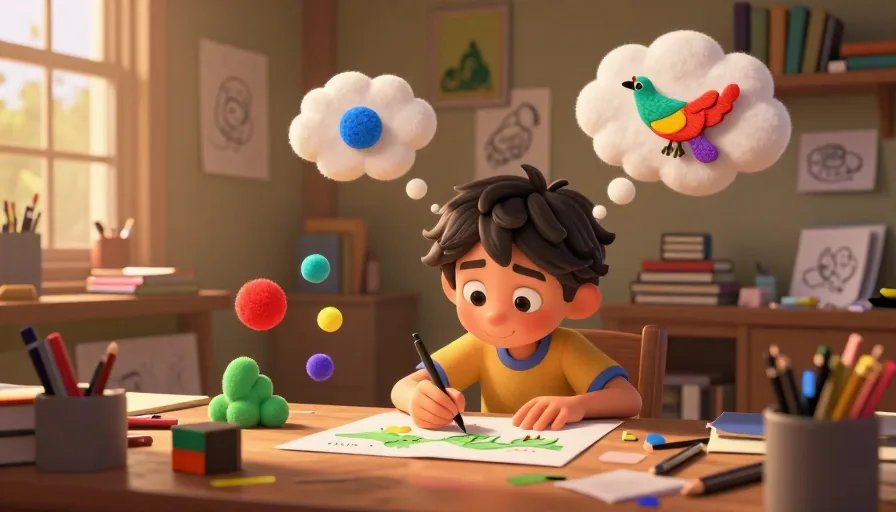
Picturing meaning is a versatile concept in the English language, encompassing both literal and abstract interpretations. Whether you're a language learner or a native speaker looking to refine your vocabulary, understanding the nuances of 'picturing' can significantly enhance your communication skills. This guide will delve into the core definitions, synonyms, antonyms, and practical examples to help you master the term.
What Does 'Picturing' Mean? Core Definitions
As a Verb
When used as a verb, 'picturing' refers to the act of forming a mental image or imagining something. For example:
- I can't picture myself living in a big city.
In this sentence, 'picturing' means to visualize or imagine a scenario.
As a Noun
As a noun, 'picturing' can refer to the process or act of creating a visual representation, often through photography, painting, or other artistic means. For instance:
- The picturing of the event was done beautifully by the photographer.
Here, 'picturing' denotes the act of capturing an event through photographs.
Expanding Your Vocabulary: Synonyms for Picturing
To enrich your vocabulary, it's essential to explore synonyms and antonyms for 'picturing'. Here are some useful alternatives:
Synonyms
- Visualizing: Creating a mental image.
- Imagining: Forming a concept in your mind.
- Envisioning: Seeing something in your mind's eye.
- Depicting: Representing something through art or words.
- Portraying: Showing or describing something in a particular way.
Antonyms
- Misrepresenting: Giving a false or misleading account.
- Distorting: Altering something from its original form.
- Obfuscating: Making something unclear or difficult to understand.
Using 'Picturing' in Context: Real-World Examples
Understanding how to use 'picturing' in different contexts is crucial for effective communication. Here are some examples:
Formal Writing
In formal writing, 'picturing' is often used to describe the process of creating visual representations or mental images. For example:
- The artist's picturing of the landscape was so vivid that viewers felt they were standing in the scene.
Informal Writing
In informal contexts, 'picturing' is commonly used to describe the act of imagining or visualizing something. For example:
- I can't picture myself waking up early tomorrow.
Comparative Analysis: Formal vs. Informal
| Formal Writing | Informal Writing |
|---|---|
| The picturing of the event was meticulously planned. | I can't picture myself doing that. |
| The artist's picturing of the landscape was breathtaking. | Can you picture us on a beach vacation? |

Learn Languages with YouTube
Watch videos in your target language, auto-capture words into flashcards, and track your progress — all in one place.
See How It Works →The Difference Between 'Picturing' and Related Concepts
Picturing vs. Imagining
While both terms involve creating mental images, 'picturing' often implies a more deliberate and detailed process. For example:
- I can picture the scene clearly in my mind. (More detailed and deliberate)
- I imagine a future where technology solves all problems. (More general and abstract)
Picturing vs. Representing
'Picturing' can be a part of 'representing,' but representing is broader and can include other forms of depiction, such as through words or symbols. For example:
- The painting is a beautiful picturing of the landscape.
- The novel represents the struggles of the working class.
Visual Aids to Help Learners Grasp the Concept of 'Picturing'
While we can't include literal images, conceptual visual aids can help learners understand the abstract mental act of 'picturing'. Here are some tips:
Conceptual Visualization
- Mind Maps: Create a mind map with 'picturing' at the center and branches for different contexts (e.g., formal writing, informal writing, mental imagery).
- Flowcharts: Develop a flowchart showing the process of picturing, from forming a mental image to representing it visually.
- Diagrams: Use diagrams to illustrate the difference between 'picturing' and related concepts like 'imagining' and 'representing'.
Mini Drills
- Contextual Drill: Write five sentences using 'picturing' in different contexts (e.g., formal, informal, literary).
- Synonym Drill: Replace 'picturing' with its synonyms in the sentences you wrote and observe the changes in meaning.
- Antonym Drill: Create sentences using antonyms of 'picturing' and compare them with the original sentences.
Checklist for Mastering 'Picturing'
- Understand the core definitions of 'picturing' as a verb and a noun.
- Learn and practice using synonyms and antonyms.
- Write sentences using 'picturing' in various contexts.
- Create conceptual visual aids to reinforce your understanding.
- Compare 'picturing' with related concepts like 'imagining' and 'representing'.
By following this checklist, you'll be well on your way to mastering the term 'picturing' and expanding your vocabulary.
Practical Examples and Common Mistakes
Example 1: Correct Usage
- I can picture the scene from the movie clearly in my mind.
Example 2: Incorrect Usage
- I can picture the scene from the movie clearly in my eyes. (Incorrect because 'picturing' is a mental act, not a physical one.)
Example 3: Contextual Mistake
- The artist's picturing of the landscape was so vivid that viewers felt they were standing in the scene. (Formal context, but the sentence structure is too informal.)
Example 4: Synonym Mistake
- I can imagine the scene from the movie clearly in my mind. (While 'imagining' is a synonym, it lacks the deliberate detail that 'picturing' implies.)
By avoiding these common mistakes, you can use 'picturing' more effectively in your writing and communication.
Conclusion
Understanding and mastering the term 'picturing' can significantly enhance your vocabulary and communication skills. By exploring its definitions, synonyms, antonyms, and practical examples, you'll be able to use 'picturing' with confidence in various contexts. Whether you're a language learner or a native speaker, this guide provides the tools and insights you need to expand your vocabulary and improve your language skills.
FAQ
Is 'picturing' always about visual imagery?
While 'picturing' often involves visual imagery, it can also refer to the act of forming a mental concept or idea, which may not necessarily be visual. For example, you can picture a complex mathematical problem in your mind without visualizing it.
Can 'picturing' be used in formal writing?
Yes, 'picturing' can be used in formal writing, especially when describing the process of creating visual representations or mental images. For example, 'The artist's picturing of the landscape was so vivid that viewers felt they were standing in the scene.'
What is the difference between 'picturing' and 'imagining'?
While both terms involve creating mental images, 'picturing' often implies a more deliberate and detailed process. 'Imagining' is more general and abstract. For example, 'I can picture the scene clearly in my mind' is more detailed than 'I imagine a future where technology solves all problems.'
Related phrases
Start with Metheus
Watch videos in your target language, auto-capture words into flashcards, and track your progress — all in one place.
Get Started →

