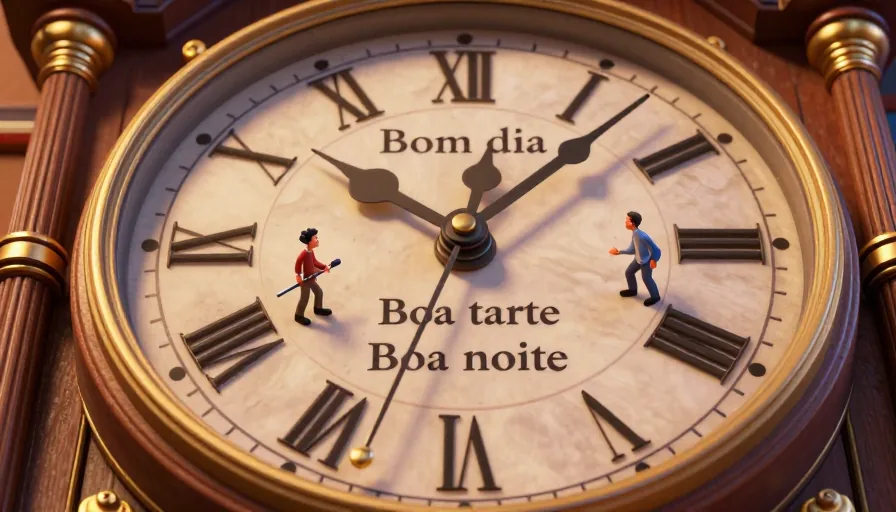
Mastering the art of Portuguese greeting is essential for effective communication in Brazil and Portugal. This guide will help you understand the nuances of Portuguese greetings, including formal vs. informal greetings, time-based greetings, and essential phrases for daily interactions.
Choosing the Right Greeting: Formal vs. Informal
Understanding when to use formal vs. informal Portuguese greetings is crucial. Formal greetings are used in professional settings, with elders, or when addressing someone you've just met. Informal greetings are reserved for friends, family, and close acquaintances.
Formal Greetings
- Olá (Oh-lah) - A versatile greeting that can be used in both formal and informal settings.
- Bom dia (Bohn dee-ah) - Good morning (formal)
- Boa tarde (Bohn tahr-deh) - Good afternoon (formal)
- Boa noite (Bohn noh-chee) - Good evening/night (formal)
Informal Greetings
- E aí? (Eh eye) - What's up? (informal)
- Tudo bem? (Too-doh behm) - How are you? (informal)
- Oi (Oy) - Hi (informal)
Comparison Chart
| Formal | Informal |
|---|---|
| Olá | Oi |
| Bom dia | E aí? |
| Boa tarde | Tudo bem? |
| Boa noite |
Greetings by Time of Day in Portuguese
Portuguese greetings vary based on the time of day. Here's a guide to help you choose the right greeting.
Morning Greetings
- Bom dia (Bohn dee-ah) - Good morning (formal/informal)
- Bom dia, tudo bem? (Bohn dee-ah, too-doh behm) - Good morning, how are you?
Afternoon Greetings
- Boa tarde (Bohn tahr-deh) - Good afternoon (formal/informal)
- Boa tarde, tudo bem? (Bohn tahr-deh, too-doh behm) - Good afternoon, how are you?
Evening/Night Greetings
- Boa noite (Bohn noh-chee) - Good evening/night (formal/informal)
- Boa noite, até amanhã (Bohn noh-chee, ah-teh ah-mahn-yah) - Good night, see you tomorrow

Learn Languages with YouTube
Watch videos in your target language, auto-capture words into flashcards, and track your progress — all in one place.
See How It Works →Essential Phrases for Daily Interactions
Saying Hello
- Olá (Oh-lah) - Hello
- Oi (Oy) - Hi
- E aí? (Eh eye) - What's up?
Saying Goodbye
- Tchau (Chow) - Bye
- Adeus (Ah-deh-oo) - Goodbye (formal)
- Até mais (Ah-teh mah-eesh) - See you later
- Até amanhã (Ah-teh ah-mahn-yah) - See you tomorrow
Asking How Someone Is
- Tudo bem? (Too-doh behm) - How are you? (informal)
- Como vai? (Koh-moh vah-ee) - How are you? (formal)
- Como está? (Koh-moh eh-stah) - How are you? (formal)
Responding to Greetings
- Tudo bem, e você? (Too-doh behm, eh voh-seh) - I'm fine, and you?
- Estou bem, obrigado(a). (Eh-stow behm, oh-bree-gah-doh) - I'm fine, thank you.
Practical Examples and Checklist
Example Conversations
Morning (Informal)
A: Oi, tudo bem? B: Oi, tudo bem, e você? A: Tudo bem, obrigado.
Afternoon (Formal)
A: Boa tarde, como vai? B: Boa tarde, estou bem, obrigado.
Checklist for Mastering Portuguese Greetings
- Learn the basic formal and informal greetings.
- Practice greetings based on the time of day.
- Use the comparison chart to choose the right greeting.
- Engage in mini-drills with a language partner or tutor.
- Listen to native speakers and mimic their pronunciation.
Mini Drills for Practice
- Greeting Drill: Practice greeting someone at different times of the day. Record yourself and compare your pronunciation with native speakers.
- Role-Play: Act out scenarios where you greet someone formally and informally. This will help you understand the context better.
- Listening Practice: Listen to Portuguese podcasts or watch videos to hear native speakers use greetings in context.
Common Mistakes to Avoid
- Using informal greetings with elders or in professional settings: Always use formal greetings in these contexts.
- Not adjusting greetings based on the time of day: Using 'Bom dia' in the evening can be confusing.
- Mispronouncing greetings: Practice pronunciation to avoid misunderstandings.
Conclusion
Mastering Portuguese greetings is a crucial step in learning the language. By understanding the nuances of formal vs. informal greetings and time-based greetings, you'll be well on your way to effective communication in Portuguese.
FAQ
What is the difference between 'Olá' and 'Oi'?
'Olá' is a versatile greeting that can be used in both formal and informal settings, while 'Oi' is more informal and typically used with friends and family.
Can I use 'Bom dia' in the afternoon?
No, 'Bom dia' is specifically for the morning. In the afternoon, you should use 'Boa tarde'.
Is 'Tchau' too informal for professional settings?
Yes, 'Tchau' is quite informal. In professional settings, it's better to use 'Adeus' or 'Até mais'.
Related phrases
Start with Metheus
Watch videos in your target language, auto-capture words into flashcards, and track your progress — all in one place.
Get Started →

