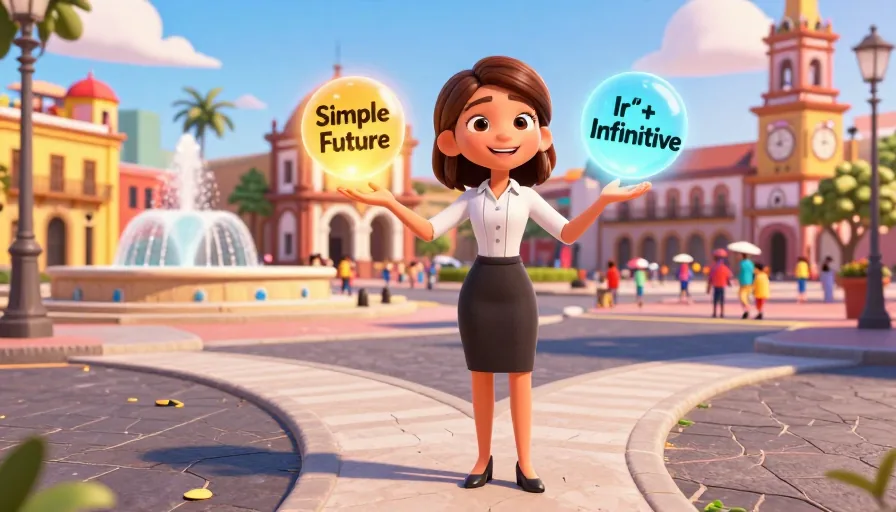
Understanding future endings Spanish is crucial for expressing future events and intentions. Spanish offers two main ways to talk about the future: the Simple Future and the 'Ir' + Infinitive construction. This guide will help you master both, ensuring you use them correctly in natural conversation.
Understanding the Two Futures in Spanish: Simple Future vs. 'Ir' + Infinitive
In Spanish, the future can be expressed in two primary ways: the Simple Future and the 'Ir' + Infinitive construction. Each has its unique structure, usage, and context. Let's dive into the details to understand when and how to use each.
Simple Future vs. 'Ir' + Infinitive: A Quick Comparison
| Simple Future | 'Ir' + Infinitive | |
|---|---|---|
| Structure | Conjugated verb | Ir + a + infinitive |
| Usage | Predictions, commands | Plans, intentions |
| Example | Mañana lloverá. | Mañana voy a estudiar. |
How to Form the Simple Future Tense (Regular and Irregular)
Regular Verbs
For regular verbs, the Simple Future is formed by dropping the infinitive ending (-ar, -er, -ir) and adding the appropriate future ending. Here are the endings:
| -ar | -er | -ir | |
|---|---|---|---|
| yo | -é | -é | -é |
| tú | -ás | -ás | -ás |
| él/ella/usted | -á | -á | -á |
| nosotros/as | -emos | -emos | -emos |
| vosotros/as | -éis | -éis | -éis |
| ellos/ellas/ustedes | -án | -án | -án |
Example:
- Hablar (to speak)
- Yo hablaré.
- Tú hablarás.
- Él/ella/usted hablará.
- Nosotros/as hablaremos.
- Vosotros/as hablaréis.
- Ellos/ellas/ustedes hablarán.
Irregular Verbs
Some verbs have irregular future forms. Here are a few common ones:
- Ser/ir (to be/go): seré, serás, será, seremos, seréis, serán / iré, irás, irá, iremos, iréis, irán
- Tener (to have): tendré, tendrás, tendrá, tendremos, tendréis, tendrán
- Hacer (to do/make): haré, harás, hará, haremos, haréis, harán
- Poder (to be able to): podré, podrás, podrá, podremos, podréis, podrán
- Querer (to want): querré, querrás, querrá, querremos, querréis, querrán
- Decir (to say): diré, dirás, dirá, diremos, diréis, dirán
When to Use the 'Ir' + Infinitive (Talking About Plans)
The 'Ir' + Infinitive construction is used to express plans, intentions, or decisions made at the moment of speaking. It translates to 'going to' in English.
Structure
The structure is simple: ir conjugated in the present tense + a + infinitive verb.
Examples:
- Yo voy a estudiar español mañana. (I am going to study Spanish tomorrow.)
- ¿Vas a comer con nosotros? (Are you going to eat with us?)
- Ella va a viajar a España el próximo mes. (She is going to travel to Spain next month.)
Common Mistakes
- Mistake: *Voy a comeré.
- Correction: Voy a comer.

Learn Languages with YouTube
Watch videos in your target language, auto-capture words into flashcards, and track your progress — all in one place.
See How It Works →When to Use the Simple Future (Predictions and Commands)
The Simple Future is used for predictions, spontaneous decisions, and commands. It translates to 'will' in English.
Predictions
Examples:
- Lloverá mañana. (It will rain tomorrow.)
- **¿Crees que ella ganará el premio? (Do you think she will win the prize?)
- **No sé si vendrá a la fiesta. (I don't know if he will come to the party.)
Spontaneous Decisions
Examples:
- ¡Te ayudaré! (I will help you!)
- **No iré a la fiesta. (I will not go to the party.)
- **¿Me llamarás más tarde? (Will you call me later?)
Commands
Examples:
- ¡Cuidarás del perro mientras estoy fuera. (You will take care of the dog while I am away.)
- **No comerás chocolate antes de la cena. (You will not eat chocolate before dinner.)
Decision Tree: Choosing Between the Two Futures
- If you mean a plan or intention: Use 'Ir' + Infinitive.
- Example: Voy a estudiar. (I am going to study.)
- If you mean a prediction or spontaneous decision: Use the Simple Future.
- Example: Lloverá. (It will rain.)
- If you are giving a command: Use the Simple Future.
- Example: No comerás chocolate. (You will not eat chocolate.)
Practical Examples and Checklist
Conversational Flow
Friend 1: ¿Qué vas a hacer este fin de semana? (What are you going to do this weekend?) Friend 2: Voy a estudiar para el examen de español. (I am going to study for the Spanish exam.) Friend 1: ¡Qué bien! ¿Crees que lloverá? (That's great! Do you think it will rain?) Friend 2: No lo sé, pero si llueve, me quedaré en casa. (I don't know, but if it rains, I will stay home.)
Checklist: When to Use Each Future
- Use 'Ir' + Infinitive for plans and intentions.
- Use the Simple Future for predictions and spontaneous decisions.
- Use the Simple Future for commands.
Mini Drill: Fill in the Blanks
- Yo _ (estudiar) para el examen mañana. (I am going to study for the exam tomorrow.)
- Ella _ (ganar) el premio. (She will win the prize.)
- ¿Vas a _ (comer) con nosotros? (Are you going to eat with us?)
- No sé si _ (llover). (I don't know if it will rain.)
- ¡Te _ (ayudar)! (I will help you!)
Common Mistakes and How to Avoid Them
- Mistake: *Voy a comeré.
- Correction: Voy a comer.
- Mistake: *Ella ganará el premio.
- Correction: Ella va a ganar el premio.
By understanding the differences and practicing with examples, you'll be able to use future endings Spanish correctly and confidently.
Practice Makes Perfect
To solidify your understanding, try the following exercises:
- Write five sentences using the 'Ir' + Infinitive construction to describe your plans for the weekend.
- Write five sentences using the Simple Future to make predictions about the weather.
- Translate the following English sentences into Spanish using the correct future tense:
- I will call you later.
- She is going to travel to Spain next month.
- They will win the game.
- We are going to eat dinner together.
- You will not come to the party.
By mastering these future endings Spanish, you'll be well on your way to expressing future events and intentions like a native speaker.
FAQ
When should I use the Simple Future instead of 'Ir' + Infinitive?
Use the Simple Future for predictions, spontaneous decisions, and commands. For example, 'Lloverá mañana' (It will rain tomorrow) or '¡Te ayudaré!' (I will help you!). Use 'Ir' + Infinitive for plans and intentions, such as 'Voy a estudiar' (I am going to study).
Are there any irregular verbs in the Simple Future tense?
Yes, some verbs have irregular future forms. Common irregular verbs include ser/ir, tener, hacer, poder, querer, and decir. For example, 'ser' becomes 'seré,' 'tendré,' 'haré,' 'podré,' 'querré,' and 'diré' respectively.
Can I use 'Ir' + Infinitive for predictions?
While 'Ir' + Infinitive is primarily used for plans and intentions, it can sometimes be used for predictions, especially when the prediction is based on current evidence or a strong likelihood. However, the Simple Future is generally preferred for predictions about uncertain future events.
Related phrases
Start with Metheus
Watch videos in your target language, auto-capture words into flashcards, and track your progress — all in one place.
Get Started →

