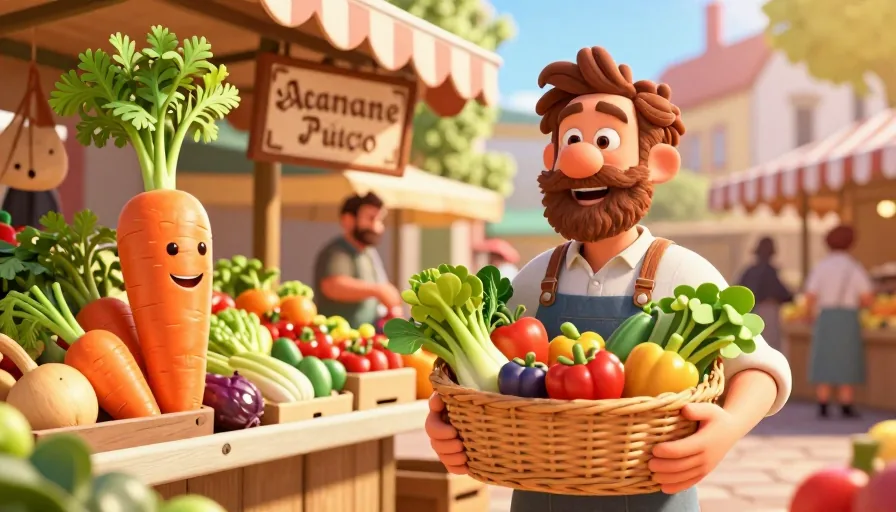
Learning the names of vegetables in German is a practical and delicious way to expand your vocabulary. Whether you're planning a trip to Germany, cooking German recipes, or simply want to impress your friends, this guide will help you master the essential terms for vegetables in German.
Essential German Vocabulary for Vegetables
Start with the basics. Here are some core German translations for common vegetables:
- Kohl (cabbage)
- Tomate (tomato)
- Kartoffel (potato)
- Karotte (carrot)
- Gurke (cucumber)
- Paprika (bell pepper)
- Zwiebel (onion)
- Brokkoli (broccoli)
- Spinat (spinach)
- Erbsen (peas)
Interactive Flashcards
Create flashcards for each vegetable, focusing on the gender and plural forms. For example:
- Die Tomate (feminine, singular)
- Die Tomaten (feminine, plural)
Understanding the Noun: Gemüse vs. Gemüseart
The German word for 'vegetable' is 'Gemüse.' It's a neuter noun, so you'll use 'das' as the definite article. For example:
- Das Gemüse ist frisch. (The vegetable is fresh.)
'Gemüseart' refers to the type or variety of vegetable. For example:
- Welche Gemüseart bevorzugst du? (Which type of vegetable do you prefer?)
Mini Drill: Gender and Plural Forms
Practice the gender and plural forms of the following vegetables:
- Die Karotte
- Der Brokkoli
- Die Gurke
- Die Tomate
- Die Kartoffel

Learn Languages with YouTube
Watch videos in your target language, auto-capture words into flashcards, and track your progress — all in one place.
See How It Works →Putting Vegetables into Context: Sample Sentences
To truly master vegetable in German, you need to see them in context. Here are some sample sentences:
- Ich esse gerne Gemüse. (I like to eat vegetables.)
- Das Gemüse ist frisch. (The vegetable is fresh.)
- Welche Gemüseart bevorzugst du? (Which type of vegetable do you prefer?)
- Ich kaufe Gemüse auf dem Markt. (I buy vegetables at the market.)
- Das Gemüse ist gesund. (Vegetables are healthy.)
Contextual Learning Modules
Create modules that show vegetables in different sentence structures. For example:
- Ich esse Gemüse. (I eat vegetables.)
- Das Gemüse ist grün. (The vegetable is green.)
Gardening Vocabulary: Growing Vegetables in German
If you're interested in gardening, here are some related terms:
- Der Garten (the garden)
- Pflanzen (to plant)
- Gießen (to water)
- Ernten (to harvest)
- Der Kompost (the compost)
Practical Usage: Conversational Contexts
Imagine you're at a German market. Here's how you might use vegetable vocabulary:
- Verkäufer: Was möchten Sie kaufen? (Salesperson: What would you like to buy?)
- Kunde: Ich möchte Gemüse kaufen. (Customer: I would like to buy vegetables.)
- Verkäufer: Welche Gemüseart bevorzugen Sie? (Salesperson: Which type of vegetable do you prefer?)
- Kunde: Ich möchte Tomaten und Karotten. (Customer: I would like tomatoes and carrots.)
Cultural Nuances: Vegetables in German vs. English
In German, vegetables are often discussed in the context of meals and health. For example, 'Das Gemüse ist gesund' (Vegetables are healthy) is a common phrase. In English, we might discuss vegetables in terms of taste or variety. For example, 'I like a variety of vegetables' or 'This vegetable tastes great.'
Common Mistakes to Avoid
- Gender Mistakes: Remember that 'Gemüse' is neuter. Avoid saying 'die Gemüse.'
- Plural Forms: Some vegetables have irregular plural forms. For example, 'die Tomate' becomes 'die Tomaten,' but 'das Brokkoli' becomes 'die Brokkoli.'
- Contextual Errors: Be mindful of the context. 'Gemüse' can refer to a single vegetable or multiple vegetables, depending on the sentence structure.
Pronunciation Guides for Common Vegetable Vocabulary
Pronunciation is key to sounding natural. Here are some guides:
- Kohl: /koːl/
- Tomate: /toˈmaːtə/
- Kartoffel: /karˈtɔfəl/
- Karotte: /kaˈʁɔtə/
- Gurke: /ˈɡʊʁkə/
Checklist for Mastering Vegetable in German
- Learn the core vocabulary for common vegetables.
- Practice the gender and plural forms using flashcards.
- Create sample sentences to understand context.
- Learn related gardening vocabulary.
- Practice pronunciation to sound natural.
- Understand cultural nuances and common mistakes.
By following this guide, you'll be well on your way to mastering vegetable in German. Happy learning!
FAQ
Why is it important to learn the gender of German nouns like 'Gemüse'?
Learning the gender of German nouns is crucial because it affects the articles and adjectives used with them. 'Gemüse' is a neuter noun, so you'll use 'das' as the definite article. For example, 'Das Gemüse ist frisch' (The vegetable is fresh).
How can I practice using vegetable vocabulary in conversational contexts?
Practice using vegetable vocabulary in conversational contexts by creating sample dialogues. For example, imagine you're at a German market and practice asking for and discussing vegetables with a friend or language exchange partner.
What are some common mistakes to avoid when learning vegetable vocabulary in German?
Common mistakes include incorrect gender usage, incorrect plural forms, and contextual errors. For example, remember that 'Gemüse' is neuter, so avoid saying 'die Gemüse.' Also, be mindful of irregular plural forms like 'die Tomaten' and 'die Brokkoli.'
Related phrases
Start with Metheus
Watch videos in your target language, auto-capture words into flashcards, and track your progress — all in one place.
Get Started →

