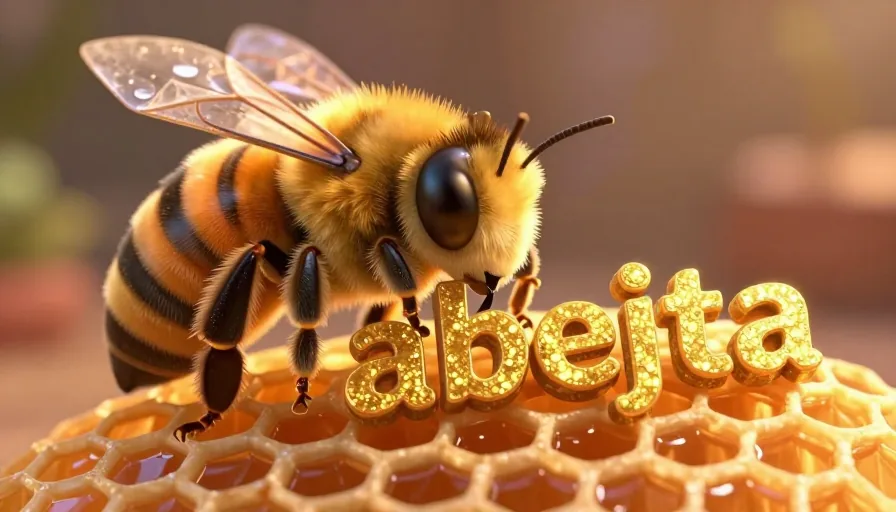
In Spanish, the term abejitas refers to 'little bees.' This diminutive form of 'abejas' (bees) is not only a useful word to know but also a gateway to understanding Spanish grammar and vocabulary. In this guide, we'll explore the meaning, pronunciation, and various uses of 'abejitas,' along with practical examples and interactive exercises to enhance your language learning journey with Metheus.app.
What are 'Abejitas' and How Are They Used?
'Abejitas' is the diminutive form of 'abejas,' which means 'bees' in Spanish. The diminutive form is often used to express endearment, smallness, or affection. For example, you might use 'abejitas' to refer to small bees or to express affection towards bees in a playful context.
Pronunciation Guide
To pronounce 'abejitas' correctly, follow these phonetic guidelines:
- a-be-ji-tas
- a as in 'ah'
- be as in 'be'
- ji as in 'hee'
- tas as in 'tahs'
Listen to the audio pronunciation here.
Mastering Spanish Plurals and Noun Forms
Understanding how to form plurals and use different noun forms is crucial in Spanish. 'Abejitas' is a plural noun, and it follows the typical pattern for feminine nouns ending in '-as.' Here are some key points to remember:
- Singular Form: 'abeja' (bee)
- Plural Form: 'abejas' (bees)
- Diminutive Singular Form: 'abejita' (little bee)
- Diminutive Plural Form: 'abejitas' (little bees)
Checklist for Noun Forms
- Identify the singular and plural forms of common nouns.
- Practice using diminutive forms in sentences.
- Understand the gender of nouns and how it affects the article and adjectives.

Learn Languages with YouTube
Watch videos in your target language, auto-capture words into flashcards, and track your progress — all in one place.
See How It Works →Contextual Examples: Using 'Abejitas' in Conversation
To truly master 'abejitas,' it's essential to see it in context. Here are some examples of how 'abejitas' can be used in everyday conversations:
- Example 1: 'Las abejitas están polinizando las flores.' (The little bees are pollinating the flowers.)
- Example 2: 'Me encantan las abejitas porque son tan trabajadoras.' (I love little bees because they are so hardworking.)
- Example 3: 'Las abejitas son importantes para el ecosistema.' (Little bees are important for the ecosystem.)
Mini Drill: Fill in the Blanks
Complete the following sentences with the correct form of 'abeja' or 'abejitas':
- Las
están volando alrededor de las flores. 2. Una
está construyendo un panal. 3. Las
son esenciales para la agricultura.
Connecting 'Abejitas' to Broader Spanish Vocabulary
Learning 'abejitas' opens the door to a wealth of related vocabulary. Here are some words and phrases that can help you expand your Spanish vocabulary:
- Panal: Honeycomb
- Miel: Honey
- Polinización: Pollination
- Colmena: Beehive
- Abejorro: Bumblebee
Cultural Context
In Spanish-speaking cultures, bees are often associated with hard work and productivity. The phrase 'trabajar como una abeja' (to work like a bee) is commonly used to describe someone who is very diligent and industrious.
Enhancing Your Learning with Metheus.app
Metheus.app offers a comprehensive language learning experience that goes beyond simple translations. With our platform, you can:
- Practice conjugations and verb forms.
- Engage in interactive exercises to reinforce your learning.
- Access contextual learning modules that show how 'abejitas' is used in common phrases.
- Join a community of learners and native speakers for real-time practice.
Interactive Exercise: Sentence Building
Create sentences using 'abejitas' and other related vocabulary. Share your sentences with the Metheus.app community for feedback and improvement.
Conclusion
Mastering 'abejitas' is just the beginning of your Spanish language journey. By understanding its meaning, pronunciation, and usage, you can expand your vocabulary and improve your conversational skills. With Metheus.app, you have access to a wealth of resources and interactive exercises to help you achieve fluency.
Start your language learning adventure today and discover the joy of speaking Spanish with confidence.
FAQ
How do I pronounce 'abejitas' correctly?
To pronounce 'abejitas' correctly, follow these phonetic guidelines: **a-be-ji-tas**. Listen to the audio pronunciation [here](INSERT_AUDIO_LINK).
What is the difference between 'abeja' and 'abejitas'?
'Abeja' is the singular form of the word, meaning 'bee,' while 'abejitas' is the diminutive plural form, meaning 'little bees.' The diminutive form is often used to express endearment, smallness, or affection.
How can I practice using 'abejitas' in sentences?
You can practice using 'abejitas' in sentences by creating your own examples and sharing them with the Metheus.app community. Additionally, engage in interactive exercises and contextual learning modules available on the platform.
Related phrases
Start with Metheus
Watch videos in your target language, auto-capture words into flashcards, and track your progress — all in one place.
Get Started →

