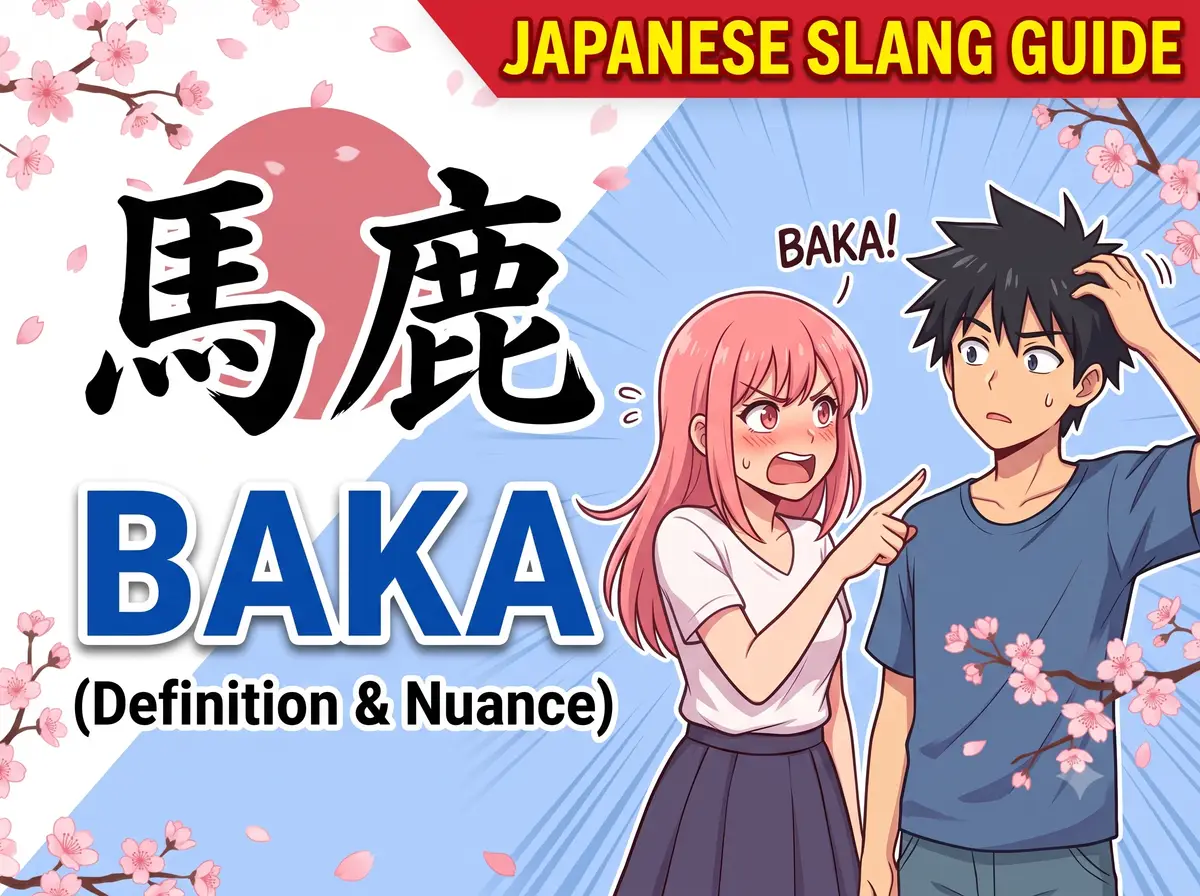
If you have ever watched anime or studied basic Japanese, you have undoubtedly heard the word Baka (ばã‹ / 馬鹿). It is widely known as the Japanese word for 'fool', 'idiot', or 'stupid'. However, depending on the tone, context, and region of Japan, its meaning can range from a harsh insult to an affectionate tease.
In this comprehensive guide, we explore the origins of the word, its various meanings, and how to use it appropriately without causing offense.
The Origins of Baka (馬鹿)
The kanji characters for baka are 馬 (horse) and 鹿 (deer). While the exact etymology is debated, the most popular theory stems from a Chinese historical event during the Qin dynasty. An ambitious court official presented a deer to the emperor but insisted it was a horse. Those who disagreed with him were executed. Thus, 'pointing at a deer and calling it a horse' became synonymous with foolishness, ignorance, or deceit.
Today, baka is written in Hiragana (ばã‹), Katakana (ãƒã‚«), or Kanji (馬鹿).
The Nuances of Baka
The translation of baka is not always a simple insult. Here are its main usages in Japanese culture:
1. The Mild Tease
Between close friends or romantic partners, baka is often used affectionately, similar to saying 'silly' or 'dummy' in English. A soft tone and smiling face change the word from an insult to a sign of intimacy.
2. The True Insult
When spoken with a flat or angry tone, baka means 'idiot' or 'fool'. It is considered rude in polite Japanese society, and you should avoid using it with strangers, coworkers, or superiors.
3. The Prefix for 'Crazy' or 'Excessive'
Baka can also be attached to other words as a prefix (often pronounced baka- or bakarashii) to mean 'ridiculous' or 'excessive'. For example, baka-shoujiki (馬鹿正ç›´) means 'foolishly honest', and baka-mitai (ばã‹みãŸã„) means 'looks ridiculous'.

Learn Languages with YouTube
Watch videos in your target language, auto-capture words into flashcards, and track your progress — all in one place.
Start Free →Regional Differences: Kanto vs. Kansai
The impact of the word changes depending on where you are in Japan:
-
Tokyo (Kanto): Baka is used casually. It can be friendly or lighthearted.
-
Osaka/Kyoto (Kansai): In the Kansai region, Aho (アホ) is the friendly, casual word for silly. In Kansai, calling someone Baka is considered a much sharper, harsher insult. Conversely, in Tokyo, calling someone Aho is considered harsher.
Summary of Usage
Be careful when using Japanese slang. While media makes insults look common, native speakers value politeness. Only use baka with close friends who understand your intention.
Study Japanese Slang with Context
The best way to learn slang nuances is through native content. Start studying Japanese with Metheus for free to look up words in anime and YouTube videos instantly.
FAQ
What is the difference between Baka and Aho?
Baka is more common in Eastern Japan (Kanto/Tokyo) as a light tease, while Aho is the preferred friendly slang in Western Japan (Kansai/Osaka). Using Baka in Osaka is taken much more seriously.
Related phrases
Language learning in 2026 isn't about finishing daily streaks. The fastest path to fluency combines three elements: comprehensible input from real media you enjoy, active vocabulary capture while consuming that content, and spaced repetition to lock words into long-term memory. Gamified apps build the habit. Immersion tools build the fluency. The most effective learners use both—in that order.
Start with Metheus
Watch videos in your target language, auto-capture words into flashcards, and track your progress — all in one place.
Get Started Free →