You are writing an email about a postponed meeting, and suddenly you freeze: canceled or cancelled? Both spellings are correct, both appear in published books, and both will pass your spell checker — depending on which variant of English you have configured. The difference is not about grammar; it is about geography and standardization. In this guide, we explain the rule behind the double L, where each spelling is used, and how to remember it for exams, academic writing, and professional emails.
The Short Answer: One L in the US, Two in the UK
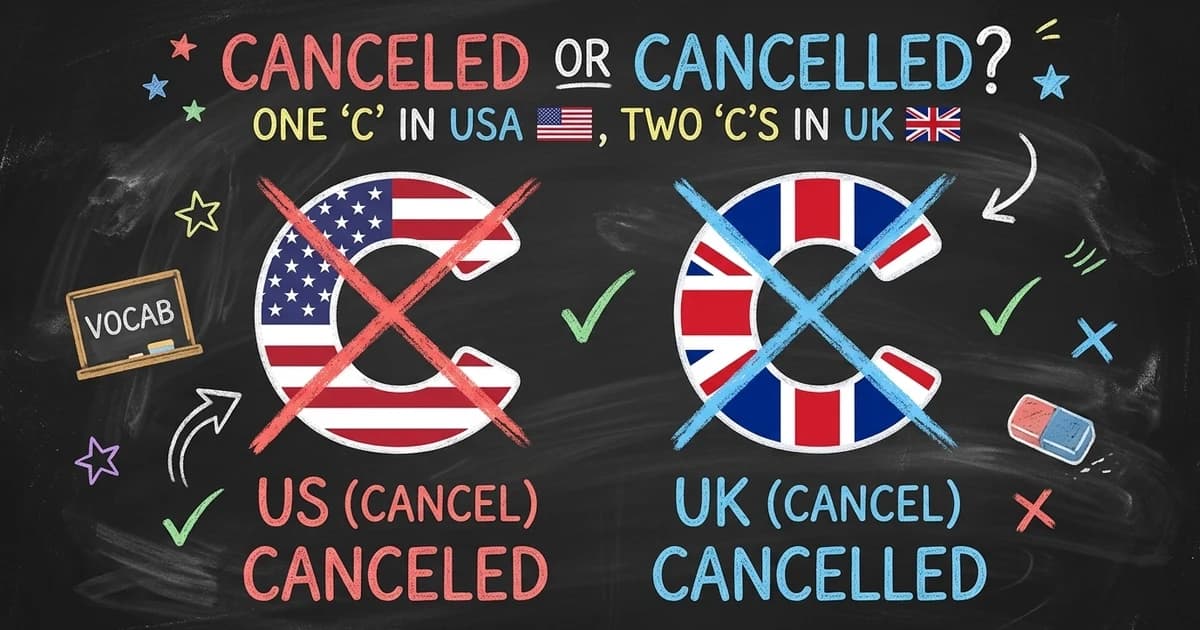
American English prefers canceled, while British English — and most other English-speaking countries, including Australia, New Zealand, Canada, Ireland, and South Africa — prefers cancelled. The same pattern applies to many verbs ending in a single L: traveled vs travelled, modeled vs modelled, labeled vs labelled, fueled vs fuelled, and signaling vs signalling. The choice matters most when you write for a specific audience: a US recruiter, a UK university, or a journal with a stated house style.
American vs British Spelling: The Same Verbs, Two Conventions
| Verb | US English | UK English |
|---|---|---|
| cancel | canceled / canceling | cancelled / cancelling |
| travel | traveled / traveling | travelled / travelling |
| model | modeled / modeling | modelled / modelling |
| label | labeled / labeling | labelled / labelling |
| fuel | fueled / fueling | fuelled / fuelling |
| signal | signaled / signaling | signalled / signalling |
Why Did English End Up With Two Spellings?
The double-L spelling is older. English inherited the pattern of doubling a final consonant before a suffix that begins with a vowel (like -ed or -ing), which is why we write stopped, hugged, and planned. When Noah Webster published his American dictionaries in the early 19th century, he deliberately simplified many spellings to make American English more regular and distinct from British usage. Dropping the second L in cancel and its cousins was part of that project, along with changes like color, center, and the -ize endings. One interesting exception survived the reform: the noun cancellation keeps two Ls in both varieties, so you will write "a cancelled event" in the UK but "a canceled event" in the US — and always "cancellation" either way.

Learn Languages with YouTube
Watch videos in your target language, auto-capture words into flashcards, and track your progress — all in one place.
Start Free →The Real Rule: When Do You Double the Final Consonant?
The confusion around canceled vs cancelled comes from the general English rule for doubling consonants. English doubles a final consonant only when the stress falls on the last syllable, as in occur → occurred and prefer → preferred. Because cancel, travel, and model are stressed on the first syllable, American English skips the doubling. British English makes an exception: verbs ending in L double it regardless of stress. This is exactly the kind of rule learners ask about in forums — a recurring question is: "When do you double the final consonant in English verbs when adding suffixes like -ed or -ing?" The practical answer: for unstressed verbs ending in L, US writes one L and UK writes two; for stressed-final-syllable verbs like occur, both varieties double the consonant.
Which Spelling Should You Use? (And How to Keep Them Straight)
- US audience or TOEFL-style US materials: use canceled.
- UK audience, Cambridge exams, or formal British writing: use cancelled.
- Consistency matters more than the choice: pick one variant for the whole document; mixing them looks careless.
- Configure your editor: set the language of your spell checker to US or UK English so it flags the variant you do not want.
- International contexts: either form is accepted, but matching your reader's convention signals care, especially in academic journals.
Learning Spelling Variants in Real Reading Contexts
Memorizing spelling rules is one thing; recognizing both variants quickly while reading is another. The more English content you read — British news, American novels, academic papers — the more naturally both forms will feel. This is where a reading tool helps: the Metheus Library reader lets you import articles and books and click on any word for an instant contextual translation, so when you come across travelled in a British novel or traveled in an American blog, you can verify the meaning in context without breaking your reading flow. The same awareness applies to other regional pairs, like the acknowledgment vs acknowledgement spelling question we covered in our earlier guide.
Canceled or Cancelled: The Bottom Line
Both spellings are correct. Use canceled with one L for American English and cancelled with two Ls for British English, keep your choice consistent, and remember the stress rule that explains why. The hesitation disappears once you stop trying to memorize an exception and instead learn the pattern: unstressed final L doubles in the UK, but not in the US.
Start Free with Metheus and train your eye on real English texts in both spelling variants.
FAQ
Which is correct: canceled or cancelled?
Both are correct. Canceled is standard in American English, while cancelled is standard in British English and most other English-speaking countries.
When do you double the final consonant in English verbs?
English doubles a final consonant when the stress falls on the last syllable, as in occur → occurred. American English makes an exception for verbs ending in L with stress on the first syllable (cancel → canceled), while British English doubles the L regardless of stress.
Is it canceled or cancelled in Canada?
Canadian English follows British conventions for this pattern, so cancelled is the standard Canadian spelling, alongside other UK-style forms like travelled.
Related phrases
Language learning in 2026 isn't about finishing daily streaks. The fastest path to fluency combines three elements: comprehensible input from real media you enjoy, active vocabulary capture while consuming that content, and spaced repetition to lock words into long-term memory. Gamified apps build the habit. Immersion tools build the fluency. The most effective learners use both—in that order.
Start with Metheus
Watch videos in your target language, auto-capture words into flashcards, and track your progress — all in one place.
Get Started Free →