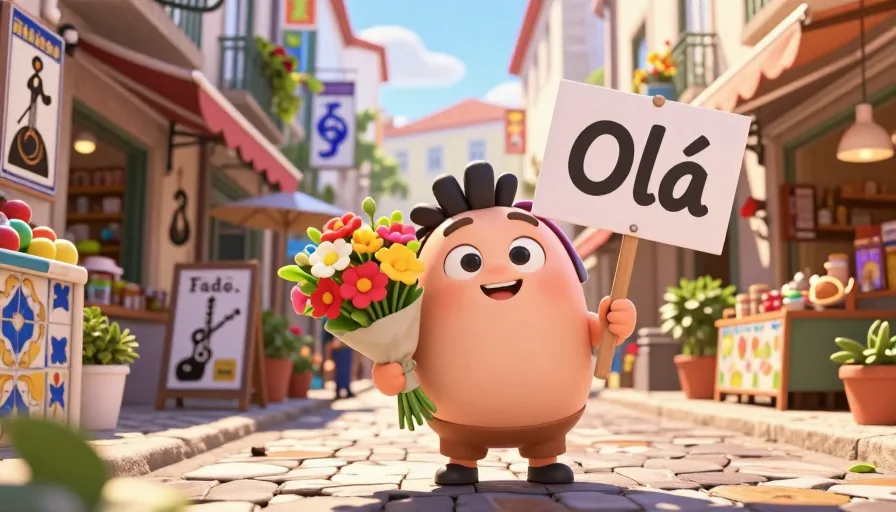
Learning how to say 'hello in Portuguese language' is your first step to mastering this beautiful language. Whether you're traveling to Portugal or Brazil, understanding the nuances of greetings will enhance your communication skills. This guide covers everything from basic greetings to time-based and informal expressions, ensuring you're well-prepared for any social situation.
The Essential Basics: Saying 'Hello' in Portuguese
Starting with the basics, here are the fundamental ways to say 'hello' in Portuguese:
- Olá (oh-lah): This is the most common way to say 'hello' in both European and Brazilian Portuguese. It's informal and can be used in most situations.
- Bom dia (bohn dee-ah): Literally meaning 'good day,' this greeting is used in the morning until around noon.
- Boa tarde (boh-ah tahr-deh): Meaning 'good afternoon,' this is used from noon until late afternoon.
- Boa noite (boh-ah noh-eh-teh): Meaning 'good night,' this greeting is used from late afternoon until bedtime.
Mini Drill: Basic Greetings
Try saying these greetings out loud to get a feel for the pronunciation:
- Olá
- Bom dia
- Boa tarde
- Boa noite
Greetings by Time of Day: Morning, Afternoon, and Night
Portuguese greetings often change based on the time of day. Here’s a breakdown:
Morning Greetings
- Bom dia: As mentioned, this is used from morning until around noon.
- Bom dia, como está? (bohn dee-ah, koh-moh eh-stah): This means 'good morning, how are you?' and is a friendly way to start a conversation.
Afternoon Greetings
- Boa tarde: This is used from noon until late afternoon.
- Boa tarde, tudo bem? (boh-ah tahr-deh, tooh-doh behm): Meaning 'good afternoon, how are you?', this is a casual way to greet someone in the afternoon.
Evening Greetings
- Boa noite: This is used from late afternoon until bedtime.
- Boa noite, até amanhã (boh-ah noh-eh-teh, ah-teh ah-mah-nyah): Meaning 'good night, see you tomorrow,' this is a polite way to end a conversation in the evening.
Understanding the Difference: European vs. Brazilian Portuguese Greetings
While both European Portuguese (EP) and Brazilian Portuguese (BP) share many similarities, there are distinct differences in greetings:
European Portuguese Greetings
- Olá: Informal and commonly used.
- Bom dia: Used in the morning.
- Boa tarde: Used in the afternoon.
- Boa noite: Used in the evening.
Brazilian Portuguese Greetings
- Olá: Informal and commonly used.
- Bom dia: Used in the morning.
- Boa tarde: Used in the afternoon.
- Boa noite: Used in the evening.
Key Differences
- Pronunciation: EP tends to be more formal and has a distinct pronunciation, while BP is more relaxed and has a softer sound.
- Vocabulary: Some words and phrases differ slightly. For example, in EP, you might hear 'como está?' more frequently, while in BP, 'tudo bem?' is more common.
Checklist: Common Mistakes to Avoid
- Mixing Greetings: Avoid using morning greetings in the afternoon or evening.
- Formality: Be mindful of the formality of the situation. Use 'Olá' for informal settings and 'Bom dia/Boa tarde/Boa noite' for more formal ones.
- Pronunciation: Pay attention to the pronunciation differences between EP and BP.

Learn Languages with YouTube
Watch videos in your target language, auto-capture words into flashcards, and track your progress — all in one place.
See How It Works →Beyond Hello: Common Slang and Informal Greetings
In addition to formal greetings, there are several informal and slang expressions you can use:
Informal Greetings
- E aí? (eh ah-ee): Meaning 'what's up?', this is a casual way to greet friends.
- Tudo bem? (tooh-doh behm): Meaning 'how are you?', this is a very common informal greeting.
- Beleza? (beh-leh-zah): Meaning 'all good?', this is a relaxed way to ask how someone is doing.
Slang Greetings
- Fala, mané (fah-lah, mah-neh): Meaning 'speak, man,' this is a very informal and friendly way to greet someone.
- E aí, galera? (eh ah-ee, gah-leh-rah): Meaning 'what's up, crew?', this is a casual way to greet a group of friends.
Mini Drill: Informal Greetings
Try using these informal greetings in different contexts to get comfortable with them:
- E aí?
- Tudo bem?
- Beleza?
- Fala, mané
- E aí, galera?
Practical Examples and Conversations
Example 1: Morning Greeting
Situation: You meet a friend in the morning. Greeting: Bom dia, como está? Response: Bom dia, estou bem, obrigado. E você? Translation: Good morning, how are you? I'm good, thank you. And you?
Example 2: Afternoon Greeting
Situation: You meet a colleague in the afternoon. Greeting: Boa tarde, tudo bem? Response: Boa tarde, tudo bem, e você? Translation: Good afternoon, how are you? I'm good, and you?
Example 3: Evening Greeting
Situation: You meet a friend in the evening. Greeting: Boa noite, até amanhã. Response: Boa noite, até amanhã. Translation: Good night, see you tomorrow. Good night, see you tomorrow.
Example 4: Informal Greeting
Situation: You meet a friend casually. Greeting: E aí, tudo bem? Response: E aí, beleza? Translation: What's up, how are you? All good?
Conclusion
Mastering greetings in Portuguese is the first step to becoming fluent. By understanding the differences between European and Brazilian Portuguese, and knowing when to use formal and informal greetings, you'll be well on your way to effective communication. Practice these greetings regularly, and you'll soon feel confident in any social situation.
FAQ
What is the most common way to say 'hello' in Portuguese?
The most common way to say 'hello' in Portuguese is 'Olá'. It is informal and can be used in most situations.
How do greetings differ between European and Brazilian Portuguese?
While both European and Brazilian Portuguese use similar greetings, the pronunciation and some vocabulary differ. European Portuguese tends to be more formal, while Brazilian Portuguese is more relaxed. For example, 'como está?' is more common in European Portuguese, while 'tudo bem?' is more common in Brazilian Portuguese.
Can I use 'Bom dia' in the afternoon?
No, 'Bom dia' is specifically used in the morning until around noon. For the afternoon, use 'Boa tarde', and for the evening, use 'Boa noite'.
What are some informal greetings in Portuguese?
Some informal greetings in Portuguese include 'E aí?', 'Tudo bem?', 'Beleza?', 'Fala, mané', and 'E aí, galera?'. These are casual and friendly ways to greet friends and acquaintances.
Related phrases
Start with Metheus
Watch videos in your target language, auto-capture words into flashcards, and track your progress — all in one place.
Get Started →

