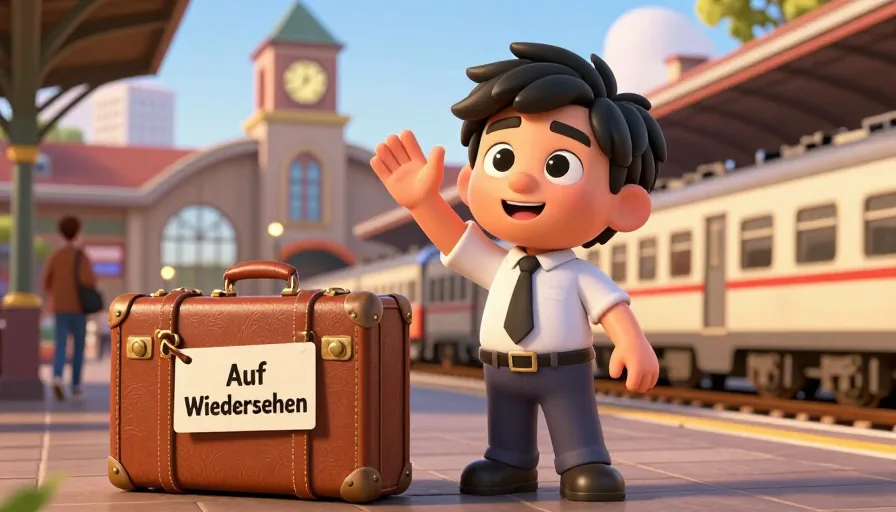
Learning how to say bye in German is an essential part of mastering the language. Whether you're in a casual setting or a formal environment, knowing the right phrases can make a significant difference. This guide will walk you through the most common and formal ways to say goodbye in German, along with contextual variations and pronunciation tips.
The Most Common & Casual Ways to Say Goodbye
In casual settings, Germans use a variety of phrases to say goodbye. Here are some of the most common ones:
Tschüss
Pronunciation: /tʃʏs/
Usage: Tschüss is the most casual way to say goodbye in German. It's similar to saying 'bye' in English and can be used with friends, family, and acquaintances.
Example:
Friend 1: Tschüss, ich muss jetzt gehen. Friend 2: Tschüss, bis später!
Mini Drill: Practice saying Tschüss with different intonations to get a feel for its casual nature.
Ciao
Pronunciation: /tʃaːo/
Usage: Ciao is borrowed from Italian and is used in a similar casual context. It's less common than Tschüss but still widely understood.
Example:
Friend 1: Ciao, ich sehe dich später. Friend 2: Ciao, pass auf dich auf!
Tschau
Pronunciation: /tʃaʊ/
Usage: Tschau is another casual way to say goodbye, often used interchangeably with Tschüss.
Example:
Friend 1: Tschau, ich muss los. Friend 2: Tschau, bis morgen!
Checklist for Casual Farewells
- Use Tschüss, Ciao, or Tschau with friends and family.
- Practice the pronunciation to sound natural.
- Experiment with different intonations to convey casualness.
Formal Farewells for Professional Settings
In professional or formal settings, it's important to use more polite phrases. Here are some key phrases:
Auf Wiedersehen
Pronunciation: /aʊ̯f ˈviːdɐˌzeːən/
Usage: Auf Wiedersehen is a formal way to say goodbye, often used in professional settings or when addressing someone you don't know well.
Example:
Colleague 1: Auf Wiedersehen, Herr Müller. Colleague 2: Auf Wiedersehen, Frau Schmidt. Bis morgen.
Bis bald
Pronunciation: /bɪs ˈbaːlt/
Usage: Bis bald means 'see you soon' and is a polite way to say goodbye when you expect to meet the person again soon.
Example:
Colleague 1: Bis bald, Herr Müller. Colleague 2: Bis bald, Frau Schmidt. Gute Nacht.
Checklist for Formal Farewells
- Use Auf Wiedersehen in professional settings.
- Practice the pronunciation to sound respectful.
- Use Bis bald when you expect to see the person soon.

Learn Languages with YouTube
Watch videos in your target language, auto-capture words into flashcards, and track your progress — all in one place.
See How It Works →Phrases for Saying 'See You Later' and 'See You Soon'
Sometimes, you need more specific phrases to convey when you'll see the person again. Here are some useful phrases:
Bis später
Pronunciation: /bɪs ˈlɛːtɐ/
Usage: Bis später means 'see you later' and is a casual way to say goodbye when you expect to see the person again later in the day.
Example:
Friend 1: Bis später, ich muss jetzt gehen. Friend 2: Bis später, viel Spaß!
Bis morgen
Pronunciation: /bɪs ˈmɔʁɡn̩/
Usage: Bis morgen means 'see you tomorrow' and is a polite way to say goodbye when you expect to see the person the next day.
Example:
Colleague 1: Bis morgen, Herr Müller. Colleague 2: Bis morgen, Frau Schmidt. Gute Nacht.
Bis zum nächsten Mal
Pronunciation: /bɪs t͡sʊm ˈnɛkstn̩ maːl/
Usage: Bis zum nächsten Mal means 'see you next time' and is a formal way to say goodbye when you expect to see the person again at an unspecified future time.
Example:
Colleague 1: Bis zum nächsten Mal, Herr Müller. Colleague 2: Bis zum nächsten Mal, Frau Schmidt. Auf Wiedersehen.
Checklist for Contextual Farewells
- Use Bis später for casual settings when you'll see the person again later in the day.
- Use Bis morgen for polite settings when you'll see the person the next day.
- Use Bis zum nächsten Mal for formal settings when you'll see the person again at an unspecified future time.
Pronunciation Tips for Key Phrases
Pronunciation is key to sounding natural in any language. Here are some tips for pronouncing the key phrases:
- Tschüss: Practice the 'tsch' sound, which is similar to the 'ch' in 'chat.'
- Ciao: Pronounce it like the Italian word, with a long 'a' sound.
- Tschau: Similar to Tschüss, but with a shorter 'au' sound.
- Auf Wiedersehen: Break it down into 'auf' (like 'off'), 'Wieder' (like 'vee-der'), and 'sehen' (like 'zay-en').
- Bis bald: Pronounce 'bis' like 'bees' and 'bald' like 'balt.'
Mini Drill for Pronunciation
- Repeat each phrase slowly, focusing on the individual sounds.
- Record yourself and compare it to native speakers.
- Practice with a language exchange partner to get real-time feedback.
Common Mistakes to Avoid
- Overusing Formal Phrases: Avoid using formal phrases like Auf Wiedersehen in casual settings, as it can sound stiff and unnatural.
- Mispronouncing Key Sounds: Pay special attention to the 'tsch' sound in Tschüss and Tschau, as it's unique to German.
- Not Considering Context: Always consider the context and formality level when choosing a farewell phrase.
Checklist for Avoiding Mistakes
- Practice using casual phrases in casual settings.
- Focus on correct pronunciation, especially for unique sounds.
- Always consider the context and formality level.
Practice Exercises for Mastery
To truly master these phrases, practice is key. Here are some exercises to help you:
Role-Playing Scenarios
- Casual Setting: Imagine you're leaving a friend's house. Practice saying Tschüss, Ciao, or Tschau with different intonations.
- Professional Setting: Imagine you're leaving a meeting. Practice saying Auf Wiedersehen or Bis bald with a formal tone.
- Contextual Setting: Imagine you're leaving a colleague you'll see again soon. Practice saying Bis später or Bis morgen with the appropriate context.
Listening and Repeating
- Find German audio clips or videos where people say these phrases.
- Listen carefully to the pronunciation and intonation.
- Repeat the phrases aloud, trying to mimic the native speakers.
Writing Practice
- Write short dialogues using these phrases in different contexts.
- Have a language exchange partner or tutor check your work.
- Practice writing and speaking the phrases until they feel natural.
By following this comprehensive guide, you'll be able to say goodbye in German with confidence in any situation. Whether you're in a casual setting or a formal environment, you'll have the right phrases at your disposal. Happy learning!
FAQ
Is it okay to use Tschüss in a professional setting?
No, Tschüss is too casual for a professional setting. Stick to formal phrases like Auf Wiedersehen or Bis bald in professional environments.
Can I use Ciao in any casual setting?
While Ciao is casual, it's less common than Tschüss or Tschau. It's best to use it with friends or in informal settings where you know the person well.
How do I know when to use Bis später vs. Bis morgen?
Use Bis später when you expect to see the person again later in the day. Use Bis morgen when you expect to see the person the next day.
Related phrases
Start with Metheus
Watch videos in your target language, auto-capture words into flashcards, and track your progress — all in one place.
Get Started →

