How to Write Happy Birthday in Italian Language: A Comprehensive Guide to Italian Birthday Culture and Greetings
Learning how to write happy birthday in Italian language is more than just translating a phrase; it's about understanding the cultural nuances and traditions that make Italian birthday celebrations unique. This guide will take you beyond the basic 'Buon compleanno' and provide you with the tools to express heartfelt wishes in Italian.
The Essential Italian Birthday Greetings: From Basic to Beautiful
The Most Common Way to Say 'Happy Birthday'
The most common way to say 'Happy Birthday' in Italian is 'Buon compleanno.' This phrase is used in both formal and informal settings and is the go-to greeting for most occasions. Here's how to write and pronounce it:
- Writing: Buon compleanno
- Pronunciation: /bwon kom pleh AH noh/
Alternative Phrases for Special Occasions
While 'Buon compleanno' is the standard, there are other phrases you can use to add variety and personal touch to your birthday wishes. Here are a few alternatives:
-
Tanti auguri: This phrase means 'Many wishes' and is often used interchangeably with 'Buon compleanno.'
- Writing: Tanti auguri
- Pronunciation: /TAHN tee aw GOO ree/
-
Buon anniversario: Literally translating to 'Happy anniversary,' this phrase can be used for birthdays as well, especially for milestones.
- Writing: Buon anniversario
- Pronunciation: /bwon ann ee ver SAH ree oh/
-
Tanti auguri di buon compleanno: A more elaborate way to wish someone a happy birthday, combining 'Many wishes' and 'Happy Birthday.'
- Writing: Tanti auguri di buon compleanno
- Pronunciation: /TAHN tee aw GOO ree dee bwon kom pleh AH noh/
Mastering Pronunciation: How to Say 'Buon Compleanno' Perfectly
Pronunciation is key to sounding natural and respectful. Here's a breakdown of 'Buon compleanno' to help you master it:
-
Buon: /bwon/
- Tip: Pronounce 'buon' as 'bwon,' with the 'u' sound similar to the 'u' in 'fun.'
-
Compleanno: /kom pleh AH noh/
- Tip: Break it down: 'kom' as in 'come,' 'pleh' as in 'play,' 'AH' as in 'ah,' and 'noh' as in 'no.'
Mini Drill: Pronunciation Practice
- Listen to native speakers pronounce 'Buon compleanno.'
- Repeat the phrase aloud, focusing on each syllable.
- Record yourself and compare it to the native pronunciation.
- Practice daily until you feel comfortable.
Italian Birthday Culture: Traditions and Etiquette You Need to Know
Understanding Italian birthday culture can enhance your language learning experience and help you connect with Italian speakers on a deeper level. Here are some key traditions and etiquette tips:
The Art of Gift-Giving
In Italy, gift-giving is an essential part of birthday celebrations. Italians typically bring a small gift, such as flowers, chocolates, or a bottle of wine, to the birthday party. If you're invited to an Italian birthday, consider bringing a gift, even if it's just a small token of appreciation.
The Birthday Cake
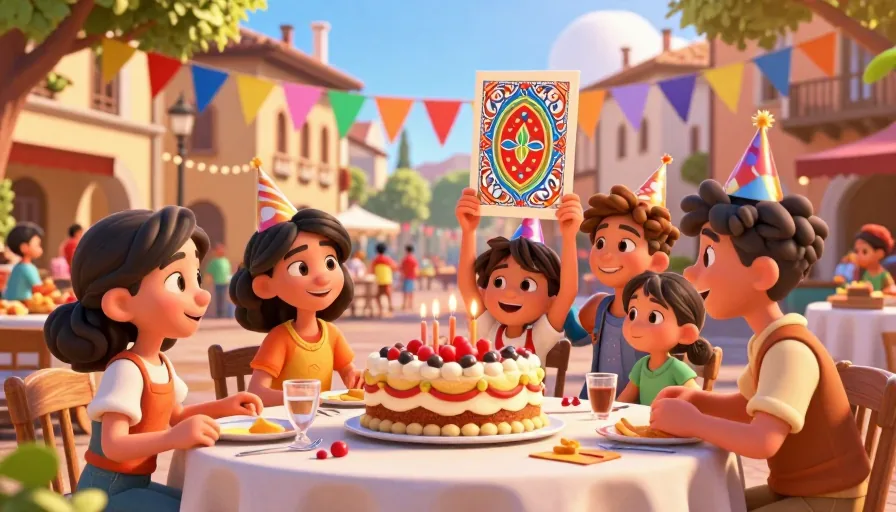
The birthday cake, or 'torta di compleanno,' is a central part of the celebration. Italians often sing 'Tanti auguri a te,' the Italian version of 'Happy Birthday,' before cutting the cake. The birthday person usually makes a wish and blows out the candles before everyone enjoys a slice of cake.
The Birthday Toast
A birthday toast, or 'brindisi,' is a traditional way to wish the birthday person good health and happiness. The toast is usually given by the host or a close friend and is accompanied by a glass of wine or another beverage. If you're the one giving the toast, keep it short, heartfelt, and personal.
Italians Don't Turn Their Age, They Complete It
One unique aspect of Italian birthday culture is the concept of 'completing' an age rather than 'turning' it. For example, instead of saying 'I'm turning 30,' an Italian might say 'I'm completing 30 years.' This subtle difference reflects the Italian perspective on birthdays as a celebration of life and growth.
Checklist: Italian Birthday Etiquette
- Bring a small gift if invited to a birthday party.
- Sing 'Tanti auguri a te' before cutting the cake.
- Make a wish and blow out the candles before enjoying the cake.
- Give a short, heartfelt toast if asked to do so.
- Use the phrase 'completing' instead of 'turning' when referring to age.

Learn Languages with YouTube
Watch videos in your target language, auto-capture words into flashcards, and track your progress — all in one place.
See How It Works →Crafting Heartfelt Messages: Creative Ways to Wish Someone a Happy Birthday
Expressing your wishes in a creative and heartfelt way can make the birthday person feel special. Here are some examples tailored to different relationships:
For Friends
-
Buon compleanno, amico mio! Spero che questo giorno sia pieno di gioia e felicità. Ti auguro un anno fantastico pieno di avventure e sorrisi.
- Translation: Happy Birthday, my friend! I hope this day is full of joy and happiness. I wish you a fantastic year filled with adventures and smiles.
-
Tanti auguri di buon compleanno! Che il tuo giorno speciale sia magico come te.
- Translation: Many wishes for a happy birthday! May your special day be as magical as you are.
For Family
-
Buon compleanno, mamma! Ti voglio bene e spero che questo giorno sia pieno di amore e felicità.
- Translation: Happy Birthday, mom! I love you and hope this day is full of love and happiness.
-
Tanti auguri di buon compleanno, papà! Che il tuo giorno speciale sia pieno di gioia e ricordi preziosi.
- Translation: Many wishes for a happy birthday, dad! May your special day be full of joy and precious memories.
For Romantic Partners
-
Buon compleanno, amore mio! Ti amo più di quanto le parole possano esprimere. Che questo giorno sia pieno di amore e felicità.
- Translation: Happy Birthday, my love! I love you more than words can express. May this day be full of love and happiness.
-
Tanti auguri di buon compleanno, tesoro! Che il tuo giorno speciale sia pieno di magia e momenti indimenticabili.
- Translation: Many wishes for a happy birthday, sweetheart! May your special day be full of magic and unforgettable moments.
For Colleagues
-
Buon compleanno! Spero che questo giorno sia pieno di successo e realizzazioni. Ti auguro un anno fantastico pieno di opportunità e crescita.
- Translation: Happy Birthday! I hope this day is full of success and achievements. I wish you a fantastic year filled with opportunities and growth.
-
Tanti auguri di buon compleanno! Che il tuo giorno speciale sia pieno di gioia e soddisfazioni.
- Translation: Many wishes for a happy birthday! May your special day be full of joy and satisfactions.
Nuances in Usage: When to Use Different Phrases
Understanding the nuances in usage can help you choose the right phrase for the right occasion. Here are some guidelines:
-
Formal vs. Informal: 'Buon compleanno' is suitable for both formal and informal settings, while 'Tanti auguri' is more commonly used in informal settings.
-
Age and Relationship: For close friends and family, you can use more personal and heartfelt phrases. For colleagues or acquaintances, stick to more formal greetings.
-
Cultural Context: Italians value personal connections and emotional expressions. Tailor your message to reflect the unique bond you share with the birthday person.
Conclusion
Learning how to write happy birthday in Italian language is more than just memorizing a phrase; it's about embracing the culture and traditions that make Italian birthday celebrations special. By understanding the nuances in usage, mastering pronunciation, and crafting heartfelt messages, you can express your wishes in a way that resonates with Italian speakers and enriches your language learning journey.
Happy learning, and buon compleanno!
FAQ
Is 'Buon compleanno' the only way to say 'Happy Birthday' in Italian?
No, while 'Buon compleanno' is the most common phrase, there are other ways to express birthday wishes, such as 'Tanti auguri' and 'Buon anniversario.' The choice of phrase can depend on the formality of the occasion and the relationship you have with the birthday person.
Do Italians celebrate birthdays differently from other cultures?
Yes, Italian birthday celebrations have unique traditions, such as the concept of 'completing' an age rather than 'turning' it, and the importance of gift-giving and the birthday toast. Understanding these cultural nuances can enhance your language learning experience and help you connect with Italian speakers on a deeper level.
How can I improve my pronunciation of Italian birthday phrases?
Practice is key to improving your pronunciation. Listen to native speakers, repeat the phrases aloud, and record yourself to compare with native pronunciation. Focus on each syllable and break down the words to master the sounds. Daily practice will help you feel more comfortable and natural.
Related phrases
Start with Metheus
Watch videos in your target language, auto-capture words into flashcards, and track your progress — all in one place.
Get Started →

