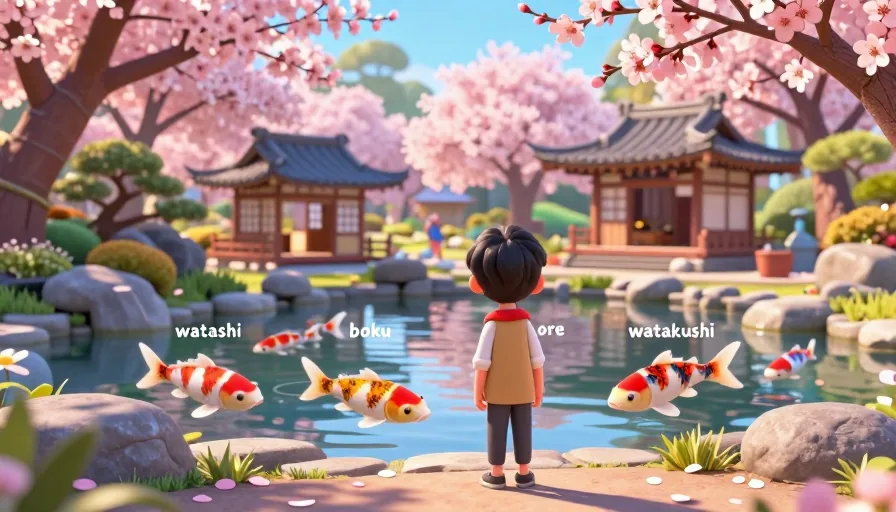
Learning how to say 'I' in Japanese is more than just memorizing vocabulary; it's about understanding the nuances and social implications of different personal pronouns. This guide will help you navigate the intricacies of Japanese personal pronouns, ensuring you use the right term in any situation.
The Standard Way: Watashi (私)
The most common and standard way to say 'I' in Japanese is watashi (私). It is gender-neutral and can be used in both formal and informal contexts. However, it is more commonly used in formal situations or when speaking to someone you respect or don't know well.
Pronunciation Guide:
- Watashi: Pronounced as 'wah-tah-shee'
Example:
- Formal Context: 私は学生です。 (Watashi wa gakusei desu.) - I am a student.
- Informal Context: 私はお腹が空いた。 (Watashi wa onaka ga suita.) - I am hungry.
Casual & Masculine: Boku and Ore
For casual and masculine contexts, boku (僕) and ore (俺) are commonly used. These pronouns are typically used by men when speaking to friends, family, or in informal settings.
Pronunciation Guide:
- Boku: Pronounced as 'boh-ku'
- Ore: Pronounced as 'oh-reh'
Example:
- Boku: 僕は映画が好きだ。 (Boku wa eiga ga suki da.) - I like movies.
- Ore: 俺は疲れている。 (Ore wa tsukarete iru.) - I am tired.
Checklist for Using Boku and Ore:
- Use boku for a more polite and humble tone.
- Use ore for a more assertive and masculine tone.
- Avoid using ore in formal or respectful contexts.
Formal & Humble: Watakushi
Watakushi (私) is a more formal and humble way to say 'I'. It is often used in business settings, formal speeches, or when addressing someone of a higher status. This pronoun conveys a sense of respect and humility.
Pronunciation Guide:
- Watakushi: Pronounced as 'wah-tah-koo-shee'
Example:
- Watakushi: 私はお客様をお迎えします。 (Watakushi wa okyaku-sama o o-mukae shimasu.) - I will welcome the customer.
Mini Drill:
- Practice using watakushi in sentences related to your job or formal introductions.

Learn Languages with YouTube
Watch videos in your target language, auto-capture words into flashcards, and track your progress — all in one place.
See How It Works →Context Matters: Choosing the Right 'I' for Different Situations
Choosing the right personal pronoun depends on the context, the relationship between the speaker and the listener, and the level of formality required. Here are some guidelines to help you choose the appropriate pronoun:
Formal Contexts:
- Use watashi or watakushi when speaking to someone you respect or don't know well.
- Use watashi in professional or business settings.
- Use watakushi in very formal or respectful situations.
Informal Contexts:
- Use boku or ore when speaking to friends, family, or in casual settings.
- Use boku for a more polite and humble tone.
- Use ore for a more assertive and masculine tone.
Mistakes to Avoid:
- Avoid using ore in formal or respectful contexts.
- Avoid using watakushi in casual or informal settings.
Practical Examples and Real-World Usage
To better understand the nuances of these pronouns, let's look at some practical examples and real-world usage scenarios:
Scenario 1: Meeting a New Colleague
- Appropriate Pronoun: Watashi or Watakushi
- Example: 私は新しい同僚です。 (Watashi wa atarashii dōryō desu.) - I am the new colleague.
Scenario 2: Talking to Friends
- Appropriate Pronoun: Boku or Ore
- Example: 俺たちは映画を見に行く。 (Oretachi wa eiga o mi ni iku.) - We are going to see a movie.
Scenario 3: Giving a Formal Speech
- Appropriate Pronoun: Watakushi
- Example: 私はこのプロジェクトのリーダーです。 (Watakushi wa kono purojekuto no rīdā desu.) - I am the leader of this project.
By understanding the nuances and social implications of these pronouns, you can effectively communicate in Japanese and build stronger relationships with native speakers.
Conclusion
Learning how to say 'I' in Japanese involves more than just vocabulary; it requires an understanding of social context and formality. By mastering the different forms of 'I' and knowing when to use each one, you can enhance your communication skills and navigate Japanese social dynamics with confidence.
Checklist for Mastering Japanese Personal Pronouns:
- Understand the nuances and social implications of each pronoun.
- Practice using different pronouns in various contexts.
- Pay attention to the formality and relationship dynamics in conversations.
- Seek feedback from native speakers to improve your usage.
FAQ
Why are there so many ways to say 'I' in Japanese?
Japanese has a complex system of personal pronouns that reflect the speaker's view of themselves and their relationship to the listener. Each pronoun has a different connotation and is used in specific contexts to convey respect, humility, or familiarity.
Can I use 'ore' in formal settings?
No, 'ore' is a very informal and masculine pronoun. Using it in formal settings can be seen as disrespectful or inappropriate. Stick to 'watashi' or 'watakushi' in formal contexts.
Is 'watashi' always the safest choice?
While 'watashi' is a versatile and safe choice, it might come across as too formal or distant in very casual settings. In such cases, using 'boku' can be more appropriate, especially for men.
Related phrases
Start with Metheus
Watch videos in your target language, auto-capture words into flashcards, and track your progress — all in one place.
Get Started →

