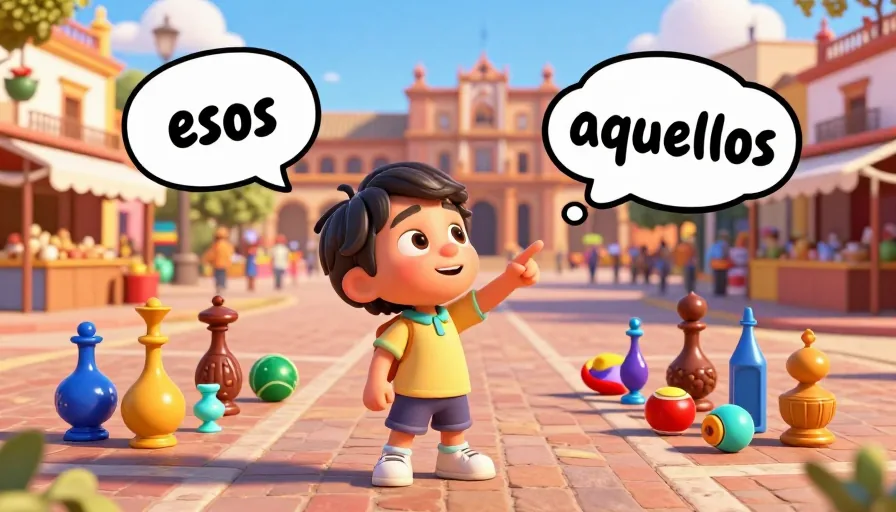
Ever found yourself struggling to translate 'those' into Spanish? You're not alone! It's a common point of confusion for learners. The simple answer is that 'those' can be translated as either esos or aquellos, but choosing the right one depends on context, specifically the perceived distance of the object or people you're referring to. This guide will break down how do you say those in spanish with clarity, providing a comprehensive understanding of these demonstrative adjectives and equipping you with the tools to use them correctly. We'll explore the subtle differences, provide practical examples, and even offer a handy checklist to ensure you're on the right track.
How to Translate 'Those' in Spanish: Choosing Between 'Esos' and 'Aquellos'
Both esos and aquellos are demonstrative adjectives, meaning they point to specific nouns. They both translate to 'those' in English, but their usage is dictated by proximity. Think of it as a spectrum of distance.
- Esos: Refers to things or people that are not immediately nearby, but are still relatively close – within sight or easily accessible. It implies a moderate distance.
- Aquellos: Refers to things or people that are further away – either physically distant or temporally distant (referring to a past event or group). It implies a greater distance.
It's crucial to understand that this isn't a purely physical distance. It can also be a figurative distance, relating to time or relevance.
Understanding Distance: When to Use 'Esos' vs. 'Aquellos'
The key to mastering esos and aquellos lies in understanding the concept of 'distance' in Spanish. Here's a breakdown:
- Physical Distance: If you're pointing at a group of books across the room, you'd use esos. If you're talking about a historical event, you'd use aquellos.
- Temporal Distance: Referring to 'those' people you met last year? Aquellos. Referring to 'those' shoes you bought last week? Esos.
- Perceived Distance: Even if something is physically close, if it feels distant or irrelevant to the conversation, aquellos might be more appropriate.
Gender and Number Agreement: Remember that esos and aquellos must agree in gender and number with the noun they modify.
- Esos libros (those books - masculine plural)
- Esas casas (those houses - feminine plural)
- Ese libro (that book - masculine singular)
- Esa casa (that house - feminine singular)
The same applies to aquellos.
Practical Examples: Putting 'Those' into Spanish Sentences
Let's look at some examples to illustrate the difference:
- Esos zapatos son muy bonitos. (Those shoes are very pretty.) – The shoes are likely within sight or recently purchased.
- ¿Ves esos pájaros en el árbol? (Do you see those birds in the tree?) – The birds are visible and relatively close.
- Aquellos días fueron muy felices. (Those days were very happy.) – Referring to a past time, a temporal distance.
- Aquellos edificios son muy altos. (Those buildings are very tall.) – Referring to buildings far away on the horizon.
- Esos estudiantes son de mi clase. (Those students are from my class.) – The students are likely present or recently encountered.
- Aquellos reyes gobernaron hace mucho tiempo. (Those kings ruled a long time ago.) – Referring to historical figures, a significant temporal distance.
Common Mistakes to Avoid:
- Using aquellos when referring to something immediately nearby. This sounds unnatural.
- Ignoring gender and number agreement. Always ensure the adjective matches the noun.

Learn Languages with YouTube
Watch videos in your target language, auto-capture words into flashcards, and track your progress — all in one place.
See How It Works →Pronunciation Guidance for 'Esos' and 'Aquellos'
- Esos: Pronounced /ˈesos/ (EH-sohs). The 's' is pronounced as a regular 's' sound.
- Aquellos: Pronounced /aˈkɛʎos/ (ah-KEH-yohs). The 'll' is often pronounced as a 'y' sound in many Spanish-speaking regions.
Listen to native speakers pronounce these words to get a feel for the correct intonation and rhythm. Many online resources and language learning apps offer audio recordings.
Related Vocabulary and Grammatical Concepts
Understanding demonstrative adjectives is key to mastering Spanish grammar. Here are some related concepts:
- Este/Esta/Estos/Estas (This/These): The near demonstrative adjectives.
- Ese/Esa/Esos/Esas (That/Those - near): The adjectives we've been focusing on.
- Aquel/Aquella/Aquellos/Aquellas (That/Those - far): The far demonstrative adjectives.
- Noun-Adjective Agreement: Adjectives in Spanish must agree in gender and number with the nouns they modify.
Checklist: Are You Using 'Esos' and 'Aquellos' Correctly?
Before you finalize your Spanish sentence, run through this quick checklist:
- Have I identified the noun I'm describing?
- Is the noun physically or temporally close? If so, esos is likely the correct choice.
- Is the noun further away or referring to a past event? If so, aquellos is likely the correct choice.
- Does the adjective agree in gender and number with the noun?
- Does the sentence sound natural to a native Spanish speaker?
Mini Drill: Choose the Correct Word
Fill in the blanks with esos or aquellos:
- _______ árboles son muy altos. (Those trees are very tall.)
- _______ recuerdos son muy especiales. (Those memories are very special.)
- _______ libros que leíste son interesantes. (Those books you read are interesting.)
- _______ problemas que tuvimos hace años fueron difíciles. (Those problems we had years ago were difficult.)
- _______ estudiantes son muy inteligentes. (Those students are very intelligent.)
(Answers: 1. Aquellos, 2. Esos, 3. Esos, 4. Aquellos, 5. Esos)
By understanding the nuances of esos and aquellos, you can significantly improve your Spanish fluency and accuracy. Practice regularly, pay attention to context, and don't be afraid to ask native speakers for feedback. ¡Buena suerte! (Good luck!)
FAQ
What happens if I use 'aquellos' when something is right next to me?
Using 'aquellos' for something immediately nearby sounds unnatural and grammatically incorrect. It implies a distance that doesn't exist, making your Spanish sound awkward. Stick to 'esos' for things within easy reach or sight.
Is there a simple rule to remember when to use 'esos' versus 'aquellos'?
Think of 'esos' as referring to things you can almost touch or are recently relevant, while 'aquellos' refers to things further away in space or time. If you're unsure, consider the context and the perceived distance from the speaker's perspective.
Do 'esos' and 'aquellos' change when referring to feminine nouns?
Yes! They have feminine and plural forms. 'Esos' becomes 'esas' for feminine nouns, and 'aquellos' becomes 'aquellas'. Always ensure agreement in gender and number.
Related phrases
Start with Metheus
Watch videos in your target language, auto-capture words into flashcards, and track your progress — all in one place.
Get Started →

