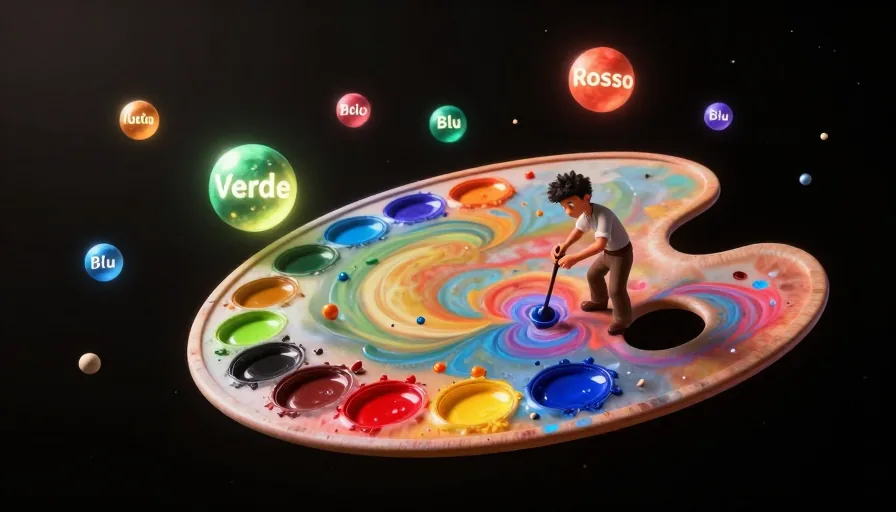
italian words colors: guía práctica y clara para dominar este tema en contexto real.
Mastering Italian Words for Colors: A Comprehensive Guide
Learning Italian words for colors is a fundamental step in mastering the language. Colors are not only essential for describing the world around us but also for understanding cultural nuances and improving communication skills. This guide will cover the essential Italian color vocabulary, grammatical usage, and nuanced pronunciation conventions.
The Essential Italian Color Vocabulary
Here is a list of basic and common Italian colors along with their pronunciations:
| Italian Word | Pronunciation | English Translation |
|---|---|---|
| Rosso | /ˈrɔsso/ | Red |
| Giallo | /ˈdʒallo/ | Yellow |
| Blu | /blu/ | Blue |
| Verde | /ˈverde/ | Green |
| Arancione | /aranˈtʃone/ | Orange |
| Viola | /ˈvjɔla/ | Violet |
| Nero | /ˈnɛro/ | Black |
| Bianco | /ˈbjanko/ | White |
| Marrone | /marˈrone/ | Brown |
| Grigio | /ˈɡriʤo/ | Grey |
| Rosa | /ˈroza/ | Pink |
| Azzurro | /adˈdzurro/ | Azure/ Light Blue |
| Viola | /ˈvjɔla/ | Purple |
| Marrone | /marˈrone/ | Brown |
| Grigio | /ˈɡriʤo/ | Grey |
| Rosa | /ˈroza/ | Pink |
| Azzurro | /adˈdzurro/ | Azure/ Light Blue |
Using Colors as Adjectives vs. Nouns in Italian
In Italian, colors can function as both adjectives and nouns. Understanding when to use each is crucial for accurate communication.
Colors as Adjectives
When describing the color of an object, colors are used as adjectives. They typically come before the noun they modify.
Examples:
- La casa è rossa. (The house is red.)
- Il cielo è azzurro. (The sky is azure.)
Colors as Nouns
When referring to the color itself, colors are used as nouns. In this case, they can be preceded by articles or other determiners.
Examples:
- Mi piace il rosso. (I like red.)
- Il verde è il mio colore preferito. (Green is my favorite color.)

Learn Languages with YouTube
Watch videos in your target language, auto-capture words into flashcards, and track your progress — all in one place.
See How It Works →Mastering Nuances: When to Use Viola, Violetto, or Porpora?
The Italian language has specific terms for different shades of purple, which can be confusing for learners. Here’s a breakdown:
- Viola: This term is used for a deep, rich purple color, similar to violet in English.
- Violetto: This refers to a lighter, more pastel shade of purple.
- Porpora: This is a more formal term for purple, often used in literary or historical contexts.
Examples:
- Il vestito è viola. (The dress is violet.)
- Le tende sono violetto. (The curtains are violet.)
- La regina indossava un abito di porpora. (The queen wore a purple gown.)
Describing Shades: How to Talk About Light and Dark Colors
To describe lighter or darker shades of a color, you can use the adjectives chiaro (light) and scuro (dark).
Examples:
- Il rosso chiaro è più delicato. (The light red is more delicate.)
- Preferisco il blu scuro. (I prefer dark blue.)
Checklist for Describing Colors in Italian
- Learn the basic color vocabulary.
- Practice using colors as adjectives and nouns.
- Understand the nuances between similar color terms (e.g., viola, violetto, porpora).
- Use chiaro and scuro to describe shades.
- Practice describing objects using colors in sentences.
Practical Examples for Describing Objects Using Italian Colors
To reinforce your learning, try describing various objects using Italian colors. Here are some examples:
- La macchina è nera. (The car is black.)
- La maglietta è gialla. (The t-shirt is yellow.)
- Il cielo è azzurro. (The sky is azure.)
- Il gatto è grigio. (The cat is grey.)
- La rosa è rossa. (The rose is red.)
Mini Drill: Describe Your Surroundings
Take a moment to look around your room or environment. Try to describe at least five objects using the Italian words for colors you’ve learned. Write down your descriptions and practice saying them aloud.
Common Mistakes to Avoid
- Mistake: Using the wrong shade term (e.g., using viola instead of violetto for a light purple).
- Solution: Memorize the specific uses of viola, violetto, and porpora.
- Mistake: Forgetting to use the correct article with color nouns.
- Solution: Practice using articles (il, lo, la, i, gli, le) with color nouns.
- Mistake: Confusing adjective and noun forms.
- Solution: Regularly practice sentences with colors as adjectives and nouns.
By following this guide and practicing regularly, you’ll be well on your way to mastering Italian words for colors and using them confidently in conversation.
FAQ
What is the difference between 'viola' and 'violetto' in Italian?
The term 'viola' refers to a deep, rich purple color, similar to violet in English. 'Violetto,' on the other hand, refers to a lighter, more pastel shade of purple. Understanding this distinction will help you describe colors more accurately in Italian.
How do I say 'light blue' and 'dark blue' in Italian?
To describe lighter or darker shades of blue, you can use the adjectives 'chiaro' (light) and 'scuro' (dark). For example, 'blu chiaro' means light blue, and 'blu scuro' means dark blue. This rule applies to other colors as well, such as 'rosso chiaro' for light red and 'rosso scuro' for dark red.
Can colors be used as nouns in Italian?
Yes, colors can be used as nouns in Italian. When referring to the color itself, you can use articles or other determiners. For example, 'Mi piace il rosso' means 'I like red,' and 'Il verde è il mio colore preferito' means 'Green is my favorite color.'
Related phrases
Start with Metheus
Watch videos in your target language, auto-capture words into flashcards, and track your progress — all in one place.
Get Started →

