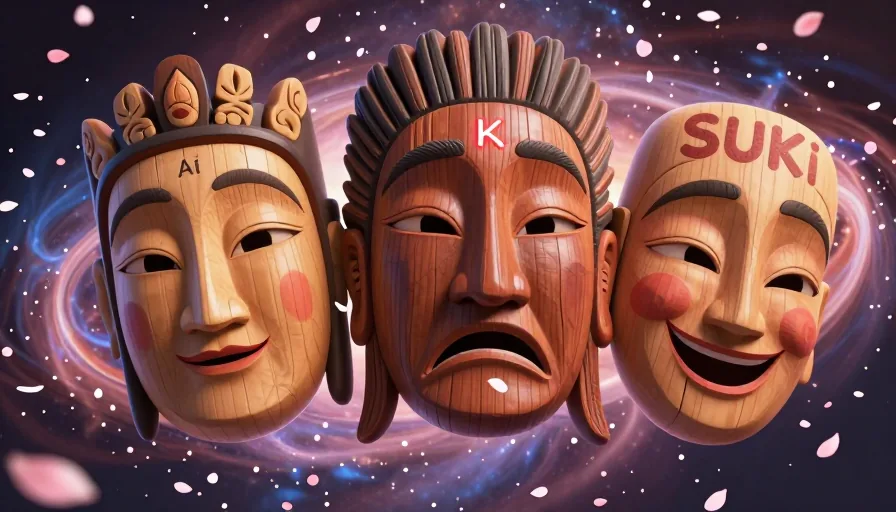
When learning the love Japanese word, it's crucial to understand the nuances between 'Ai', 'Koi', and 'Suki'. These words capture different emotional depths and contexts, making them essential for expressing love authentically in Japanese.
The Spectrum of Japanese Love: From Affection to Deep Love
Japanese culture has a rich vocabulary for expressing love, ranging from casual affection to deep, enduring emotions. Understanding these nuances can help you convey your feelings more accurately. Here's a brief overview:
- Suki (好き): Casual affection or liking something or someone.
- Koi (恋): Falling in love or infatuation.
- Ai (愛): Deep, enduring love.
Decoding 'Koi' vs. 'Ai': Understanding the Nuance
Pronunciation Guides
- Koi (恋): Pronounced as 'koh-ee'.
- Ai (愛): Pronounced as 'ah-ee'.
Emotional Depth
- Koi is often used to describe the initial stages of love, such as infatuation or the excitement of falling in love. It's more about the intense emotions and the thrill of new love.
- Ai, on the other hand, represents a deeper, more mature form of love. It's often used to describe long-term relationships, familial love, or a profound emotional connection.
Interactive Comparison Chart: 'Ai' vs. 'Koi' vs. 'Suki'
| Word | Emotional Depth | Contextual Usage | Example Scenario |
|---|---|---|---|
| Suki | Casual affection | Everyday conversations, liking something | I like sushi. (私はスシが好きです。Watashi wa sushi ga suki desu.) |
| Koi | Falling in love | Initial stages of a relationship | I'm falling in love with him. (彼に恋しています。Kare ni koi shiteimasu.) |
| Ai | Deep, enduring love | Long-term relationships, familial love | I love my family. (私は家族を愛しています。Watashi wa kazoku o aishiteimasu.) |

Learn Languages with YouTube
Watch videos in your target language, auto-capture words into flashcards, and track your progress — all in one place.
See How It Works →Beyond 'I Love You': Mastering 'Suki' in Everyday Conversation
While 'Ai' and 'Koi' are profound expressions of love, 'Suki' is the most commonly used word in everyday conversations. It's versatile and can be used in various contexts, from liking a hobby to expressing affection for someone.
Practical Examples
- Liking a hobby: 私は読書が好きです。(Watashi wa dokusho ga suki desu.) I like reading.
- Expressing affection: 彼が好きです。(Kare ga suki desu.) I like him.
- Casual affection: この映画が好きです。(Kono eiga ga suki desu.) I like this movie.
Mini Drill: Practice Using 'Suki'
- Describe your favorite hobby using 'Suki'.
- Express your affection for a friend or family member.
- Talk about a movie or book you enjoy using 'Suki'.
Contextual Usage: When to Use 'Koi' (Falling in Love) vs. 'Ai' (Deeper, Enduring Love)
Scenario-Based Examples
- Using 'Koi': Imagine you've just met someone and you're feeling the initial spark of attraction. You might say, '彼に恋しています。'(Kare ni koi shiteimasu.) I'm falling in love with him.
- Using 'Ai': If you're in a long-term relationship and want to express your deep love, you might say, '私はあなたを愛しています。'(Watashi wa anata o aishiteimasu.) I love you.
Checklist for Choosing the Right Word
- Initial attraction or infatuation: Use 'Koi'.
- Deep, long-term love: Use 'Ai'.
- Casual affection or liking: Use 'Suki'.
How These Words Fit into Broader Japanese Cultural Expressions of Love
Japanese culture values subtlety and nuance in expressing emotions. The words 'Ai', 'Koi', and 'Suki' are deeply rooted in this cultural context. Understanding their usage can help you navigate social interactions more effectively.
Cultural Context
- Kanji Structure: The kanji for 'Koi' (恋) includes elements that represent 'heart' and 'love', emphasizing the emotional intensity. 'Ai' (愛), on the other hand, includes elements that signify 'love' and 'affection', indicating a deeper, more enduring emotion.
- Cultural Expressions: In Japanese literature and media, 'Koi' is often depicted as a passionate, sometimes tumultuous emotion, while 'Ai' is portrayed as a steady, reliable love.
Common Mistakes to Avoid
- Overusing 'Ai': Using 'Ai' too frequently can make your expressions of love seem insincere or over-the-top.
- Confusing 'Suki' with 'Ai': 'Suki' is more casual and should not be used to express deep love.
- Ignoring Context: Always consider the emotional context and the stage of the relationship when choosing between 'Koi' and 'Ai'.
Conclusion
Understanding the nuances of the love Japanese word—'Ai', 'Koi', and 'Suki'—can greatly enhance your ability to express emotions authentically. By mastering these words and their contextual usage, you'll be able to navigate the rich landscape of Japanese love expressions with confidence.
FAQ
Can 'Suki' be used to express romantic love?
'Suki' is generally used for casual affection or liking something. For romantic love, 'Koi' or 'Ai' would be more appropriate, depending on the depth of your feelings.
Is 'Ai' always used for romantic love?
No, 'Ai' can also be used to express deep affection for family members or friends. It's not exclusively romantic.
How do I know when to use 'Koi' vs. 'Ai'?
Use 'Koi' for the initial stages of falling in love or infatuation. Use 'Ai' for deeper, more enduring love, especially in long-term relationships.
Related phrases
Start with Metheus
Watch videos in your target language, auto-capture words into flashcards, and track your progress — all in one place.
Get Started →

