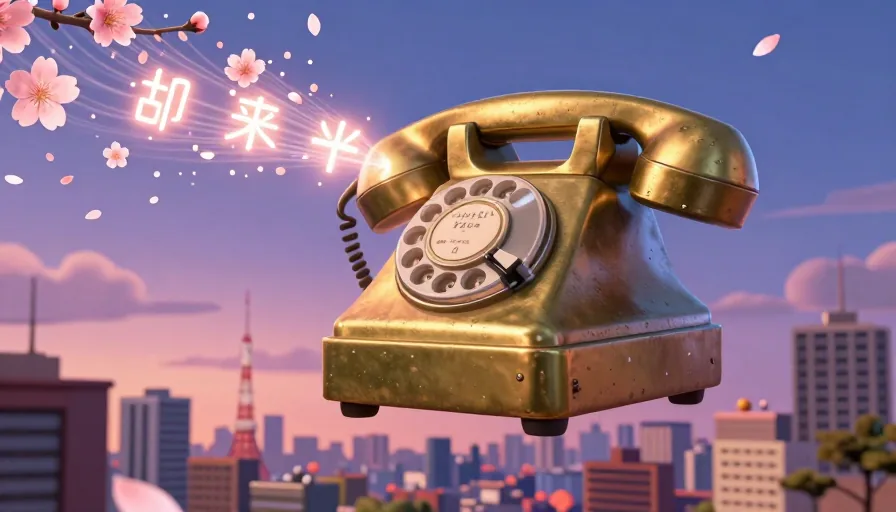
When learning Japanese, you've likely encountered the phrase Japanese moshi moshi. It's a common greeting used when answering the phone, but its meaning and appropriate usage go beyond a simple translation. This guide will delve into the cultural nuances, history, and context-specific alternatives to help you master Japanese phone etiquette.
What Does 'Moshi Moshi' Actually Mean?
The literal translation of 'Moshi Moshi' is 'to speak, to say,' but its actual usage is more nuanced. It's an informal way to say 'hello' on the phone, similar to how English speakers might say 'hey' or 'hi.' However, using 'Moshi Moshi' inappropriately can lead to misunderstandings or even offense, so it's crucial to understand the context.
Mini Drill: Practice the Pronunciation
- Listen to native speakers pronounce 'Moshi Moshi.'
- Repeat the phrase aloud, focusing on the rhythm and intonation.
- Record yourself and compare it to native speakers.
The Cultural Context: When to Use (and When Not to Use) Moshi Moshi
When to Use 'Moshi Moshi'
- Casual settings: Use 'Moshi Moshi' with friends, family, or colleagues you're familiar with.
- Informal conversations: It's suitable for brief, informal calls.
When to Avoid 'Moshi Moshi'
- Formal settings: Avoid using 'Moshi Moshi' in professional or formal contexts, such as business calls or when speaking to someone you've just met.
- Written communication: 'Moshi Moshi' is exclusively for verbal communication. Don't use it in texts or emails.
Common Misconceptions
- Misconception 1: 'Moshi Moshi' is always the correct way to answer the phone.
- Reality: Its usage depends on the context and the relationship between the speakers.
- Misconception 2: 'Moshi Moshi' can be used in written communication.
- Reality: It's strictly for verbal communication.
The History of 'Moshi Moshi'
The origin of 'Moshi Moshi' is unclear, but it's believed to have emerged in the early 20th century with the rise of telephone usage in Japan. The phrase was popularized by its use in Japanese media and has since become a staple in Japanese phone culture.

Learn Languages with YouTube
Watch videos in your target language, auto-capture words into flashcards, and track your progress — all in one place.
See How It Works →Beyond 'Moshi Moshi': Essential Japanese Phone Greetings for Every Situation
Formal Greetings
| Greeting | Usage Context | English Equivalent |
|---|---|---|
| こんにちは (Kon'nichi wa) | Formal, polite greeting | Hello |
| おはようございます (Ohayou gozaimasu) | Morning greeting | Good morning |
| こんばんは (Konban wa) | Evening greeting | Good evening |
| 失礼します (Shitsurei shimasu) | When ending a call | Goodbye |
Informal Greetings
| Greeting | Usage Context | English Equivalent |
|---|---|---|
| よう (Yoh) | Very informal, casual | Hey |
| もしもし (Moshi Moshi) | Informal, casual | Hi |
| おやすみ (Oyasumi) | Informal, goodnight | Goodnight |
Mini Drill: Practice Phone Greetings
- Create a list of contacts and assign each a greeting based on the context.
- Practice answering the phone with the appropriate greeting for each contact.
- Role-play phone conversations with a language partner, focusing on using the correct greetings.
Understanding Japanese Telephone Etiquette
Checklist for Proper Phone Etiquette
- Answer the phone promptly and politely.
- Use the appropriate greeting based on the context and relationship.
- Speak clearly and at a moderate pace.
- Use polite language (Keigo) in formal settings.
- End the call politely, using phrases like 'Shitsurei shimasu' or 'Sayounara.'
Addressing Common Learner Misconceptions
- Misconception: Japanese phone etiquette is overly complicated.
- Reality: While there are nuances, mastering basic greetings and polite language will go a long way.
- Misconception: It's okay to use 'Moshi Moshi' in all situations.
- Reality: Using 'Moshi Moshi' inappropriately can lead to misunderstandings or offense.
Comparison Chart: Japanese Phone Greetings Based on Formality Level
| Formality Level | Greeting | Usage Context | English Equivalent |
|---|---|---|---|
| Very Informal | よう (Yoh) | Friends, family | Hey |
| Informal | もしもし (Moshi Moshi) | Casual calls | Hi |
| Neutral | こんにちは (Kon'nichi wa) | General greeting | Hello |
| Formal | おはようございます (Ohayou gozaimasu) | Morning greeting | Good morning |
| Formal | こんばんは (Konban wa) | Evening greeting | Good evening |
| Formal | 失礼します (Shitsurei shimasu) | Ending a call | Goodbye |
By understanding the nuances of 'Moshi Moshi' and other Japanese phone greetings, you'll be well on your way to mastering Japanese phone etiquette. Practice regularly, and don't be afraid to make mistakes. With time and dedication, you'll become a pro at navigating Japanese phone conversations.
FAQ
Is it okay to use 'Moshi Moshi' in a business call?
No, 'Moshi Moshi' is too informal for business calls. Use a more formal greeting like 'Kon'nichi wa' or 'Ohayou gozaimasu' instead.
Can I use 'Moshi Moshi' in written communication?
No, 'Moshi Moshi' is strictly for verbal communication. Use appropriate written greetings like 'Kon'nichi wa' or 'Ohayou gozaimasu' instead.
What should I do if I accidentally use 'Moshi Moshi' in a formal setting?
Apologize politely and correct yourself. For example, you can say 'Sumimasen, kon'nichi wa' (Excuse me, hello).
Related phrases
Start with Metheus
Watch videos in your target language, auto-capture words into flashcards, and track your progress — all in one place.
Get Started →

