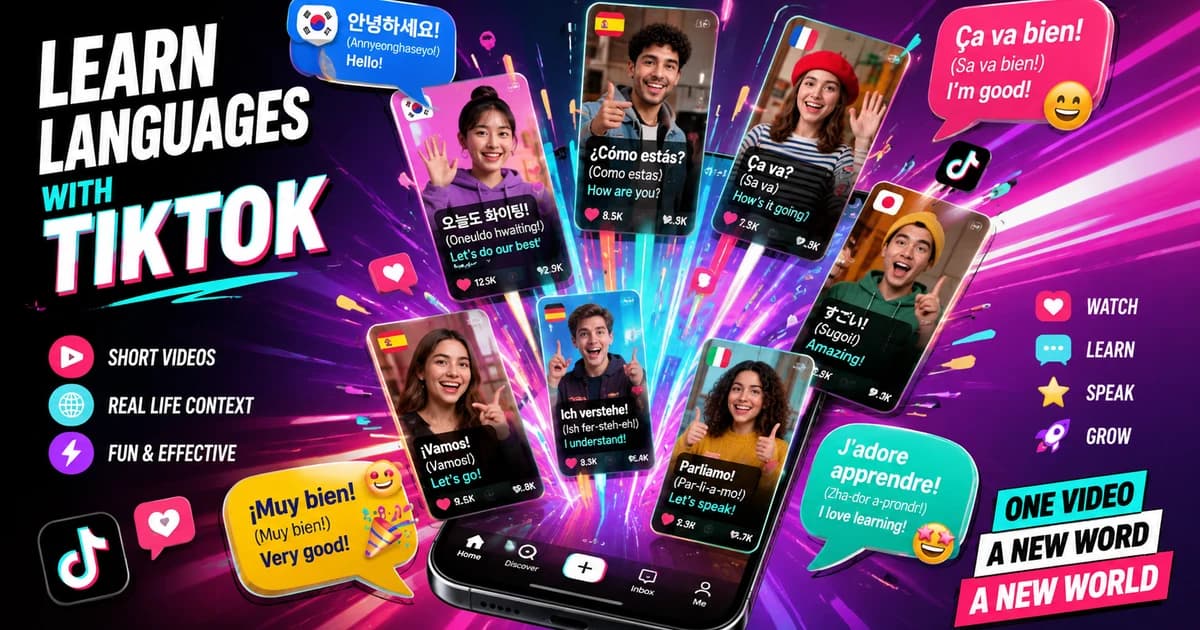
TikTok and Instagram Reels are the most consumed media on the planet, and most language learners treat them as a distraction. That is a waste: short-form video is dense, colloquial, endlessly repeated, and perfectly aligned with how humans acquire language through context. With a few deliberate habits, your feed becomes a daily immersion tool. This guide shows you how to learn languages with TikTok and Reels, how to capture vocabulary without breaking the scroll, and why short-form input deserves a slot in your routine.
Why Short-Form Video Works for Language Acquisition
Short-form content hits several acquisition sweet spots at once:
-
Micro-context. Every 30-second clip is a complete situation: a recipe, a prank, a reaction. Meaning is visible, not abstract.
-
Colloquial register. TikTok runs on slang, interjections, and spoken grammar that textbooks skip.
-
Format repetition. Trending sounds and formats repeat across thousands of videos, which is massive repetition disguised as entertainment.
-
Motivation. As one learner said: 'Using social media posts and short stories makes me feel more engaged and motivated to keep immersing myself.'
The last point matters more than it sounds. Immersion you actually keep doing beats immersion that is theoretically optimal and practically abandoned.
Short-Form vs Long-Form Immersion
| Aspect | Long-form (Netflix, YouTube) | Short-form (TikTok, Reels) |
|---|---|---|
| Slang and colloquial density | Medium | Very high |
| Repetition of core vocabulary | Moderate | High (trending formats) |
| Suitability by level | A2+ | B1+ (fast speech) |
| Fits into idle time | Requires deliberate blocks | Fills scrolling moments |
| Friction of vocabulary capture | Medium | High without tools |
| Sentence context quality | Long narratives | Short, complete situations |
Neither replaces the other. Long-form builds stamina and narrative comprehension; short-form builds speed, register, and cultural fluency.
Train the Algorithm to Teach You
Your For You page is a mirror of your behavior. To turn it into a curriculum:
-
Change the app language to your target language in settings (the interface itself becomes input).
-
Follow creators who teach or speak the language, and like their videos.
-
Watch to the end. Engagement signals are what the algorithm reads; finishing a video is a vote.
-
Use search. Typing a word or phrase in the target language in TikTok search primes the recommendation engine.
After a week of this, a meaningful share of your feed will arrive in the target language without any extra effort.

Learn Languages with YouTube
Watch videos in your target language, auto-capture words into flashcards, and track your progress — all in one place.
Start Free →The Capture Problem: Subtitles Move Fast
Short-form video is great input and terrible note-taking material. Lines fly by in two seconds, and by the time you reach for your phone, the moment is gone. Learners on desktop face the same wall: 'How can I keep learning while I am at work or scrolling on desktop?' The answer is a capture workflow that happens in the scroll, not after it.
Capture Vocabulary Without Breaking the Scroll
If you browse TikTok or Instagram on desktop, the Metheus browser extension turns the scroll into a study session:
-
Subtitle translation in place. Press Ctrl+D over any on-screen text to get the exact meaning for that moment.
-
One-click capture. Save the phrase, its translation, and the source context without leaving the page.
-
No pausing required. The video keeps playing while the card is created.
Five captures a day is a sustainable harvest from even the fastest feed. Add them to your review queue and they become permanent vocabulary instead of a flash of recognition.
A 15-Minute Daily Short-Form Routine
Make short-form immersion a deliberate block:
-
10 minutes of scrolling in the target language (with the algorithm already trained).
-
Capture 3 to 5 phrases that you would actually use, not rare slang.
-
2 minutes of review of yesterday's captures before you close the tab.
Keep the queue small. If you want the full system for managing captures without drowning in reviews, our guide on fixing Anki overload covers the queue side of this workflow.
What to Capture (and What to Let Go)
Not every phrase deserves a card. Good captures are expressions you can imagine using: filler words, reaction phrases, and everyday verbs. Skip niche slang tied to a single trend, inside jokes, and sentences whose grammar you cannot parse yet; they will be there when you come back. A useful filter is the replacement test: would you use this phrase in a conversation this week? If the answer is not immediate, let the video go and keep scrolling. Selective capture keeps reviews fast and the feed fun, which is the whole point of this method.
Turn Your Feed into a Study Tool with Metheus
Short-form video immersion is free, endless, and already in your pocket. Metheus adds the missing layer: instant subtitle translation and vocabulary capture on the desktop web versions of TikTok and Instagram, so every scroll can quietly build your vocabulary.
Start Free with Metheus and make your next scroll a study session.
FAQ
Can you really learn a language with TikTok?
Yes, as a source of comprehensible input. Short-form video is colloquial, repetitive, and full of cultural context. For systematic study it works best combined with vocabulary capture and review.
What level do I need for TikTok in a new language?
Around B1 you can follow most content. Beginners can still use it with heavy reliance on subtitles and translation tools like Metheus.
How do I save words from TikTok videos?
On desktop, the Metheus extension lets you translate subtitles with Ctrl+D and capture the phrase with one click while the video keeps playing.
Related phrases
Language learning in 2026 isn't about finishing daily streaks. The fastest path to fluency combines three elements: comprehensible input from real media you enjoy, active vocabulary capture while consuming that content, and spaced repetition to lock words into long-term memory. Gamified apps build the habit. Immersion tools build the fluency. The most effective learners use both—in that order.
Start with Metheus
Watch videos in your target language, auto-capture words into flashcards, and track your progress — all in one place.
Get Started Free →