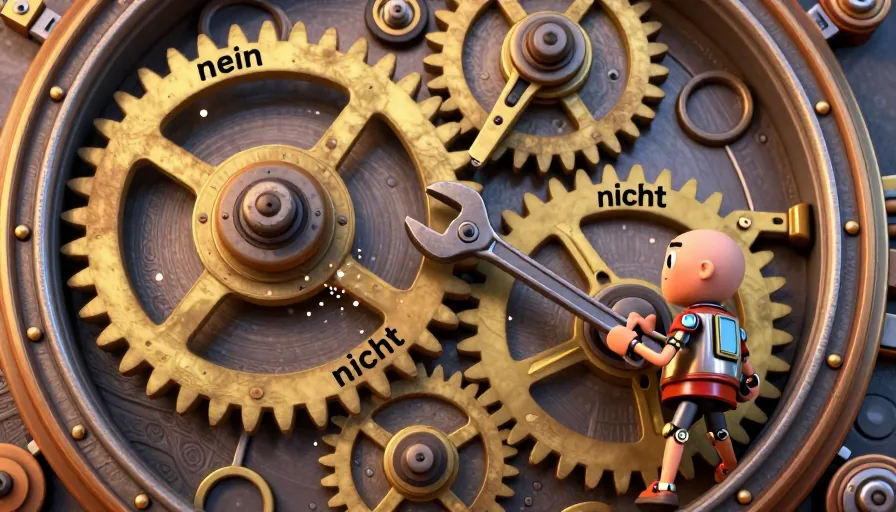
Understanding how to express negation in German is crucial for fluent communication. While 'nein' is the most basic way to say 'no' in English, German offers a rich spectrum of negation words and phrases that go beyond simple translations. This guide will help you master 'nein in English', 'nicht', 'kein', and casual alternatives to sound natural and fluent.
Nein vs. Nicht vs. Kein: The Essential Guide to German Negation
The Basic Meaning and Usage of 'Nein'
'Nein' is the most straightforward way to say 'no' in German. It is used to reject an offer, disagree with a statement, or decline an invitation. For example:
-
Offer: Möchtest du ein Stück Kuchen? (Would you like a piece of cake?)
- Response: Nein, danke. (No, thank you.)
-
Statement: Du kommst heute Abend. (You are coming tonight.)
- Response: Nein, ich komme morgen. (No, I am coming tomorrow.)
The Crucial Difference Between 'Nein', 'Nicht', and 'Kein'
While 'nein' is used for simple negations, 'nicht' and 'kein' serve different purposes in German grammar.
-
Nicht: Used to negate verbs, adjectives, and adverbs. It is placed directly before the word it negates.
- Example: Ich nicht mag Kaffee. (I do not like coffee.)
-
Kein: Used to negate nouns. It is placed directly before the noun it negates.
- Example: Ich habe kein Geld. (I have no money.)
Contextual Usage Examples for Each Form
To truly master these negation words, it's essential to see them in context. Here are some practical examples:
-
Nein:
- Context: You are asked if you want to go to the park.
- Response: Nein, ich möchte lieber zu Hause bleiben. (No, I would rather stay at home.)
-
Nicht:
- Context: You are asked if you like spicy food.
- Response: Ich mag nicht scharfes Essen. (I do not like spicy food.)
-
Kein:
- Context: You are asked if you have any siblings.
- Response: Ich habe keine Geschwister. (I have no siblings.)

Learn Languages with YouTube
Watch videos in your target language, auto-capture words into flashcards, and track your progress — all in one place.
See How It Works →Explanation of How Negation Works in German
German negation follows a specific structure that can be challenging for English speakers. Here are some key points to remember:
- Negation with 'Nein': Always stands alone and is used to negate entire sentences or responses.
- Negation with 'Nicht': Always placed directly before the word it negates (verb, adjective, or adverb).
- Negation with 'Kein': Always placed directly before the noun it negates.
- Double Negation: German allows for double negation, where two negative words are used in a sentence. This is grammatically correct but can be confusing for learners.
- Example: Ich habe kein Geld nicht. (I have no money not.)
Comprehensive Comparison Chart of All Primary Ways to Say 'No'
| Negation Word | Usage | Example | English Translation |
|---|---|---|---|
| Nein | Simple negation | Nein, danke. | No, thank you. |
| Nicht | Negates verbs, adjectives, adverbs | Ich mag nicht Kaffee. | I do not like coffee. |
| Kein | Negates nouns | Ich habe kein Geld. | I have no money. |
| Nee | Casual, informal | Nee, ich komme nicht. | No, I am not coming. |
| Nö | Very casual, informal | Nö, ich habe keine Zeit. | No, I have no time. |
Beyond 'Nein': Casual Ways to Decline in German
In casual conversations, Germans often use 'nee' or 'nö' to say 'no'. These are informal and should be used with friends or in relaxed settings.
-
Nee:
- Context: A friend asks if you want to go to a party.
- Response: Nee, ich bin zu müde. (No, I am too tired.)
-
Nö:
- Context: Someone asks if you have time for a coffee.
- Response: Nö, ich habe keine Zeit. (No, I have no time.)
Mini Drills for Practice
-
Negation Drill: Translate the following English sentences into German using the appropriate negation word.
- I do not like apples.
- I have no books.
- No, thank you.
- I am not coming.
- I have no time.
-
Contextual Drill: Create your own sentences using 'nein', 'nicht', and 'kein' in different contexts.
-
Casual Drill: Practice using 'nee' and 'nö' in informal settings with friends or language exchange partners.
Checklist for Mastering German Negation
- Understand the basic meaning and usage of 'nein'.
- Learn the difference between 'nein', 'nicht', and 'kein'.
- Practice contextual usage examples for each form.
- Master the structure of German negation.
- Use a comprehensive comparison chart to reinforce learning.
- Practice casual and informal ways to say 'no'.
- Engage in mini drills and contextual exercises.
By following this guide and practicing regularly, you will be well on your way to mastering 'nein in English' and other forms of German negation. This will not only improve your grammar but also enhance your conversational fluency, making you sound more natural and confident in German.
FAQ
Is 'nein' the only way to say 'no' in German?
No, 'nein' is the most basic way to say 'no', but German offers a rich spectrum of negation words and phrases, including 'nicht', 'kein', 'nee', and 'nö'. Each has its own usage and context, and mastering them will help you sound more natural and fluent.
How do I use 'nicht' and 'kein' correctly?
'Nicht' is used to negate verbs, adjectives, and adverbs, while 'kein' is used to negate nouns. 'Nicht' is placed directly before the word it negates, whereas 'kein' is placed directly before the noun it negates. For example, 'Ich mag **nicht** Kaffee' (I do not like coffee) and 'Ich habe **kein** Geld' (I have no money).
Can I use 'nee' and 'nö' in formal settings?
No, 'nee' and 'nö' are very casual and informal ways to say 'no'. They should be used with friends or in relaxed settings. In formal or professional contexts, it is best to stick with 'nein', 'nicht', or 'kein' to maintain appropriate language use.
Related phrases
Start with Metheus
Watch videos in your target language, auto-capture words into flashcards, and track your progress — all in one place.
Get Started →

