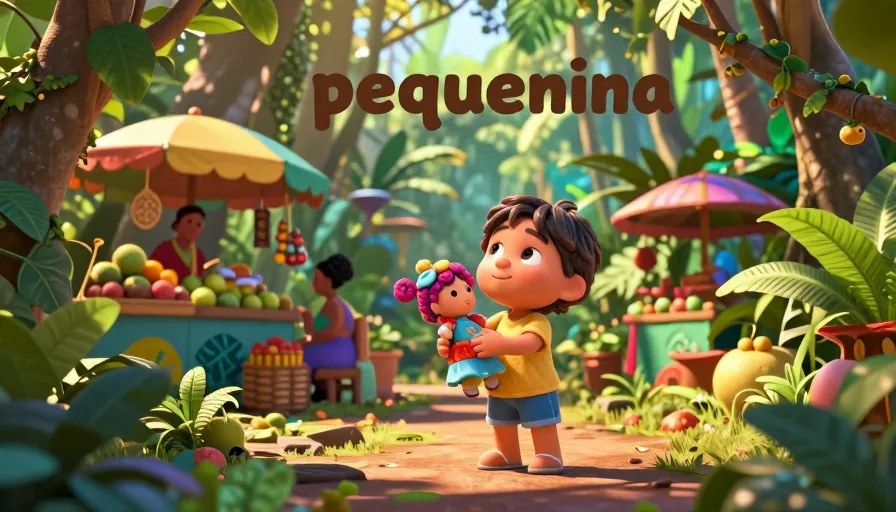
Understanding how to translate 'pequenina' in English is essential for anyone learning Portuguese. This guide will provide you with the primary translations, contextual usage examples, pronunciation guidance, and grammatical insights to help you master this word.
What is 'Pequenina' in English? (Core Translations)
The word 'pequenina' in Portuguese translates to 'little one' or simply 'little' in English. It is often used as a term of endearment or to describe something small. For example, if you are talking about a small child, you might refer to them as 'pequenina.'
Grammatical Role
'Pequenina' functions primarily as a noun or an adjective in Portuguese. In English, it can be translated as a noun ('little one') or an adjective ('little'). Understanding its grammatical role will help you use it correctly in sentences.
Contextual Usage: How to Use 'Pequenina' in Sentences
To truly grasp the meaning of 'pequenina' in English, it's important to see it in context. Here are some practical examples:
As a Noun
-
Portuguese: A pequenina está dormindo.
-
English: The little one is sleeping.
-
Portuguese: O pequenina precisa de um abraço.
-
English: The little one needs a hug.
As an Adjective
-
Portuguese: Ela é uma pequenina.
-
English: She is a little one.
-
Portuguese: Ele tem uma casa pequenina.
-
English: He has a little house.
Idiomatic Usage
'Pequenina' can also be used idiomatically to convey affection or familiarity. For example:
- Portuguese: Minha pequenina, você está bem?
- English: My little one, are you okay?

Learn Languages with YouTube
Watch videos in your target language, auto-capture words into flashcards, and track your progress — all in one place.
See How It Works →Pronunciation Guide for 'Pequenina'
Pronunciation is key to effective communication. Here’s a step-by-step guide to pronouncing 'pequenina' correctly:
- Break it down: pe-que-ni-na
- Phonetic spelling: /pɛˈkɛninə/
- Audio Pronunciation: [Insert audio link here]
Mini Drill: Practice Pronunciation
- Listen to the audio pronunciation.
- Repeat the word aloud.
- Record yourself and compare.
- Practice with a language partner or tutor.
Common Mistakes and How to Avoid Them
Mistake 1: Confusing 'Pequenina' with 'Pequenino'
'Pequenina' is feminine, while 'pequenino' is masculine. Make sure to use the correct form based on the gender of the noun.
Mistake 2: Overusing 'Little'
While 'little' is a direct translation, it can sound repetitive. Use synonyms like 'small' or 'tiny' to vary your language.
Mistake 3: Incorrect Pronunciation
Practice the pronunciation regularly to avoid sounding awkward. Use the audio guide and mini drills to improve.
Checklist for Mastering 'Pequenina' in English
- Understand the core translations: 'little one' and 'little'.
- Practice using 'pequenina' in sentences as both a noun and an adjective.
- Listen to and mimic the correct pronunciation.
- Use 'pequenina' in context with idiomatic expressions.
- Avoid common mistakes by paying attention to gender and pronunciation.
Conclusion
Mastering 'pequenina' in English involves understanding its translations, contextual usage, and pronunciation. With practice and attention to detail, you can confidently use this word in your conversations and writing. Happy learning!
FAQ
Is 'pequenina' always translated as 'little one'?
No, 'pequenina' can be translated as 'little one' or simply 'little,' depending on the context. It can also function as an adjective to describe something small.
How do I know when to use 'pequenina' or 'pequenino'?
Use 'pequenina' for feminine nouns and 'pequenino' for masculine nouns. For example, 'a pequenina' refers to a little girl, while 'o pequenino' refers to a little boy.
Can 'pequenina' be used in formal contexts?
While 'pequenina' is often used in informal or affectionate contexts, it can be used in formal settings when referring to something small or endearing. However, it's important to consider the tone and formality of the situation.
Related phrases
Start with Metheus
Watch videos in your target language, auto-capture words into flashcards, and track your progress — all in one place.
Get Started →

