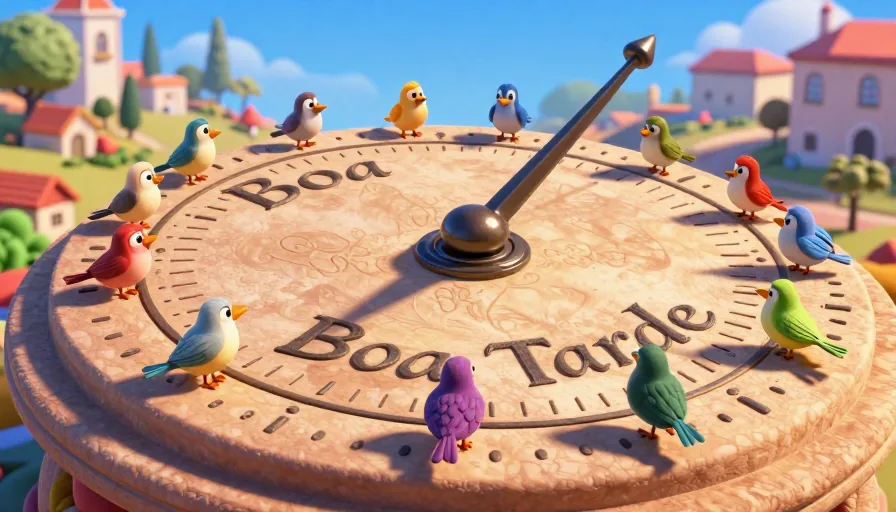
Mastering 'Portuguese Good Afternoon': A Comprehensive Guide to 'Boa Tarde'
Learning how to say 'Portuguese good afternoon' (Boa tarde) is essential for anyone looking to communicate effectively in Portuguese-speaking countries. This guide will help you master the pronunciation, understand the cultural nuances, and use 'Boa tarde' appropriately in various contexts.
Understanding 'Boa Tarde': European vs. Brazilian Portuguese
Pronunciation Guide
The correct pronunciation of 'Boa tarde' is crucial for clear communication. In European Portuguese, it is pronounced as /ˈbo.ɐ ˈtaɾ.dɨ/, while in Brazilian Portuguese, it is pronounced as /ˈbo.ɐ ˈtaɾ.dʒi/.
Pronunciation Drill:
- Listen to native speakers pronounce 'Boa tarde'.
- Practice the pronunciation slowly, focusing on the correct sounds.
- Record yourself and compare it with native speakers.
Direct Comparison Chart
| Feature | European Portuguese | Brazilian Portuguese |
|---|---|---|
| Pronunciation | /ˈbo.ɐ ˈtaɾ.dɨ/ | /ˈbo.ɐ ˈtaɾ.dʒi/ |
| Usage Context | More formal, less frequent | More casual, frequent |
| Cultural Nuance | Often used in formal settings | Used in both formal and informal settings |
Beyond 'Good Afternoon': Other Essential Portuguese Greetings
Morning Greetings
- Bom dia (Good morning) is used from sunrise until around noon.
- Olá (Hello) can be used at any time of the day but is more common in the morning.
Evening Greetings
- Boa noite (Good night) is used from sunset until bedtime.
- Até logo (See you later) is a casual way to say goodbye in the evening.
Other Common Greetings
- Tudo bem? (How are you?) is a casual way to greet someone.
- Como vai? (How are you?) is a more formal way to ask about someone's well-being.

Learn Languages with YouTube
Watch videos in your target language, auto-capture words into flashcards, and track your progress — all in one place.
See How It Works →When to Use Which Greeting: Contextual Guide
Formal vs. Informal Contexts
- Formal Contexts: Use 'Boa tarde' in formal settings such as business meetings, official events, or when addressing someone you don't know well.
- Informal Contexts: Use 'Boa tarde' in casual settings such as with friends, family, or acquaintances.
Example Dialogues
Formal:
A: Boa tarde, Senhor Silva. Como está? B: Boa tarde, Senhora Martins. Estou bem, obrigado. E a senhora?
Informal:
A: Boa tarde, João! Tudo bem? B: Boa tarde, Maria! Tudo ótimo, e você?
Related Vocabulary for Greetings
Time-of-Day Vocabulary
- Manhã (Morning)
- Tarde (Afternoon)
- Noite (Night)
Greeting Vocabulary
- Olá (Hello)
- Tchau (Bye)
- Até mais (See you later)
Cultural Nuances
In Brazilian Portuguese, greetings are often more casual and frequent. It's common to greet someone with 'Boa tarde' even if you've seen them earlier in the day. In European Portuguese, greetings are more formal and less frequent.
Practical Checklist for Using 'Boa Tarde'
- Pronunciation: Practice the correct pronunciation for both European and Brazilian Portuguese.
- Context: Understand when to use 'Boa tarde' in formal vs. informal settings.
- Cultural Awareness: Be aware of the cultural differences in greeting etiquette.
- Practice: Use 'Boa tarde' in real-life conversations to build confidence.
- Expand Vocabulary: Learn related vocabulary to enhance your communication skills.
Mini Drills for Mastery
- Pronunciation Practice: Record yourself saying 'Boa tarde' and compare it with native speakers.
- Contextual Usage: Write short dialogues using 'Boa tarde' in both formal and informal settings.
- Vocabulary Expansion: Create a list of related vocabulary and practice using them in sentences.
By following this comprehensive guide, you'll be able to master 'Portuguese good afternoon' and communicate effectively in Portuguese-speaking countries.
FAQ
Is 'Boa tarde' used differently in European Portuguese and Brazilian Portuguese?
Yes, 'Boa tarde' is used more formally and less frequently in European Portuguese compared to Brazilian Portuguese, where it is used more casually and frequently.
Can I use 'Boa tarde' at any time of the day?
No, 'Boa tarde' is specifically used in the afternoon. For other times of the day, use 'Bom dia' for morning and 'Boa noite' for evening.
What are some common mistakes to avoid when using 'Boa tarde'?
Common mistakes include incorrect pronunciation, using it at the wrong time of day, and not adapting to the formality of the context. Always practice the correct pronunciation and understand the cultural nuances.
Related phrases
Start with Metheus
Watch videos in your target language, auto-capture words into flashcards, and track your progress — all in one place.
Get Started →

