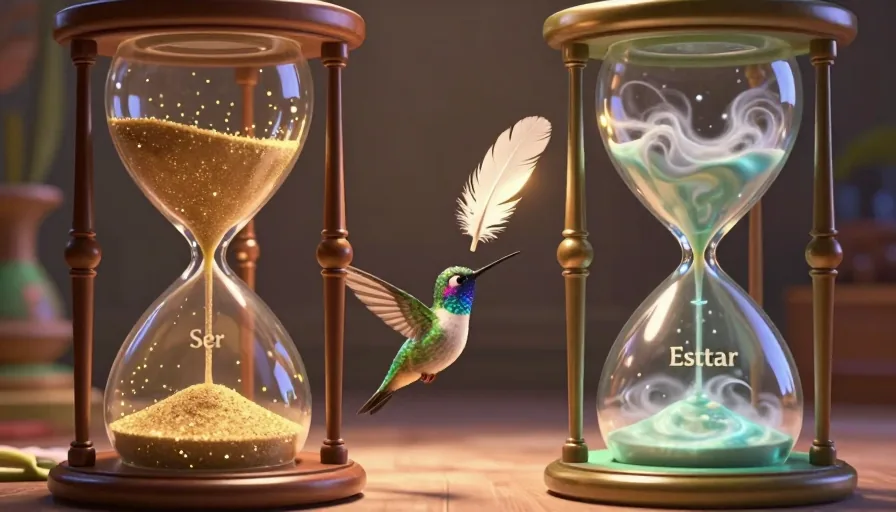
When learning Spanish, one of the first questions that arises is how do you say to be in Spanish. The answer is not as simple as it seems in English, as Spanish uses two verbs: 'ser' and 'estar'. Understanding the difference between these two verbs is crucial for effective communication. This guide will help you master 'ser' and 'estar' with clear explanations, practical examples, and useful checklists.
Ser vs. Estar: The Essential Difference
The fundamental difference between 'ser' and 'estar' lies in their usage. 'Ser' is used for permanent characteristics, origin, and time, while 'estar' is used for location, temporary states, and emotions. Here's a quick side-by-side comparison:
| Ser | Estar | |
|---|---|---|
| Permanent Characteristics | Sí, soy alto. (Yes, I am tall.) | No, no estoy alto. (No, I am not tall.) |
| Origin | Soy de España. (I am from Spain.) | |
| Time | Son las dos. (It is two o'clock.) | |
| Location | Estoy en la casa. (I am in the house.) | |
| Temporary States | Estoy enfermo. (I am sick.) | |
| Emotions | Estoy feliz. (I am happy.) |
Mastering 'Ser': When to Use It
'Ser' is used for permanent characteristics, origin, and time. Here are some key points to remember:
- Permanent Characteristics: Use 'ser' for physical traits, personality traits, and other permanent characteristics.
- Ejemplo: Soy inteligente. (I am intelligent.)
- Origin: Use 'ser' to indicate where you are from or the material something is made of.
- Ejemplo: Soy de México. (I am from Mexico.)
- Time: Use 'ser' to tell the time.
- Ejemplo: Son las tres. (It is three o'clock.)
Conjugation Basics for 'Ser'
Here's a quick conjugation guide for 'ser':
- Yo soy
- Tú eres
- Él/Ella/Usted es
- Nosotros/as somos
- Vosotros/as sois
- Ellos/as/Ustedes son
Mastering 'Estar': When to Use It
'Estar' is used for location, temporary states, and emotions. Here are some key points to remember:
- Location: Use 'estar' to indicate where something or someone is.
- Ejemplo: Estoy en la cocina. (I am in the kitchen.)
- Temporary States: Use 'estar' for temporary conditions or states.
- Ejemplo: Estoy cansado. (I am tired.)
- Emotions: Use 'estar' to express emotions, even though they might seem permanent.
- Ejemplo: Estoy triste. (I am sad.)
Conjugation Basics for 'Estar'
Here's a quick conjugation guide for 'estar':
- Yo estoy
- Tú estás
- Él/Ella/Usted está
- Nosotros/as estamos
- Vosotros/as estáis
- Ellos/as/Ustedes están

Learn Languages with YouTube
Watch videos in your target language, auto-capture words into flashcards, and track your progress — all in one place.
See How It Works →Quick Practice: Putting Ser and Estar into Action
Let's practice with some common phrases and sentences. Fill in the blanks with either 'ser' or 'estar':
- ¿______ tú de España? (Are you from Spain?)
- ¿Dónde ______ el libro? (Where is the book?)
- ¿A qué hora ______ la clase? (What time is the class?)
- ¿Cómo ______ tú? (How are you?)
- ¿______ tú contento? (Are you happy?)
Checklist for Mastery
- I can explain the difference between 'ser' and 'estar'.
- I can conjugate 'ser' and 'estar' in the present tense.
- I can use 'ser' correctly for permanent characteristics, origin, and time.
- I can use 'estar' correctly for location, temporary states, and emotions.
- I can fill in the blanks in the practice exercise with the correct verb.
Common Mistakes to Avoid
- Using 'ser' for temporary states or locations.
- Using 'estar' for permanent characteristics or origin.
- Forgetting to conjugate the verbs correctly.
Integrating 'Ser' and 'Estar' into Conversation
To truly master 'ser' and 'estar', practice using them in conversation. Here are some phrases to help you get started:
- ¿De dónde ______? (Where are you from?)
- ¿Dónde ______ el baño? (Where is the bathroom?)
- ¿A qué hora ______ la cita? (What time is the appointment?)
- ¿Cómo ______? (How are you?)
- ¿______ listo para salir? (Are you ready to go out?)
By practicing these phrases and understanding the context-based usage of 'ser' and 'estar', you'll be well on your way to mastering how to say 'to be' in Spanish.
Mini Drill: Ser vs. Estar
Translate the following sentences into Spanish, using either 'ser' or 'estar':
- I am from Italy.
- I am in the car.
- I am happy.
- I am sick.
- It is five o'clock.
Answers
- Soy de Italia.
- Estoy en el coche.
- Estoy feliz.
- Estoy enfermo.
- Son las cinco.
By completing this mini drill, you've reinforced your understanding of 'ser' and 'estar'. Keep practicing, and soon you'll be using these verbs like a native speaker.
Conclusion
Learning how to say 'to be' in Spanish involves understanding and practicing 'ser' and 'estar'. By following this guide, you've gained a solid foundation in the differences between these two verbs and how to use them correctly. Keep practicing, and don't forget to use context-based learning to reinforce your skills.
FAQ
Why are there two verbs for 'to be' in Spanish?
Spanish uses 'ser' and 'estar' to convey different nuances of the English verb 'to be'. 'Ser' is used for permanent characteristics, origin, and time, while 'estar' is used for location, temporary states, and emotions. This distinction allows for more precise communication.
How can I remember when to use 'ser' and 'estar'?
A helpful way to remember is to associate 'ser' with permanent, unchanging characteristics and 'estar' with temporary states and locations. Practice with common phrases and sentences to reinforce your understanding.
What are some common mistakes to avoid with 'ser' and 'estar'?
Common mistakes include using 'ser' for temporary states or locations, using 'estar' for permanent characteristics or origin, and forgetting to conjugate the verbs correctly. Regular practice and context-based learning can help you avoid these errors.
Related phrases
Start with Metheus
Watch videos in your target language, auto-capture words into flashcards, and track your progress — all in one place.
Get Started →

