Understanding the preterite vs imperfect tense in Spanish can be challenging, but mastering these past tenses is crucial for effective communication. This guide provides a clear framework to help you choose the correct tense based on the function of the sentence, rather than just conjugation rules.
The Core Difference: Completed Actions vs. Ongoing Descriptions
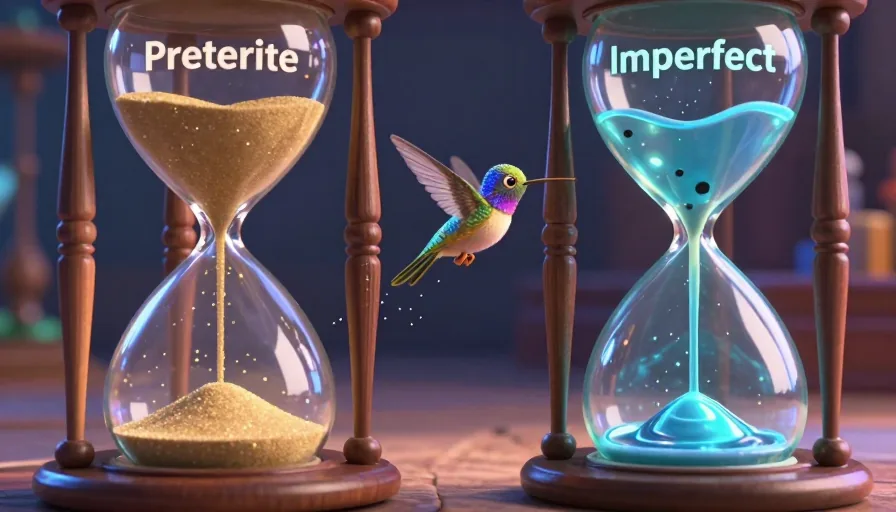
The preterite tense is used for completed, single actions, while the imperfect tense describes ongoing, habitual, or descriptive actions. Here's a simple analogy to help you understand:
- Preterite (Snapshot): Captures a single moment in time, like a photograph.
- Imperfect (Movie): Shows a continuous action or setting, like a movie scene.
Preterite vs Imperfect Tense: Examples
- Preterite: Ayer, comí una pizza. (Yesterday, I ate a pizza.)
- Imperfect: Cuando era niño, comía muchas pizzas. (When I was a child, I ate many pizzas.)
When to Use the Preterite: Snapshot Moments
Use the preterite tense for actions that happened at a specific time and were completed. These actions are often interrupted or have a clear beginning and end.
Preterite Tense Triggers
- Specific time references (ayer, anoche, el lunes pasado)
- Completed actions (terminé, comí, fui)
- Interruptions (cuando llegó, mientras comía)
Preterite Tense Examples
- Ayer, fui al cine. (Yesterday, I went to the movies.)
- El lunes pasado, terminé mi proyecto. (Last Monday, I finished my project.)
- Mientras comía, sonó mi teléfono. (While I was eating, my phone rang.)
When to Use the Imperfect: Setting the Scene and Habits
Use the imperfect tense for ongoing, habitual, or descriptive actions. These actions often set the scene, describe habits, or provide background information.
Imperfect Tense Triggers
- Habitual actions (siempre, a menudo, nunca)
- Descriptive actions (era, parecía, había)
- Time references with 'used to' (solía, solíamos)
Imperfect Tense Examples
- Cuando era niño, siempre jugaba al fútbol. (When I was a child, I always played soccer.)
- El cielo estaba nublado y hacía frío. (The sky was cloudy and it was cold.)
- Solía ir al parque los fines de semana. (I used to go to the park on weekends.)
Trigger Phrases: Keywords That Signal Preterite or Imperfect
Certain phrases and keywords can help you determine whether to use the preterite or imperfect tense. Here's a checklist to guide you:
Preterite Tense Checklist
- The action happened at a specific time.
- The action was completed.
- The action was interrupted.
- The action has a clear beginning and end.
Imperfect Tense Checklist
- The action was ongoing or habitual.
- The action sets the scene or provides background information.
- The action describes a state or condition.
- The action is used with 'used to' or descriptive verbs.
Common Mistakes and Confusing Scenarios
Even advanced learners can struggle with preterite vs imperfect tense. Here are some common mistakes and how to avoid them:
Mistake 1: Confusing Specific Time References
- Incorrect: Cuando era niño, comí muchas pizzas. (When I was a child, I ate many pizzas.)
- Correct: Cuando era niño, comía muchas pizzas. (When I was a child, I ate many pizzas.)
Mistake 2: Misusing 'While' Clauses
- Incorrect: Mientras comía, siempre veía la televisión. (While I was eating, I always watched TV.)
- Correct: Mientras comía, vi la televisión. (While I was eating, I watched TV.)
Mistake 3: Overusing the Preterite for Habits
- Incorrect: Todos los días, comí una manzana. (Every day, I ate an apple.)
- Correct: Todos los días, comía una manzana. (Every day, I ate an apple.)

Learn Languages with YouTube
Watch videos in your target language, auto-capture words into flashcards, and track your progress — all in one place.
See How It Works →Interactive Examples: Preterite vs Imperfect Tense in Context
To solidify your understanding, try these interactive examples. Choose the correct tense for each sentence:
- Ayer,
[ ] comía / [ ] comí una pizza.
- Cuando era niño,
[ ] jugaba / [ ] jugué al fútbol.
- Mientras estudiaba,
[ ] sonó / [ ] sonaba mi teléfono.
- El cielo
[ ] estaba / [ ] estuvo nublado.
- El lunes pasado,
[ ] terminaba / [ ] terminé mi proyecto.
Preterite vs Imperfect Tense: Decision-Making Table
Use this table to help you decide between preterite and imperfect tense based on the function of the sentence:
| Function | Preterite | Imperfect |
|---|---|---|
| Completed Action | ✓ | |
| Ongoing/Habitual Action | ✓ | |
| Descriptive/Background Information | ✓ | |
| Specific Time Reference | ✓ | |
| 'Used to' or Descriptive Verbs | ✓ |
By focusing on the function of the sentence, you can choose the correct tense with confidence. Practice with real-life scenarios, and soon you'll master preterite vs imperfect tense in Spanish.
Preterite vs Imperfect Tense: Mini Drill
Complete the following sentences with the correct tense:
- Ayer,
(ir) al cine.
- Cuando era niño,
(jugar) al fútbol.
- Mientras comía,
(sonar) mi teléfono.
- El cielo
(estar) nublado.
- El lunes pasado,
(terminar) mi proyecto.
FAQ
What if a sentence has both completed and ongoing actions?
If a sentence has both completed and ongoing actions, use the preterite for the completed action and the imperfect for the ongoing action. For example: 'Mientras comía (imperfect), terminé (preterite) mi tarea.' (While I was eating, I finished my homework.)
How do I handle multiple actions in a single sentence?
When dealing with multiple actions in a single sentence, determine the main action and use the appropriate tense for that action. Use the other tense for supporting actions. For example: 'Cuando era niño, siempre jugaba (imperfect) al fútbol y ganaba (preterite) todos los partidos.' (When I was a child, I always played soccer and won all the games.)
What if I'm still unsure about which tense to use?
If you're still unsure, try rewriting the sentence with a clear time reference or using a different structure. Practice with real-life scenarios and seek feedback from native speakers or language tutors. With time and practice, you'll gain confidence in choosing the correct tense.
Related phrases
Start with Metheus
Watch videos in your target language, auto-capture words into flashcards, and track your progress — all in one place.
Get Started →