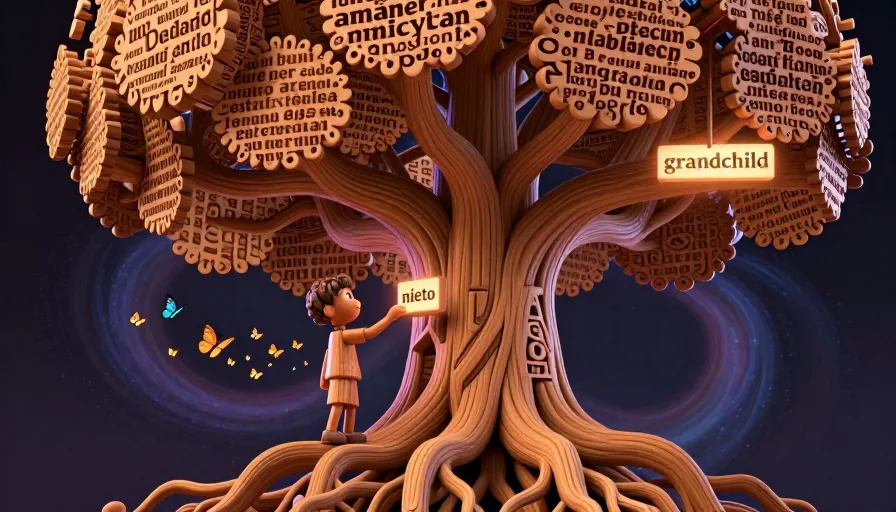
Understanding how to translate 'nieto' to English is a fundamental skill for any language learner. 'Nieto' is a masculine noun that translates to 'grandson' in English. However, the translation and usage of 'nieto' go beyond simple dictionary definitions. This guide will help you master the translation and usage of 'nieto' in various contexts, ensuring you can communicate effectively in Spanish-speaking cultures.
What is 'Nieto' in English? (Grandson vs. Granddaughter)
The primary translation of 'nieto' in English is 'grandson.' However, it's essential to understand the gender-specific nuances. 'Nieto' refers specifically to a male grandchild. The feminine form, 'nieta,' refers to a female grandchild. This distinction is crucial for accurate communication.
Pronunciation Practice
- Nieto: /ˈnje.to/ (Spanish)
- Grandson: /ˈɡræn.sən/ (English)
Practice saying these words aloud to get comfortable with the pronunciation.
Understanding the Nuances: Nieto vs. Nietos
The plural form of 'nieto' is 'nietos,' which translates to 'grandsons' in English. It's important to note that 'nietos' can refer to a group of male grandchildren or a mixed group of grandchildren when the gender is unspecified. For example:
- Spanish: Tengo dos nietos. (I have two grandsons.)
- English: I have two grandsons.
However, if you want to specify a mixed group, you would say:
- Spanish: Tengo dos nietos y una nieta. (I have two grandsons and one granddaughter.)
- English: I have two grandsons and one granddaughter.
Real-World Examples: Using 'Nieto' in Conversation
Example 1: Formal Context
Spanish: Mi nieto está estudiando medicina en la universidad. English: My grandson is studying medicine at university.
Example 2: Informal Context
Spanish: ¡Mi nieto es un niño muy travieso! English: My grandson is a very mischievous boy!
Example 3: Cultural Context
In Spanish-speaking cultures, family is often a central theme. Grandparents play a significant role in the upbringing of their grandchildren. Understanding this cultural context can help you appreciate the importance of family terms like 'nieto.'

Aprendé Idiomas con YouTube
Mirá videos en tu idioma objetivo, capturá palabras nuevas como flashcards automáticamente, y seguí tu progreso — todo en un solo lugar.
Ver Cómo Funciona →Related Vocabulary: Expanding Your Family Terms
To expand your vocabulary, it's helpful to learn related family terms. Here are some examples:
- Abuelo: Grandfather
- Abuela: Grandmother
- Tío: Uncle
- Tía: Aunt
- Primo: Cousin (male)
- Prima: Cousin (female)
Mini Drill: Fill in the Blanks
Complete the following sentences with the correct family terms:
- Mi ______ está visitando desde otro país. (My ______ is visiting from another country.)
- Mi ______ me enseñó a cocinar. (My ______ taught me to cook.)
- Mi ______ y yo jugamos juntos todos los días. (My ______ and I play together every day.)
Common Mistakes Learners Make When Translating Family Terms
Mistake 1: Confusing 'Nieto' and 'Nieta'
One common mistake is confusing 'nieto' and 'nieta.' Remember that 'nieto' is masculine and 'nieta' is feminine. Always match the gender of the grandchild to the correct term.
Mistake 2: Using the Wrong Plural Form
Another mistake is using the wrong plural form. 'Nietos' refers to multiple grandsons or a mixed group of grandchildren. If you have only granddaughters, you should use 'nietas.'
Mistake 3: Overlooking Cultural Context
Overlooking the cultural context can lead to misunderstandings. In Spanish-speaking cultures, family terms are often used in a more formal and respectful manner. Be mindful of the context and use the appropriate terms.
Checklist for Mastering 'Nieto' in English
- Understand the primary translation of 'nieto' as 'grandson.'
- Learn the feminine form 'nieta' for 'granddaughter.'
- Practice pronunciation for both 'nieto' and 'grandson.'
- Use 'nietos' for multiple grandsons or a mixed group.
- Expand your vocabulary with related family terms.
- Avoid common mistakes by matching gender and context.
By following this checklist, you'll be well on your way to mastering the translation and usage of 'nieto' in English.
Interactive Pronunciation Practice
To further enhance your learning, try the following interactive exercises:
- Record Yourself: Use a voice recorder to say the words 'nieto' and 'grandson' aloud. Compare your pronunciation with a native speaker.
- Shadowing: Listen to a native speaker say sentences containing 'nieto' and repeat them immediately, mimicking their pronunciation and intonation.
- Role-Play: Practice conversations with a language partner, using 'nieto' and related family terms in context.
By incorporating these exercises into your study routine, you'll gain confidence in using 'nieto' and other family terms in Spanish.
Conclusion
Mastering the translation and usage of 'nieto' in English involves understanding the primary translations, contextual nuances, and related vocabulary. By practicing pronunciation, using real-world examples, and avoiding common mistakes, you'll be able to communicate effectively in Spanish-speaking cultures. Happy learning!
Preguntas frecuentes
What is the difference between 'nieto' and 'nieta'?
'Nieto' is the masculine form referring to a grandson, while 'nieta' is the feminine form referring to a granddaughter. It's important to use the correct term based on the gender of the grandchild.
How do you say 'grandchildren' in Spanish?
The term 'grandchildren' can be translated as 'nietos' when referring to a group of male grandchildren or a mixed group. If you have only granddaughters, you should use 'nietas.'
Is 'nieto' used differently in formal and informal contexts?
Yes, the usage of 'nieto' can vary depending on the context. In formal contexts, you might use more respectful language, while in informal contexts, the language can be more casual. However, the translation remains the same.
Frases relacionadas
Empezá con Metheus
Mirá videos en tu idioma objetivo, capturá palabras nuevas como flashcards automáticamente, y seguí tu progreso — todo en un solo lugar.
Comenzar →

