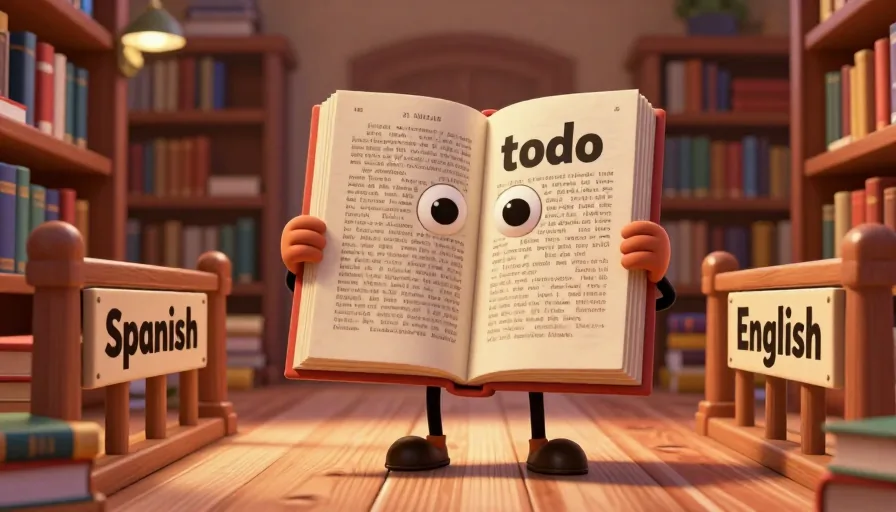
Translating 'todo' into English can be tricky because it serves multiple functions in Spanish. Whether you're using 'todo' as an adjective, a determiner, or part of a phrase, understanding its nuances is crucial for effective communication. This guide will help you navigate the complexities of translating 'todo' into English, focusing on practical examples and common mistakes.
Understanding 'Todo' in Context: Adjective vs. Determiner
In Spanish, 'todo' can function as both an adjective and a determiner. As an adjective, it means 'all' or 'every,' while as a determiner, it translates to 'all the' or 'every.' Let's break down these usages with examples:
As an Adjective
When 'todo' is used as an adjective, it describes a noun. For example:
- Spanish: Todo el mundo está aquí.
- English: Everyone is here.
As a Determiner
When 'todo' is used as a determiner, it modifies a noun phrase. For example:
- Spanish: Todo lo que necesitas está en la tienda.
- English: Everything you need is in the store.
Idiomatic Translations for 'Todo' in Everyday English
'Todo' is often part of idiomatic expressions in Spanish. Translating these directly can lead to confusion. Here are some common idiomatic usages:
'Todo el Tiempo'
- Spanish: Todo el tiempo.
- English: All the time.
'Todo lo Que'
- Spanish: Todo lo que necesitas.
- English: Everything you need.
'Todo el Día'
- Spanish: Todo el día.
- English: All day.

Aprendé Idiomas con YouTube
Mirá videos en tu idioma objetivo, capturá palabras nuevas como flashcards automáticamente, y seguí tu progreso — todo en un solo lugar.
Ver Cómo Funciona →Common Mistakes: How Native Speakers Use 'Todo' Differently
One common mistake is using 'todo' as a direct translation without considering the context. For example, 'todo el mundo' translates to 'everyone,' not 'all the world.' Here are some tips to avoid these mistakes:
- Context Matters: Always consider the context in which 'todo' is used.
- Practice with Examples: Use the examples provided to practice translating sentences.
- Avoid Literal Translations: Remember that idiomatic expressions often don't translate literally.
Checklist for Correct Usage
- Understand the context of 'todo' in the sentence.
- Identify whether 'todo' is an adjective or a determiner.
- Practice translating common idiomatic expressions.
- Avoid literal translations for idiomatic expressions.
Interactive Examples for Practice
Let's practice with some interactive examples to solidify your understanding:
Example 1
- Spanish: Todo el mundo está aquí.
- English: Everyone is here.
Example 2
- Spanish: Todo lo que necesitas está en la tienda.
- English: Everything you need is in the store.
Example 3
- Spanish: Todo el tiempo.
- English: All the time.
Example 4
- Spanish: Todo el día.
- English: All day.
Example 5
- Spanish: Todo el mundo está aquí.
- English: Everyone is here.
Mini Drill: Translate the Following Sentences
- Todo el mundo está aquí.
- Todo lo que necesitas está en la tienda.
- Todo el tiempo.
- Todo el día.
- Todo el mundo está aquí.
Conclusion
Mastering the translation of 'todo' into English involves understanding its various functions and contexts. By practicing with examples and avoiding common mistakes, you can improve your language skills and communicate more effectively.
Preguntas frecuentes
Why is 'todo' difficult to translate into English?
'Todo' is difficult to translate because it serves multiple functions in Spanish, such as an adjective and a determiner, and is often part of idiomatic expressions that don't translate literally.
What are the most common mistakes when translating 'todo' into English?
The most common mistakes include using 'todo' as a direct translation without considering the context, and not recognizing when 'todo' is part of an idiomatic expression.
How can I practice translating 'todo' into English?
Practice with examples and interactive drills, focusing on understanding the context and avoiding literal translations for idiomatic expressions.
Frases relacionadas
Empezá con Metheus
Mirá videos en tu idioma objetivo, capturá palabras nuevas como flashcards automáticamente, y seguí tu progreso — todo en un solo lugar.
Comenzar →

