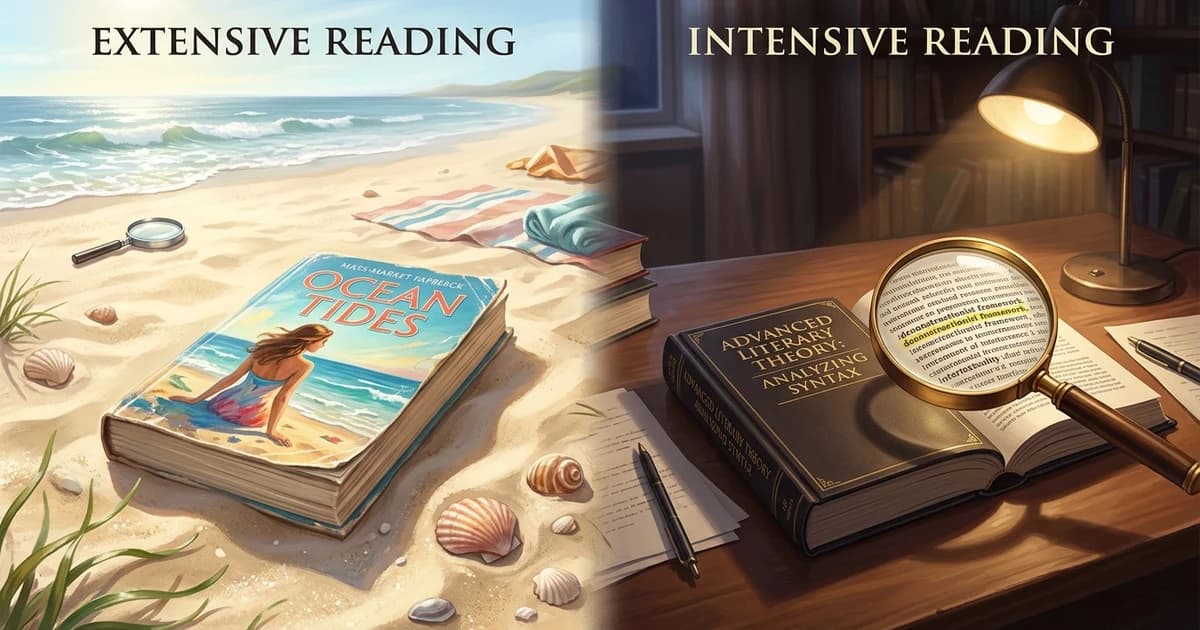
Open any language-learning forum and you will find the same debate under different names: should you power through pages without stopping, or dissect every unknown word? Proponents of extensive reading argue that fluency comes from volume and flow; advocates of intensive reading insist that lookup and analysis are what actually build precision. The uncomfortable truth is that both camps are right—but only at the right moment. This guide breaks down how extensive and intensive reading work, the comprehension thresholds that decide which mode you are in, and how to combine them into a reading plan that accelerates fluency without burning you out.
Two Modes, Two Different Brain Jobs
Extensive reading is reading for pleasure and volume: you consume a lot of text, guess unknown words from context, and only stop when comprehension breaks down. Its goal is automatization—turning the patterns you know into the effortless processing that feels like fluency. Intensive reading is the opposite: slow, analytical, dictionary-in-hand, reading to acquire new structures, precise meanings, and high-value vocabulary. You can think of extensive reading as cardio and intensive reading as weightlifting. Cardio builds endurance; lifting builds specific muscles. A reader who only does one will be lopsided.
The 98% Rule: The Threshold That Picks Your Mode
Vocabulary researchers such as Paul Nation point to a practical threshold: when you understand around 98% of a text's words, you can read fluently and infer the remaining 2% from context. Below 95%, comprehension collapses into a guessing game. Learners have a working version of this test: grab a page and count the unknown words. Fewer than five per page means extensive territory—just read. Five to ten means study material—mine it intensively. More than that? Park the book for later. This simple page test is one of the most quoted pieces of reading advice in language-learning communities, and it is the closest thing to an objective answer to the question of when to look words up.
Extensive vs Intensive Reading at a Glance
| Dimension | Extensive Reading | Intensive Reading |
|---|---|---|
| Goal | Flow, volume, automatization | Depth, precision, new structures |
| Speed | Fast, unpaused | Slow, frequently interrupted |
| Lookups | Almost none (only blocking words) | Constant and deliberate |
| Ideal material | i+0 to i+1 (mostly known) | i+2 or textbook-style texts |
| Main payoff | Reading speed, recognition | Grammar mastery, exact meaning |
| Burnout risk | Low | High, if done nonstop |
| Best level | Intermediate and above | Any level, in small doses |
Notice the pattern: extensive reading trains your eye and your rhythm; intensive reading trains your precision. Neither replaces the other, and the best reading plans deliberately schedule both.

Learn Languages with YouTube
Watch videos in your target language, auto-capture words into flashcards, and track your progress — all in one place.
Start Free →Which One Accelerates Fluency Faster?
If you force a ranking, extensive reading moves fluency faster over months: it multiplies exposure, builds automatic recognition, and keeps you in the language long enough to benefit from compounding. But it only works when your precision base keeps growing, and that base comes from intensive work. Intensive reading alone feels productive and produces little fluency; extensive reading alone plateaus at the vocabulary you already know. The fastest learners do not pick a side—they alternate deliberately: extensive to build flow, intensive to raise the ceiling.
A Balanced Reading Plan: 80% Flow, 20% Dissection
- Extensive block (most of your reading): read something you can already follow at 98%—graded readers, manga, news headlines, easy novels. Do not pause; finish chapters; count pages, not words.
- Intensive block (short and focused): spend 20-30 minutes on a harder text, a page of a novel, or the sentences you captured while watching. Look up, analyze, and mine.
- The page test as a governor: if a book fails the five-unknown-words-per-page test, demote it to intensive material or park it and come back in a month.
- Review with SRS: words you dissected intensively need a spaced-repetition home or they will evaporate within days. This is where smart mining habits—and avoiding sentence mining burnout—make the difference.
The Real Question: How Do I Stop Stopping?
The most common reader complaint—"what is the best way to read a book in a foreign language without stopping every minute?"—is really a mode problem, not a willpower problem. People stop every minute because their material sits above their threshold and because lookup is expensive. Fix the material (drop to 98% texts), and fix the tooling (instant lookup without leaving the page), and the stopping instinct disappears. If you are constantly pausing, you are not bad at reading: you are reading the wrong thing in the wrong mode.
Read Fluently, Then Review Deliberately with Metheus
Metheus Library was built around exactly this two-mode workflow. As you read any text—imported articles, EPUBs, or web pages—Metheus classifies every word into three states: known, learning, and new. In extensive mode, you simply read; the system silently tracks what you actually recognize. When you switch to intensive mode, the words you flagged or encountered while reading become your study queue, complete with the original sentence, so review is always anchored in context. You get the speed of extensive reading and the precision of intensive reading without juggling three tools.
Start Free with Metheus and read your first imported article today.
FAQ
How many unknown words per page are acceptable for extensive reading?
Fewer than five per page (roughly 98% comprehension) keeps reading fluent; five to ten means the text is better used intensively; more than that, park it for later.
Should I look up every word I don't know?
No. In extensive mode, skip everything that does not block your understanding. Reserve lookups for intensive blocks so analysis never hijacks flow.
Can I do extensive and intensive reading with the same book?
Yes. Read the first pass extensively for flow, then re-read the same chapter intensively with lookups and mining. Rereading is the cheapest intensive material there is.
Related phrases
Language learning in 2026 isn't about finishing daily streaks. The fastest path to fluency combines three elements: comprehensible input from real media you enjoy, active vocabulary capture while consuming that content, and spaced repetition to lock words into long-term memory. Gamified apps build the habit. Immersion tools build the fluency. The most effective learners use both—in that order.
Start with Metheus
Watch videos in your target language, auto-capture words into flashcards, and track your progress — all in one place.
Get Started Free →