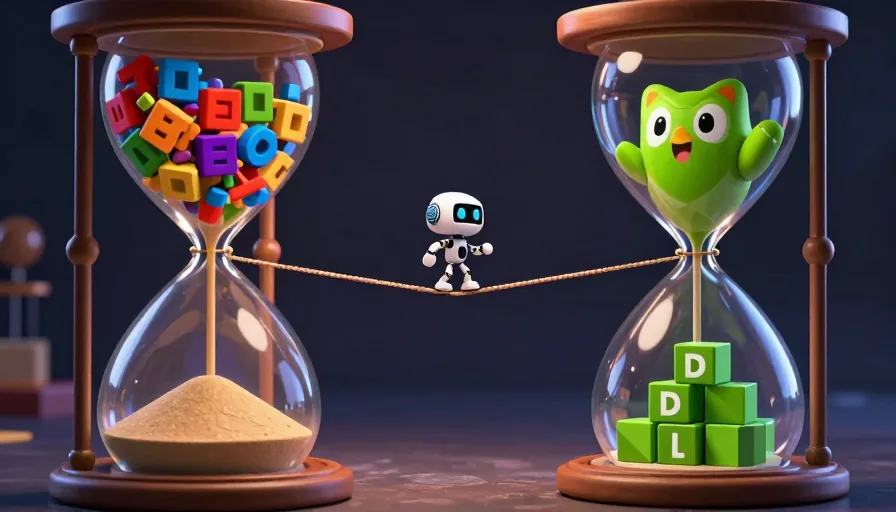
The Rosetta Stone vs. Duolingo debate is really a question about method: does fluency come from immersion-style repetition or from gamified, bite-sized lessons? Both apps have millions of users, both teach dozens of languages, and both will get you through your first sentences. What neither will do is deliver fluency on its own. This review compares their methods, their real strengths and weaknesses, cost, language catalogs, and — the question that matters most — which one fits the way you actually study and how far each can realistically take you.
Two Opposite Methods: Immersion vs. Gamification
Rosetta Stone teaches translation-free: you see a photo, hear a phrase, and match them, building meaning from context the way a child picks up a first language. Lessons are linear and repetitive, and its speech recognition (TruAccent) scores your pronunciation of full sentences in every unit. Duolingo is a game with a curriculum attached: points, streaks, leagues, and a path of short lessons mixing translations, listening, and typing. It is engineered to bring you back daily and punish a dead streak — which is exactly why beginners stick with it. Both apps should be treated as introductions rather than end states, a fact worth keeping in mind before you buy a year of either.
What Rosetta Stone Is Actually Good At
-
Pronunciation: TruAccent gives feedback on full sentences, a real advantage for languages with unfamiliar sounds.
-
Full sentences early: you speak complete phrases from unit one, not isolated vocabulary.
-
No translation crutch: because nothing is translated, you stop mentally translating much faster.
The weaknesses are just as known: grammar is never explained, so you infer it or look it up elsewhere; lessons feel mechanical by the third unit; and the phrase catalog is organized around situations like travel, business, and family rather than the language you will meet in real media. Pricing: roughly $12/month on an annual subscription, and lifetime access for a single language has historically ranged from about $180 to $300 — figures vary by region, promotion, and the current store listing.
What Duolingo Is Actually Good At
-
The free tier: genuinely free with ads — nothing else in this market matches that access.
-
Habit formation: streaks and leagues are the strongest retention mechanics in language apps.
-
Catalog breadth: roughly 40+ courses for English speakers, from Spanish, French, and Japanese to Irish, Hawaiian, and High Valyrian.
The weaknesses are equally public: main courses reach roughly A2–B1 before repeating, grammar explanations stay minimal, and content is built for exercises rather than conversation. Super Duolingo (ad-free, offline, unlimited hearts) costs around $7–$13 per month depending on plan and region, with Max adding AI features like Explain My Answer and Roleplay at a higher tier. Paying removes ads and adds drills — it does not add depth.

Learn Languages with YouTube
Watch videos in your target language, auto-capture words into flashcards, and track your progress — all in one place.
Start Free →Head to Head: Cost, Catalogs, and Outcomes
| Rosetta Stone | Duolingo | |
|---|---|---|
| Starting price | ~$12/month annual; lifetime option | Free with ads; Super ~$7–$13/month |
| Languages (for English speakers) | ~25 | 40+ |
| Method | Immersion, no translation | Gamified lessons, translation-based drills |
| Grammar explanations | Minimal | Minimal |
| Speaking feedback | TruAccent on full sentences | Limited; AI tutor on Max |
| Realistic ceiling | Lower-intermediate | Lower-intermediate |
The most honest observation is also the most uncomfortable: neither app explains grammar well, and both top out far below fluent. Learners who reach real conversation almost always add structured grammar, native content, and — the biggest multiplier by far — thousands of hours of listening to and reading the language at natural speed. A quick reality check: if an app alone built fluency, finishing a course would be enough, yet almost nobody who finishes either program can hold a natural conversation with a native speaker. The supplement is not optional; it is the main course.
Who Should Pick Which
-
Pick Rosetta Stone if: you want full-sentence speaking from day one, you like a calm and predictable routine, or you are preparing for a trip and want situational phrases drilled in.
-
Pick Duolingo if: your problem is showing up at all, you want free, or you are testing whether you even like the language before committing money.
-
Pick neither as your only tool if: your goal is real fluency — the standard that works is an app for structure and habits, a grammar resource, and heavy native input.
The Verdict
For beginners, Duolingo is the better default: free, habitual, low pressure. Rosetta Stone only wins when you specifically want immersion-style lessons and pronunciation feedback, and are willing to pay for them. And for the title question — which one actually gets you fluent — the honest answer is neither alone: the learners who level up are the ones who use an app for structure and spend the rest of their study time on real language.
Whichever method you pick, native content is where fluency is actually built — and the Metheus browser extension turns it into a classroom: translatable subtitles, hover-dictionary definitions, and spaced-repetition cards on any site or video.
FAQ
Is Rosetta Stone better than Duolingo for beginners?
For total beginners, Duolingo wins on entry cost and habit-building: the free tier costs nothing and streaks keep you coming back. Rosetta Stone is better if you want to speak full sentences immediately with scored pronunciation — but you pay for it. Most beginners should start free with Duolingo and add Rosetta Stone only if they want structured speaking practice.
Which is more cost-effective: Rosetta Stone or Duolingo?
Duolingo wins the price comparison outright: a genuinely free tier with ads, and Super Duolingo at roughly $7–$13 per month. Rosetta Stone has no permanent free tier; expect around $12/month on an annual subscription or a one-time lifetime purchase that has historically ranged from about $180 to $300 for a single language. Pay only if you know you will use the immersion method.
Can Rosetta Stone or Duolingo make you fluent?
Neither alone. Both apps top out around the beginner-to-intermediate range: Duolingo's main courses reach roughly A2–B1, and Rosetta Stone's phrase catalog is built for situations rather than free conversation. Fluency comes from grammar, native content, and speaking practice. Use an app for structure and habits, then spend most of your study time on real language.
How many languages does each app offer?
English speakers can choose from roughly 40+ Duolingo courses, including major languages like Spanish, French, and Japanese as well as niche ones like Irish and High Valyrian. Rosetta Stone offers around 25 languages depending on your region and plan, with a focus on major world languages. Both cover the essentials; Duolingo wins on raw variety.
Related phrases
Language learning in 2026 isn't about finishing daily streaks. The fastest path to fluency combines three elements: comprehensible input from real media you enjoy, active vocabulary capture while consuming that content, and spaced repetition to lock words into long-term memory. Gamified apps build the habit. Immersion tools build the fluency. The most effective learners use both—in that order.
Start with Metheus
Watch videos in your target language, auto-capture words into flashcards, and track your progress — all in one place.
Get Started Free →