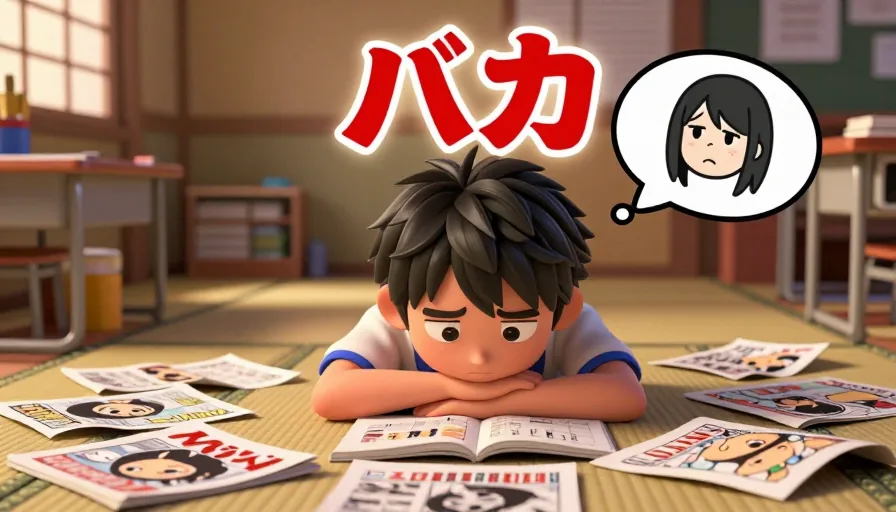
Understanding what does baka means in Japanese is essential for anyone learning the language. 'Baka' is a versatile term that can range from a mild insult to a strong expression of frustration. This guide will delve into the nuances of 'baka,' providing clear explanations, practical examples, and cultural context to help you use it appropriately.
What is 'Baka' in Japanese? (The Basics)
The literal meaning of 'baka' (馬鹿) is 'fool' or 'idiot.' It is a pejorative term used to describe someone who is foolish, silly, or lacking in intelligence. However, its usage goes beyond this simple definition. 'Baka' can also be used to express frustration, disbelief, or annoyance, similar to saying 'you idiot' in English.
Mini Drill: Basic Usage
- Baka (馬鹿) - Fool/Idiot
- Anata wa baka desu. (あなたは馬鹿です。) - You are an idiot.
- Baka na hito. (馬鹿な人。) - A foolish person.
Beyond 'Idiot': Understanding the Nuances of 'Baka'
While 'baka' can mean 'idiot,' its connotations vary based on context and tone. Here are some primary connotations:
- Foolishness: Describing someone who acts without thinking.
- Silliness: Referring to someone who does something silly or ridiculous.
- Annoyance: Expressing frustration with someone's actions or words.
Practical Examples
-
Casual Chat:
- Friend A: 「今日は雨が降るって言っていたのに、傘を持ってこなかったね。」 (Kyou wa ame ga furu tte itteita no ni, kasa wo motte konakatta ne.) - You said it was going to rain today, but you didn't bring an umbrella.
- Friend B: 「馬鹿だな、忘れてた。」 (Baka da na, wasureteta.) - I'm an idiot, I forgot.
-
Anime Context:
- In many anime, characters use 'baka' to express frustration or annoyance. For example, in 'Naruto,' characters often call each other 'baka' in heated moments. Watch this YouTube short to see how 'baka' is used in anime.

Learn Languages with YouTube
Watch videos in your target language, auto-capture words into flashcards, and track your progress — all in one place.
See How It Works →When to Use 'Baka': Contextual Usage Guide
Casual vs. Polite vs. Harsh Usage
- Casual: Among friends or in informal settings, 'baka' can be used lightly to tease or joke.
- Polite: In polite settings, avoid using 'baka' directly. Instead, use softer phrases like 'dame da ne' (だめだね) - 'That's no good, huh?'
- Harsh: In heated arguments or to express strong disapproval, 'baka' can be used harshly.
Checklist for Appropriate Usage
- Understand the context and relationship with the person you're speaking to.
- Use 'baka' lightly among friends or in casual settings.
- Avoid using 'baka' in formal or polite settings.
- Be aware of the tone and intent behind your words.
Cultural Context: How Japanese People Use This Word
In Japanese social dynamics, 'baka' is a term that can be used to express a range of emotions, from mild annoyance to strong disapproval. It is often used in casual settings among friends or family but is generally avoided in formal or polite contexts. Understanding the cultural nuances of 'baka' can help you navigate social situations more effectively.
Common Mistakes to Avoid
- Overuse: Using 'baka' too frequently can make you seem rude or disrespectful.
- Misinterpretation: Misinterpreting the context can lead to misunderstandings or offense.
- Inappropriate Settings: Using 'baka' in formal or polite settings can be seen as disrespectful.
Related Vocabulary or Expressions that Use 'Baka'
- Baka mitai (馬鹿みたい) - Acting like an idiot.
- Baka na koto (馬鹿なこと) - Foolish thing.
- Baka ni suru (馬鹿にする) - To make fun of someone.
- Baka yaro (馬鹿野郎) - Idiot (more harsh).
Mini Drill: Related Vocabulary
- Baka mitai (馬鹿みたい) - Acting like an idiot.
- Baka na koto (馬鹿なこと) - Foolish thing.
- Baka ni suru (馬鹿にする) - To make fun of someone.
- Baka yaro (馬鹿野郎) - Idiot (more harsh).
Conclusion
Understanding what does baka means in Japanese and how to use it appropriately can enhance your language skills and cultural awareness. By following the guidelines and examples provided in this guide, you can navigate the nuances of 'baka' with confidence.
FAQ
Is it okay to use 'baka' in formal settings?
No, using 'baka' in formal settings is generally considered disrespectful. It's best to use softer phrases or avoid the term altogether in polite or formal contexts.
Can 'baka' be used to tease friends?
Yes, 'baka' can be used lightly among friends to tease or joke, but be mindful of the tone and context to avoid offending anyone.
What are some alternatives to 'baka'?
Some alternatives to 'baka' include 'dame da ne' (だめだね) - 'That's no good, huh?', 'hontou ni' (本当に) - 'really?', and 'nani o suru no?' (何をするの?) - 'What are you doing?'.
Related phrases
Start with Metheus
Watch videos in your target language, auto-capture words into flashcards, and track your progress — all in one place.
Get Started →

