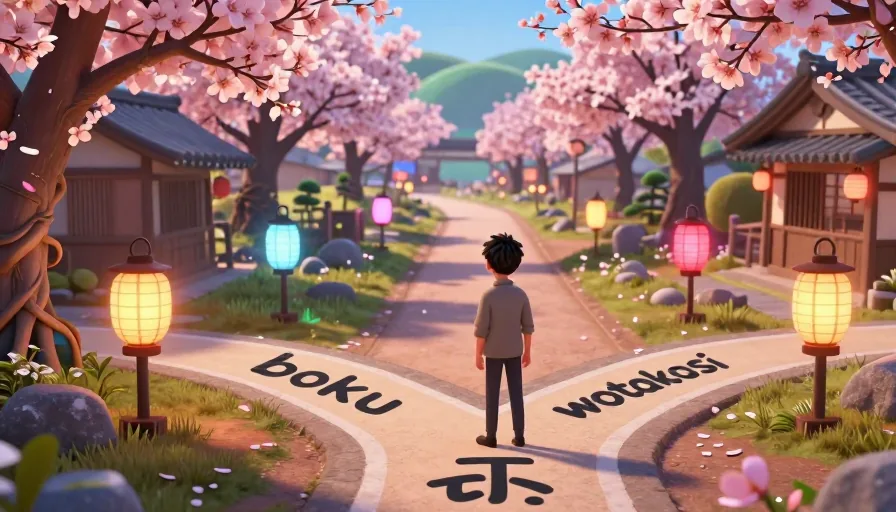
Japanese is a language rich in nuance, and one of the most intriguing aspects is the variety of ways to say 'I'. Understanding what does 'I' mean in Japanese involves more than just memorizing words; it requires grasping the social context and connotations behind each pronoun. This guide will help you navigate the complexities of Japanese self-references, ensuring you use the right pronoun in any situation.
Understanding the Nuances: Why Japanese Has So Many Ways to Say 'I'
Japanese has multiple ways to say 'I' because the language places a strong emphasis on social hierarchy and relationships. The choice of pronoun reflects the speaker's perception of themselves in relation to the listener. This can be influenced by factors such as age, gender, social status, and the formality of the situation. For example, a young woman might use 'watashi' when speaking to her boss, but 'boku' when talking to her friends.
Mini Drill: Identify the Context
- Imagine you are a student talking to your teacher.
- Imagine you are a friend talking to another friend.
- Imagine you are a businessperson talking to a client.
What pronoun would you use in each scenario?
The Core 'I' Pronouns: Watashi vs. Boku vs. Ore
Watashi (私)
'Watashi' is a neutral and polite way to say 'I'. It is commonly used in formal settings and is suitable for both men and women. It conveys a sense of respect and formality, making it a safe choice when in doubt.
Example:
Watashi wa gakusei desu.
Translation:
'I am a student.'
Boku (僕)
'Boku' is a casual and friendly way to say 'I'. It is typically used by men and boys, although some women may use it in informal settings. It conveys a sense of familiarity and closeness, making it ideal for conversations with friends and peers.
Example:
Boku wa nihongo ga suki desu.
Translation:
'I like Japanese.'
Ore (俺)
'Ore' is a very casual and sometimes aggressive way to say 'I'. It is primarily used by men and conveys a strong sense of self-confidence, sometimes to the point of arrogance. It is generally not recommended for beginners due to its potential to offend.
Example:
Ore wa sensei desu.
Translation:
'I am a teacher.'

Learn Languages with YouTube
Watch videos in your target language, auto-capture words into flashcards, and track your progress — all in one place.
See How It Works →Context is King: Choosing the Right 'I' for Different Relationships
Choosing the right pronoun depends on the context and the relationship between the speaker and the listener. Here is a checklist to help you decide:
Checklist: Choosing the Right Pronoun
- Formal Settings: Use 'watashi' when speaking to superiors, elders, or in professional environments.
- Casual Settings: Use 'boku' when speaking to friends, peers, or in informal settings.
- Avoid 'Ore': Unless you are very familiar with the listener and the context, avoid using 'ore' to prevent misunderstandings.
- Gender Considerations: While 'watashi' is gender-neutral, 'boku' and 'ore' are typically used by men. Women may use 'atashi' (あたし) or 'uchi' (うち) in casual settings.
Practical Examples
- At Work:
Watashi wa shachou to hanashimasu.
Translation:
'I am talking to the president.'
- With Friends:
Boku wa kinou eiga o mita.
Translation:
'I watched a movie yesterday.'
- With Close Friends (Male):
Ore wa ashita kyuu ni iku.
Translation:
'I am going to the gym tomorrow.'
Beyond 'I': Exploring Other Pronouns and Self-References
In addition to 'watashi', 'boku', and 'ore', there are other pronouns and self-references in Japanese that convey different nuances. Some of these include:
Watakushi (私)
'Watakushi' is a very formal and respectful way to say 'I'. It is often used in business settings or when addressing someone of a much higher rank. It conveys a deep sense of humility and respect.
Example:
Watakushi wa shachou ni aimasu.
Translation:
'I am meeting the president.'
Uchi (うち)
'Uchi' is a very casual and informal way to say 'I'. It is typically used by women and conveys a sense of closeness and familiarity. It is not commonly used in formal settings.
Example:
Uchi wa kinou eiga o mita.
Translation:
'I watched a movie yesterday.'
Temee (てめえ)
'Temee' is a highly disrespectful and aggressive way to say 'I'. It is generally avoided in polite conversation and can cause offense. It is important to understand the context and the relationship before using this pronoun.
Example:
Temee wa dare da?
Translation:
'Who are you?'
Comparison Chart: When to Use Specific Pronouns
| Pronoun | Context | Connotation | Example Usage |
|---|---|---|---|
| Watashi | Formal, Respectful | Neutral, Polite | Speaking to a teacher or boss |
| Boku | Casual, Friendly | Familiar, Close | Talking to friends or peers |
| Ore | Very Casual, Sometimes Aggressive | Confident, Sometimes Arrogant | Talking to close friends (male) |
| Watakushi | Very Formal, Respectful | Humble, Respectful | Business settings or addressing superiors |
| Uchi | Very Casual, Informal | Close, Familiar | Talking to close friends (female) |
| Temee | Highly Disrespectful, Aggressive | Offensive, Confrontational | Avoid in polite conversation |
Practical Advice on Avoiding Common Conversational Pitfalls
- Avoid Overuse of 'Ore': While 'ore' can be used in casual settings, it is important to avoid overusing it, as it can come across as aggressive or arrogant.
- Be Mindful of Gender: Remember that 'boku' and 'ore' are typically used by men, while 'uchi' is typically used by women. Using the wrong pronoun can lead to misunderstandings.
- Context Matters: Always consider the context and the relationship before choosing a pronoun. Using the wrong pronoun can cause offense or confusion.
- Practice Makes Perfect: The best way to master the nuances of Japanese pronouns is through practice. Engage in conversations with native speakers and pay attention to their choices of pronouns.
Conclusion
Understanding what does 'I' mean in Japanese involves more than just memorizing words; it requires a deep understanding of the social context and connotations behind each pronoun. By following this guide and practicing regularly, you can master the nuances of Japanese self-references and communicate effectively in any situation.
FAQ
Why are there so many ways to say 'I' in Japanese?
Japanese has multiple ways to say 'I' because the language places a strong emphasis on social hierarchy and relationships. The choice of pronoun reflects the speaker's perception of themselves in relation to the listener, influenced by factors such as age, gender, social status, and the formality of the situation.
Can women use 'boku' or 'ore'?
While 'boku' and 'ore' are typically used by men, some women may use them in informal settings. However, it is more common for women to use 'watashi' or 'uchi' in casual settings. Using the wrong pronoun can lead to misunderstandings, so it's important to be mindful of gender considerations.
Is it okay to use 'temee' in conversation?
No, 'temee' is a highly disrespectful and aggressive way to say 'I'. It is generally avoided in polite conversation and can cause offense. It is important to understand the context and the relationship before using this pronoun. In most cases, it is best to avoid using 'temee' altogether.
Related phrases
Start with Metheus
Watch videos in your target language, auto-capture words into flashcards, and track your progress — all in one place.
Get Started →

