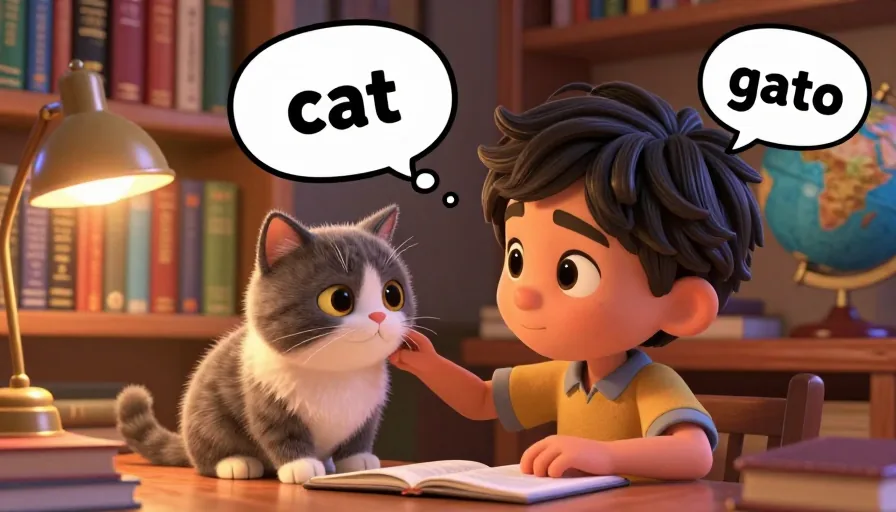
Mastering the translation of 'gato' (cat) in English is essential for Spanish speakers looking to expand their vocabulary and conversational skills. This guide will cover the direct translation, contextual usage, common phrases, and related vocabulary to help you communicate effectively about cats in English.
What is 'Gato' in English? (The Basics)
The direct translation of 'gato' in English is 'cat.' This is a straightforward translation, but understanding the nuances and context is crucial for effective communication. For example, 'Mi gato es negro' translates to 'My cat is black.'
Pronunciation Guide
To ensure you pronounce 'cat' correctly, listen to the audio pronunciation and practice the following:
- Phonetic Spelling: /kæt/
- Pronunciation: Listen to the audio pronunciation here
Common Mistakes
A common mistake is using 'gato' in contexts where 'cat' is not the appropriate translation. For example, 'gato' can also mean 'tomcat' or 'male cat' in certain contexts. Be mindful of the context to avoid confusion.
Mastering Common English Phrases with 'Cat'
English has many common phrases and idioms involving 'cat.' Understanding these will enhance your conversational skills.
Phrases and Idioms
- 'Cat got your tongue?': This idiom means 'Why are you so quiet?' or 'Why aren't you speaking?'
- 'Raining cats and dogs': This phrase means it is raining very heavily.
- 'Let the cat out of the bag': This idiom means to reveal a secret.
Mini Drill
Practice using these phrases in sentences:
- Why are you so quiet? _______
- It is raining very heavily. _______
- I revealed a secret. _______
Understanding Context: Masculine vs. Feminine Usage
In Spanish, 'gato' is masculine, and 'gata' is feminine. However, in English, 'cat' is gender-neutral. The gender of the cat is typically specified with additional words, such as 'male cat' or 'female cat.'
Examples
- Masculine: El gato negro es muy juguetón. (The black male cat is very playful.)
- Feminine: La gata blanca es muy tranquila. (The white female cat is very calm.)

Aprendé Idiomas con YouTube
Mirá videos en tu idioma objetivo, capturá palabras nuevas como flashcards automáticamente, y seguí tu progreso — todo en un solo lugar.
Ver Cómo Funciona →Advanced Vocabulary: Describing Different Types of Cats
Expanding your vocabulary to describe different types of cats will make your conversations more interesting and precise.
Types of Cats
- Domestic Cat: A cat that is kept as a pet.
- Wild Cat: A cat that lives in the wild, such as a lion or tiger.
- Stray Cat: A cat that does not have a home or owner.
- Kitty: A term of endearment for a cat, often used by children.
- Tomcat: A male cat, especially one that is not neutered.
- Queen: A female cat, especially one that is not spayed.
Mini Drill
Match the Spanish term with the correct English term:
- Gato doméstico
- Gato salvaje
- Gato callejero
- Gatito
- Gato macho
- Gata
Contextual Examples: Pet Ownership and Animal Sounds
Understanding how to talk about pet ownership and animal sounds in English is essential for everyday conversations.
Pet Ownership
- Spanish: Tengo un gato. (I have a cat.)
- English: I have a cat.
- Spanish: Mi gato come pescado. (My cat eats fish.)
- English: My cat eats fish.
Animal Sounds
- Spanish: Mi gato maúlla. (My cat meows.)
- English: My cat meows.
- Spanish: El gato ronronea. (The cat purrs.)
- English: The cat purrs.
Interactive Pronunciation Guides for Common Phrases
To enhance your pronunciation skills, use the following interactive guides:
- 'My cat is black': Listen and repeat here
- 'The cat meows': Listen and repeat here
- 'The cat purrs': Listen and repeat here
Checklist for Mastering 'Gato' in English
- Understand the direct translation of 'gato' as 'cat.'
- Learn common phrases and idioms involving 'cat.'
- Practice pronunciation using interactive guides.
- Expand your vocabulary to describe different types of cats.
- Use context to determine masculine or feminine usage.
- Practice talking about pet ownership and animal sounds.
By following this checklist, you will be well on your way to mastering 'gato' in English and enhancing your overall language skills.
Preguntas frecuentes
Is 'gato' always translated as 'cat' in English?
While 'gato' is most commonly translated as 'cat,' it's important to consider the context. For example, 'gato' can also mean 'tomcat' or refer to specific types of cats like 'jaguar' or 'lynx' in certain contexts. Always consider the context to ensure accurate translation.
How do I know when to use 'male cat' or 'female cat' in English?
In English, 'cat' is gender-neutral. To specify the gender, use 'male cat' or 'female cat.' For example, 'El gato negro es muy juguetón' translates to 'The black male cat is very playful,' and 'La gata blanca es muy tranquila' translates to 'The white female cat is very calm.'
Frases relacionadas
Empezá con Metheus
Mirá videos en tu idioma objetivo, capturá palabras nuevas como flashcards automáticamente, y seguí tu progreso — todo en un solo lugar.
Comenzar →

