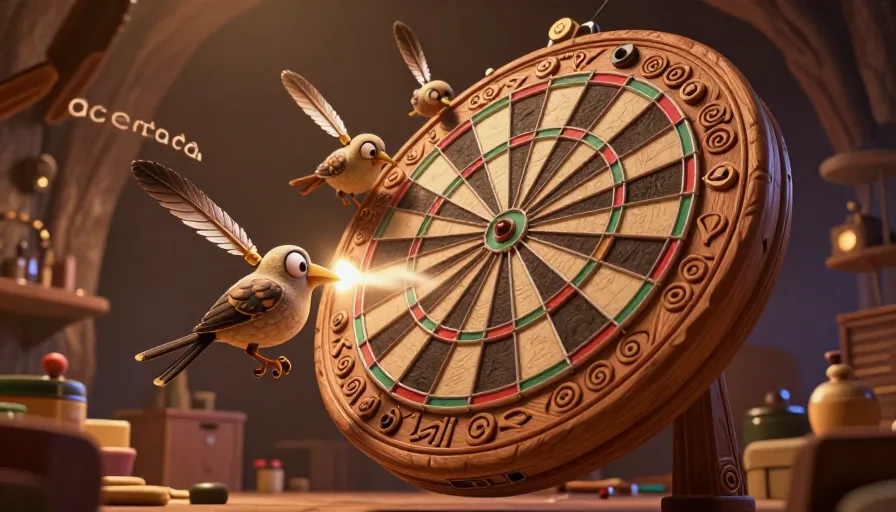
Understanding the word 'acertada' is crucial for Spanish learners aiming to communicate accurately. 'Acertada' is an adjective that translates to 'accurate' or 'correct' in English. It is often used to describe actions, decisions, or statements that are precise and on point. This guide will delve into the definition, usage, common mistakes, and provide practical examples to help you master 'acertada'.
What Does 'Acertada' Mean?
The word 'acertada' is the feminine singular form of the adjective 'acertado,' which means 'accurate' or 'correct.' It is derived from the verb 'acertar,' which means 'to hit the mark' or 'to be correct.' In Spanish, 'acertada' is used to describe something that is precise, well-aimed, or on target. For example, a 'respuesta acertada' is a 'correct answer.'
How to Use 'Acertada' in a Sentence
Using 'acertada' in a sentence requires understanding its context and grammatical structure. Here are some practical examples:
-
Describing an Action:
- Su respuesta fue acertada. (Her answer was correct.)
- La predicción del meteorólogo fue acertada. (The weather forecaster's prediction was accurate.)
-
Describing a Decision:
- Fue una decisión acertada. (It was a correct decision.)
- La estrategia de marketing fue acertada. (The marketing strategy was on point.)
-
Describing a Statement:
- Su observación fue muy acertada. (His observation was very accurate.)
- La crítica fue acertada y constructiva. (The criticism was accurate and constructive.)
Common Mistakes and How to Avoid Them
One common mistake is confusing 'acertada' with 'correcta,' which also means 'correct.' However, 'correcta' is more general and can be used in a broader range of contexts. 'Acertada' is more specific and often implies a higher degree of precision or accuracy. Here are some tips to avoid common mistakes:
- Check the Context: Ensure that 'acertada' fits the context of your sentence. If you're describing a general correctness, 'correcta' might be more appropriate.
- Grammatical Agreement: Remember that 'acertada' is feminine and singular. Use 'acertado' for masculine singular, 'acertados' for masculine plural, and 'acertadas' for feminine plural.
- Practice with Examples: Use the examples provided and create your own sentences to practice.
Pronunciation and Conjugations
Pronunciation is key to mastering any word. 'Acertada' is pronounced as /a.θeɾˈta.ða/ in Spanish. Here are some tips for correct pronunciation:
- Break it Down: Pronounce each syllable clearly: a-cer-ta-da.
- Listen to Native Speakers: Use audio resources to listen to native speakers pronounce the word.
- Practice Aloud: Repeat the word aloud several times to get the pronunciation right.

Aprendé Idiomas con YouTube
Mirá videos en tu idioma objetivo, capturá palabras nuevas como flashcards automáticamente, y seguí tu progreso — todo en un solo lugar.
Ver Cómo Funciona →Interactive Quiz: Test Your Knowledge
To reinforce your learning, take this interactive quiz. Answer the following questions to test your understanding of 'acertada':
- True or False: 'Acertada' can be used to describe a general correctness.
- False. 'Acertada' is more specific and implies a higher degree of precision.
- Fill in the Blank: La ______ respuesta fue muy precisa. (The ______ answer was very precise.)
- Acertada
- Choose the Correct Word: La predicción del meteorólogo fue ______. (The weather forecaster's prediction was ______.)
- Acertada (not 'correcta')
Cultural Context and Idiomatic Expressions
Understanding the cultural context can enhance your language skills. 'Acertada' is often used in idiomatic expressions and proverbs. For example:
- Dar en el clavo: This idiom means 'to hit the nail on the head' and is often used to describe an accurate or precise statement. For example, Su comentario dio en el clavo. (His comment hit the nail on the head.)
Comparison with Similar Words and Phrases
To avoid confusion, it's helpful to compare 'acertada' with similar words and phrases:
- Correcta: While 'correcta' also means 'correct,' it is more general and can be used in a broader range of contexts. For example, La respuesta correcta es la opción B. (The correct answer is option B.)
- Precisa: 'Precisa' means 'precise' and is often used to describe something that is exact and detailed. For example, La descripción fue muy precisa. (The description was very precise.)
Checklist for Mastering 'Acertada'
Use this checklist to ensure you have mastered the use of 'acertada':
- Understand the definition and translation of 'acertada'.
- Practice using 'acertada' in sentences with different contexts.
- Avoid common mistakes by checking the context and grammatical agreement.
- Listen to native speakers and practice pronunciation.
- Take the interactive quiz to test your knowledge.
- Learn and use idiomatic expressions and proverbs.
- Compare 'acertada' with similar words and phrases.
By following this guide and practicing regularly, you will master the use of 'acertada' and enhance your Spanish language skills.
Preguntas frecuentes
Is 'acertada' always used to describe correctness?
While 'acertada' often implies correctness, it specifically means 'accurate' or 'precise.' It is more context-specific than 'correcta,' which is more general.
Can 'acertada' be used in both formal and informal contexts?
Yes, 'acertada' can be used in both formal and informal contexts. It is a versatile word that can describe actions, decisions, or statements in various settings.
How can I improve my pronunciation of 'acertada'?
To improve your pronunciation, break the word down into syllables (a-cer-ta-da), listen to native speakers, and practice aloud. Using audio resources can also be very helpful.
Frases relacionadas
Empezá con Metheus
Mirá videos en tu idioma objetivo, capturá palabras nuevas como flashcards automáticamente, y seguí tu progreso — todo en un solo lugar.
Comenzar →

