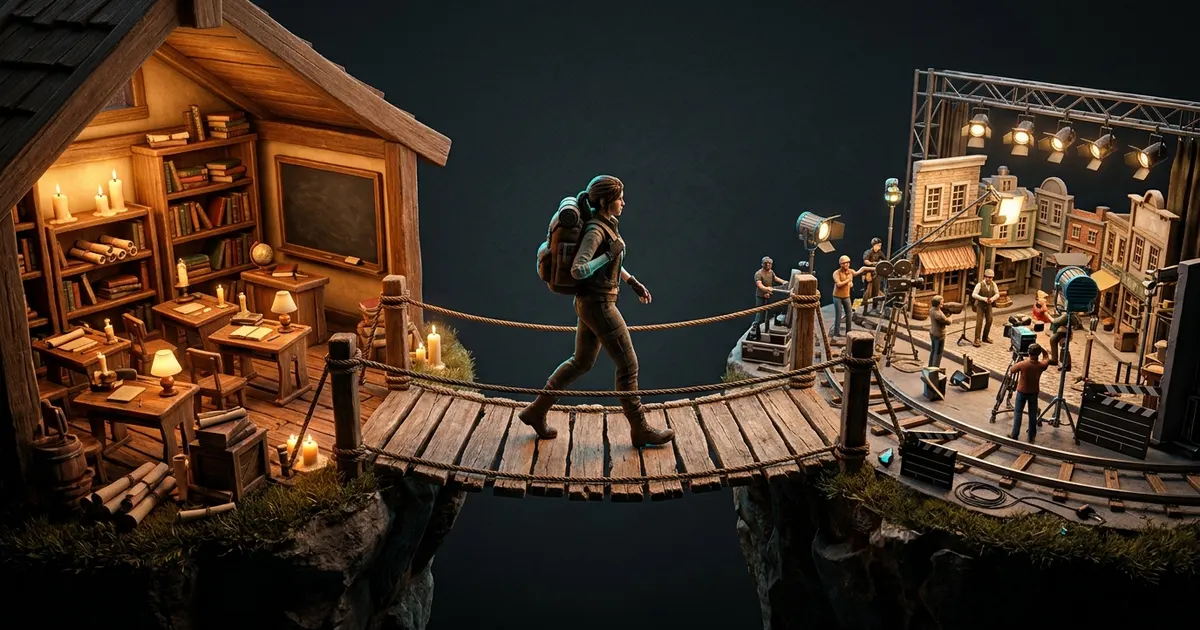
The jump from Dreaming Spanish to native shows feels steep because DS videos are built for you and native shows are not: faster speech, slang, noise, and no visual help. Bridge it with native content that is easier than average, watched with Spanish subtitles, rewatched, and with a handful of sentences saved for review. Keep DS alongside it.
If you are there now, you are in a crowded room. In r/dreamingspanish, learners describe native content as "currently out of my league", and others say they are "transitioning to mainly native content though dreaming spanish is still highly useful". Both statements are true, often for the same person in the same month.
Why does native Spanish feel so much harder than Dreaming Spanish?
Dreaming Spanish removes the four things that make native content hard, on purpose:
- Speed. DS guides speak clearly and adjust pace to the level. Actors talk to each other, not to you.
- Vocabulary spread. A DS video recycles common words. A drama brings in a profession, a city, a slang register in one scene.
- Sound. Music, overlapping voices and mumbled lines hide words you know.
- Support. DS guides draw, point and gesture. A show assumes you understand.
Dreaming Spanish's own help center describes the path in its 7-level roadmap: advanced DS videos and native content at level 6, and native content at level 7. The gap between levels 5 and 7 is where many people stall, sometimes for months; one learner described a "7 month long wall" at level 4.
What native content should you start with?
Start where the four problems are smallest, not where the hype is:
| Easier first | Why it helps | Harder, for later |
|---|---|---|
| Unscripted YouTube by native creators talking to camera | One clear voice, real speech, topics you choose | Fast group podcasts |
| Reality and cooking shows | Visual context, repeated phrases | Crime dramas with jargon |
| Sitcoms and family dramas | Everyday vocabulary, recurring characters | Period dramas |
| Shows you already saw in English | You know the plot, so you can follow the words | New plots with twists |
| One accent you hear a lot | Your ear adapts faster | Switching countries every show |
Popular series like La Casa de Papel or Élite are often recommended and often too fast at first. In r/Spanish, a March 2025 post asks for recommendations "beyond the" usual hits; the replies point to platforms beyond Netflix, such as RTVE, Antena 3 and Vix, where everyday shows for native audiences are easier to find.
Learn Languages with YouTube
Watch videos in your target language, auto-capture words into flashcards, and track your progress — all in one place.
Start Free →How do you watch a native episode without drowning?
A routine many learners at this stage settle into:
- Watch with Spanish subtitles first. Reading helps you segment fast speech into words. Make sure the subtitles match the audio; on Netflix, the closed-caption track usually does, the regular one often does not.
- Do not pause for every word. Pause only when you lose the scene.
- Rewatch the same episode, or the hardest ten minutes, a day later. The second time is where comprehension jumps.
- Save five to ten sentences that you want to understand next time, and review them with spaced repetition.
- Keep one DS video a day for easy, high-volume input while native content stretches you.
Subtitles in the language you hear are a support, not cheating. The aim is to drop them gradually, starting with content you know well.
Should native content count toward your hours?
Yes, if you understood most of it. Dreaming Spanish lets you log time outside the platform on its progress page, and learners regularly ask for a faster way to add it. A useful rule for yourself: count an episode if you could summarize what happened; do not count background audio you were not following. Comparing your hours with other people's helps less than you think; one learner at 300 hours noted needing "20 or 25 or 30% greater" hours than others with the same level, and that is normal variation, not failure.
How do you know you are ready for level 7 content?
You do not need a test. Signs that you are ready for most native shows:
- You follow the plot of an episode with Spanish subtitles without pausing more than a few times.
- On a rewatch, you understand most lines without reading.
- New words appear one or two at a time, not in clusters that hide the meaning.
If those are true for one genre, they are not yet true for all. That is fine. Native content is not one level; a cooking show and a legal drama are years apart.
Where can a tool help, and where not?
A click-to-define dictionary on subtitles removes the cost of looking a word up, and saving the sentence keeps it. That is all a tool can do; the listening hours are still yours.
Metheus is our tool: a free browser extension that adds a dictionary to subtitles on Netflix, YouTube and other supported sites and saves sentences with audio to spaced-repetition review. It does not replace Dreaming Spanish, and it does not make a fast show slower. If subtitles on Netflix do not match the audio, it shows the tracks Netflix provides and cannot fix them. For a setup, read how to learn languages with Netflix for free; for picking shows, see Spanish TV shows by level; and for the vocabulary numbers behind this stage, see how many words you need for TV.
Sources
- Dreaming Spanish help center, which videos to watch at each of the 7 levels.
- r/dreamingspanish and r/Spanish threads from 2025, linked below.
FAQ
When should I start native content with Dreaming Spanish?
Dreaming Spanish's roadmap places native content at levels 6 and 7. Many learners add easy native content earlier, such as YouTube creators talking to camera or shows they already know, while keeping DS videos. Start when you can follow the plot with Spanish subtitles without constant pausing.
Why can I understand Dreaming Spanish but not Netflix?
DS guides speak clearly, recycle common words and use visual support. Actors speak faster, use slang, overlap and talk over music. The gap is normal. Bridge it with easier native genres, Spanish subtitles that match the audio, and rewatching the same episode.
Should I use Spanish or English subtitles on Netflix?
Spanish subtitles that match the audio. On Netflix, the closed-caption track usually follows the spoken words, while the regular Spanish track on dubbed content may be a separate translation. English subtitles let you follow the story but mostly train reading English.
Do native shows count as Dreaming Spanish hours?
You can log time outside the platform on Dreaming Spanish's progress page. Count content you understood well enough to summarize, and leave out background audio you were not following. Your hours are a guide for you, not a race with other learners.
What native Spanish content is easiest?
Unscripted YouTube by creators speaking to camera, reality and cooking shows, sitcoms and telenovelas, and shows you already watched in your language. Crime dramas, period pieces and fast group podcasts are usually harder and can wait.
2026 Immersion Report
Language learning in 2026 isn't about finishing daily streaks. The fastest path to fluency combines three elements: comprehensible input from real media you enjoy, active vocabulary capture while consuming that content, and spaced repetition to lock words into long-term memory. Gamified apps build the habit. Immersion tools build the fluency. The most effective learners use both—in that order.
Read the Full 2026 Comparison GuideStart with Metheus
Watch videos in your target language, auto-capture words into flashcards, and track your progress — all in one place.
Get Started Free →